
Is Trump at an inflection point?
Advertisement
Read this article for free:
or
Already have an account? Log in here »
We need your support!
Local journalism needs your support!
As we navigate through unprecedented times, our journalists are working harder than ever to bring you the latest local updates to keep you safe and informed.
Now, more than ever, we need your support.
Starting at $15.99 plus taxes every four weeks you can access your Brandon Sun online and full access to all content as it appears on our website.
Subscribe Nowor call circulation directly at (204) 727-0527.
Your pledge helps to ensure we provide the news that matters most to your community!
To continue reading, please subscribe:
Add Brandon Sun access to your Free Press subscription for only an additional
$1 for the first 4 weeks*
*Your next subscription payment will increase by $1.00 and you will be charged $20.00 plus GST for four weeks. After four weeks, your payment will increase to $24.00 plus GST every four weeks.
Read unlimited articles for free today:
or
Already have an account? Log in here »
It’s too early to be sure, but it seems likely that we have just seen “Peak Trump.”
Last week, U.S. President Donald Trump arrived at the Davos conference radiating power and menace. Fresh from his attack on Venezuela, he was going to invade and annex Greenland. If his European allies in the NATO alliance tried to protect it, he would crush them with tariffs. And he would launch a new rival to the United Nations that would make him World-President-for-Life.
By the time Trump and his retinue landed in a fleet of four military helicopters, however, the wind had changed.
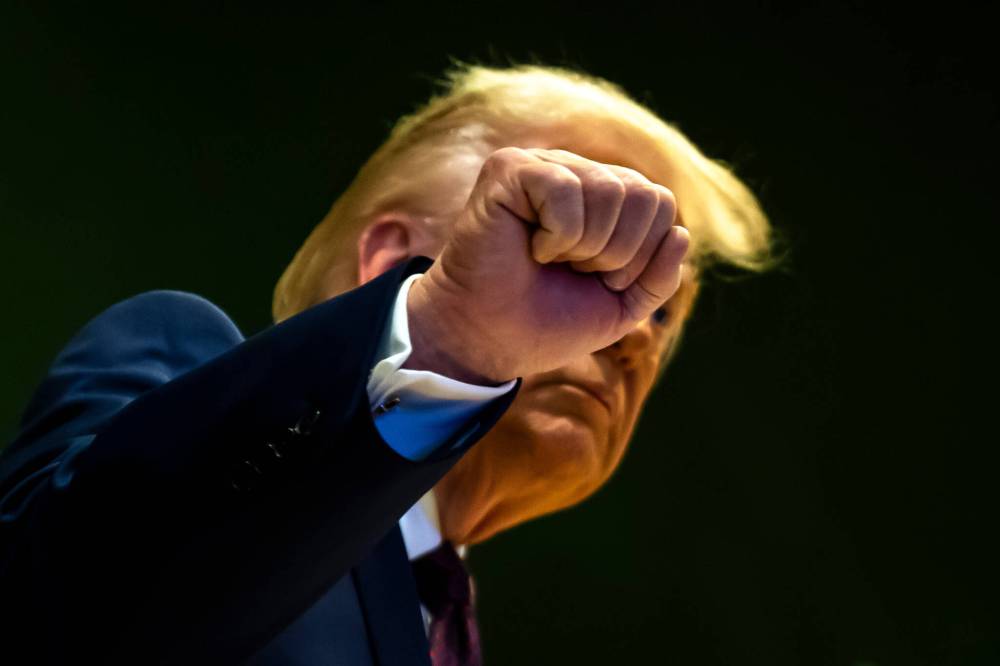
U.S. President Donald Trump gestures as he climbs a staircase after a signing ceremony for his Board of Peace initiative at the World Economic Forum annual meeting in Davos, Switzerland, last week. (The Associated Press)
Canadian Prime Minister Mark Carney had already crystallized the new mood with a remarkable speech that bade a regretful but decisive farewell to the old “rules-based” international order.
What is happening now is “rupture” with the past, Carney said, and the risk is that we end up with a world solely run by and for the great powers. He proposed instead a shifting coalition of the “middle powers” that would work to contain the more outrageous wishes and whims of the three autocratic great powers: Russia’s Vladimir Putin, Trump’s America, and Xi Jinping’s China.
For all his frankness, Carney did not name the villains, partly because they vary in their villainy. Putin is a tyrant and serial warmonger, but has limited territorial ambitions. Trump is an instinctive autocrat who demands supremacy in the Western Hemisphere but might not permanently erase U.S. democracy. And Xi hasn’t made his mind up yet.
There’s Xi’s promise to “reunify” China by conquering Taiwan, if necessary, but apart from that China’s territorial claims are limited to some seabed boundaries. Many in the Chinese elite still regret the decline of the “rules-based order” and wish for its return. And while neither Trump nor Putin want it back, they are both mortal men.
Carney didn’t get into all this — I’m just channelling his inner realist — but it was implicit in the parts he did say out loud. Don’t let the bullies win; fear is the mind-killer; stick together and you might even win. At the very least, you’ll lose less.
And he got a standing ovation, at a venue where even a brief round of polite claps is normally a triumph. He was telling the political and economic elites of the world what most of them were already thinking in a less coherent or at least less public way, and overnight the mood changed.
Trump already seemed much smaller by the time he flew in the next day.
Right away, he retracted his threat to seize Greenland by force (although the bond markets can take most of the credit for that). Soon he was also cancelling his threat to impose tariffs on NATO members that support Greenland, with only the face-saving pretence of a “framework of a future deal” (content unspecified) as a consolation prize.
But the big humiliation was the launch of his “Board of Peace,” a bold bid for symbolic status as King of the World. It was created to provide UN backing for the Trump-brokered ceasefire in the Gaza Strip, but it wound up as a Trump-controlled vehicle to run the UN off the road entirely.
Membership is pay-to-play and permanent membership costs US$1 billion (even more than Mar-a-Lago). Trump is chairman for life, wrote the rules, has veto power and can terminate any member at will. Gaza is not even mentioned in the “charter.” It is a pure vanity project: 62 invitations were sent out, but only 21 countries have signed up.
It is a useful list of those countries that still fear Trump’s wrath, and they are almost all in the Middle East or Central Asia. A few are ideological allies of Trump (e.g. Belarus, Hungary and Argentina), but no major power is a member except the U.S., and only four members are genuine democracies.
Six months ago, Trump might have pulled off this brazen attempt to hijack the UN, at least for a while. With more time, however, those who once feared him have learned what TACO means (Trump Always Chickens Out), and they can see how fast his own power base, the United States, is drifting toward chaos and irrelevance under his rule.
Just this month, we have seen his non-overthrow of the Venezuelan regime, his empty promise to stop the massacres in Iran, and his hollow threats to invade Greenland. He remains extremely dangerous to the domestic peace of the United States, but the rest of the world is realizing that it can just work around the U.S.
Except Canada, perhaps. Trump has taken to calling Carney “governor,” again, and Canadians know what that may imply.
» Gwynne Dyer’s new book is “Intervention Earth: Life-Saving Ideas from the World’s Climate Engineers.” This column previously appeared in the Winnipeg Free Press.