
Serving the U.S.? Absolutely not.
Advertisement
Read this article for free:
or
Already have an account? Log in here »
We need your support!
Local journalism needs your support!
As we navigate through unprecedented times, our journalists are working harder than ever to bring you the latest local updates to keep you safe and informed.
Now, more than ever, we need your support.
Starting at $15.99 plus taxes every four weeks you can access your Brandon Sun online and full access to all content as it appears on our website.
Subscribe Nowor call circulation directly at (204) 727-0527.
Your pledge helps to ensure we provide the news that matters most to your community!
To continue reading, please subscribe:
Add Brandon Sun access to your Free Press subscription for only an additional
$1 for the first 4 weeks*
*Your next subscription payment will increase by $1.00 and you will be charged $20.00 plus GST for four weeks. After four weeks, your payment will increase to $24.00 plus GST every four weeks.
Read unlimited articles for free today:
or
Already have an account? Log in here »
If some Canadians still hold out the hope that the Canada-U.S.-Mexico free trade agreement can be saved, or that a new free trade agreement can be negotiated to replace it, they should lower those expectations.
That is because the Trump administration has sent its strongest signal so far that it has no intention of continuing the existing free trade relationship with Canada, and no desire to enter into a new trade agreement with us on similar terms.
In testimony before a U.S. Senate committee Thursday, U.S. Treasury Secretary Scott Bessent was asked this question by Louisiana Republican Sen. John Kennedy: “If Canada … came to the United States and said ‘We’re going to zero tariffs on the United States, all of them are off on our end,’ would you … go to zero tariffs and then just let Canadian companies and American companies compete on a level playing field?”
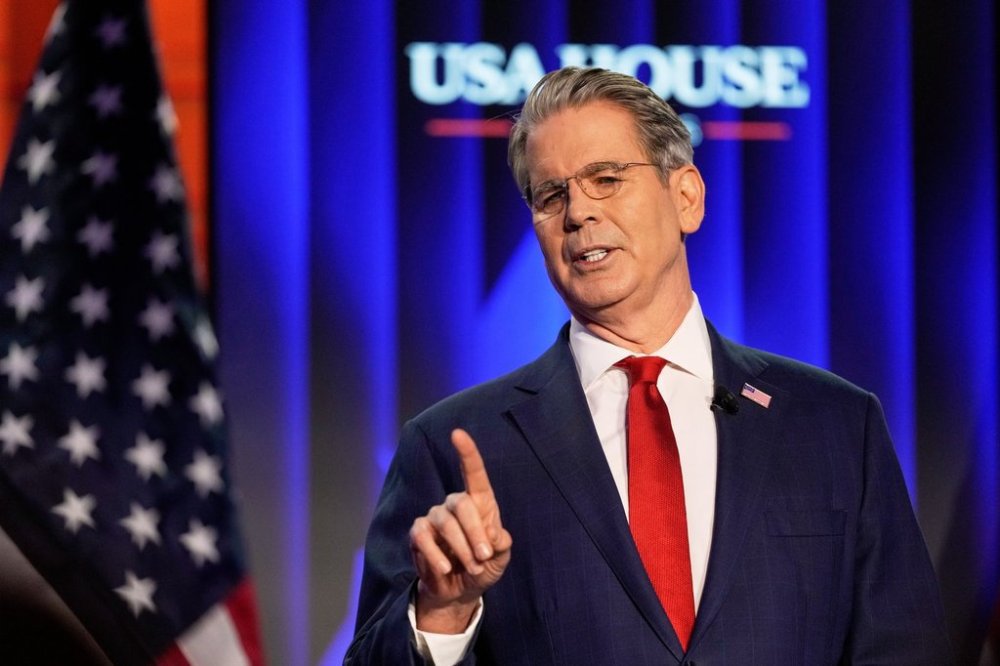
Bessent’s response could not have been clearer: “Absolutely not.”
Those words will disappoint many Canadians whose income depends on a strong trading relationship with our neighbour to the south, but there is no ambiguity in the Trump administration’s position. Free trade, in which Canada and the U.S. do not levy tariffs on the vast bulk of the other nation’s goods, services and commodities, will end when the CUSMA agreement expires.
In an interview with Bloomberg News last week, Goldy Hyder, the CEO of the Business Council of Canada, questioned the federal government’s handling of the Canada-U.S. trade relationship and called on Prime Minister Mark Carney to focus on saving CUSMA.
He pointed out that approximately 70 per cent of Canadian exports are shipped to the U.S., and said that makes us more economically vulnerable than any other nation. He argued that Canada’s top goal should be ensuring that this year’s review of CUSMA goes smoothly, and warned that our ability to attract foreign investment depends on the agreement’s survival.
Bessent’s remarks on Thursday mean that saving CUSMA is all but impossible. That leads to the question of what compromises we are prepared to agree to in order to preserve some sort of preferential trading arrangement with the U.S.
Hyder and others may believe that any deal is a good deal, but Carney holds a different view. He has repeatedly said Canada will not accept a bad deal in order to achieve trade stability with the U.S. Last summer, he told the media that “Our objective is not to reach a deal whatever it costs. We are pursuing a deal that will be in the best interest of Canadians.”
That position is echoed by Derek Burney, who was part of the Canadian team that negotiated the original North American Free Trade Agreement. He told CTV News this week that “No deal is better than a bad deal … Why would you negotiate a new agreement with a country that’s already broken the one we’ve got? … This administration cannot be trusted.”
Those are strong words, but they also expose the disagreement that exists among government leaders and business stakeholders regarding how we should deal with the Trump administration.
On one side, we have business leaders and opposition politicians, who say that fighting the U.S. on trade and other issues will cause severe economic pain for Canadian businesses and families. On the other, we have the large “elbows up” crowd, who argue we should stand our ground and not give in to American bullying.
We have reached a fork in the road, which forces Canadians to choose their future. Will we serve the interests of America, or will we be masters of our own home?
The answer is found in the advice of former prime minister Stephen Harper, who warned this week that Canada must not become a captive resource colony of the U.S. He said that we must urgently reduce our dependence on the American market in order to protect our sovereignty and the continued viability of the Canadian economy.
He’s right. The trade relationship we once had with the U.S. is gone, and unlikely to return. It’s time for Canada to stand on its own two feet again, to build new trade relationships with nations that are worthy of our trust and respect.