
Province must follow doctors’ orders
Advertisement
Read this article for free:
or
Already have an account? Log in here »
We need your support!
Local journalism needs your support!
As we navigate through unprecedented times, our journalists are working harder than ever to bring you the latest local updates to keep you safe and informed.
Now, more than ever, we need your support.
Starting at $15.99 plus taxes every four weeks you can access your Brandon Sun online and full access to all content as it appears on our website.
Subscribe Nowor call circulation directly at (204) 727-0527.
Your pledge helps to ensure we provide the news that matters most to your community!
To continue reading, please subscribe:
Add Brandon Sun access to your Free Press subscription for only an additional
$1 for the first 4 weeks*
*Your next subscription payment will increase by $1.00 and you will be charged $20.00 plus GST for four weeks. After four weeks, your payment will increase to $24.00 plus GST every four weeks.
Read unlimited articles for free today:
or
Already have an account? Log in here »
To get an honest assessment of Manitoba’s health-care system, it’s best to skip the government news releases and listen to the doctors.
That was essentially the message delivered Wednesday when provincial business leaders gathered for what Doctors Manitoba billed as a health-care “checkup.” The verdict from Dr. Nichelle Desilets, president of the physician advocacy group, was neither a partisan broadside nor a rosy government talking-point parade.
It was one of the most comprehensive evaluations of the province’s health-care system in some time.
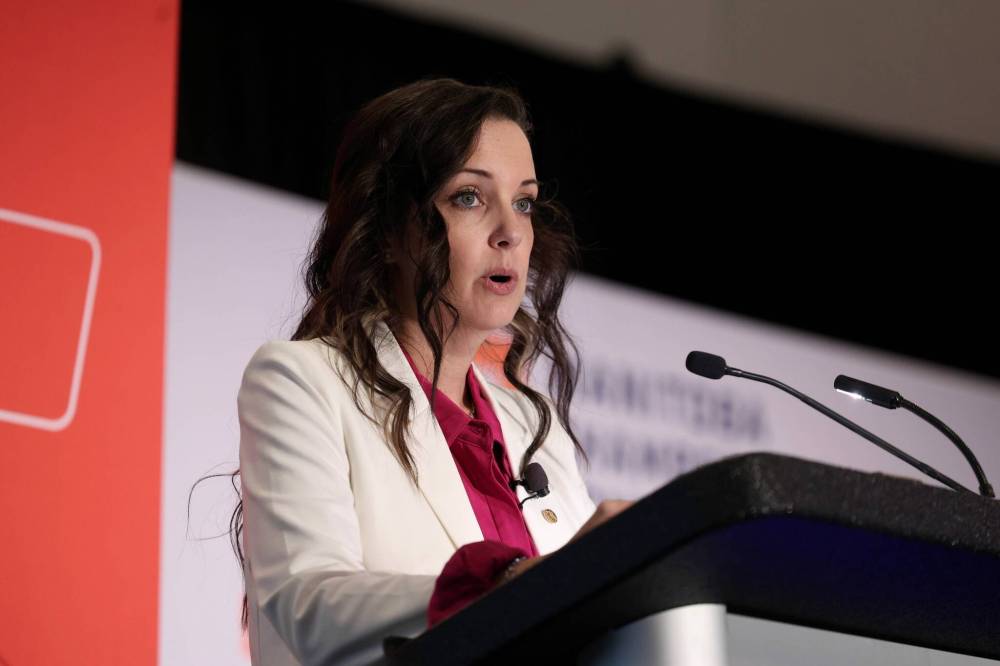
On Wednesday, Doctors Manitoba president Dr. Nichelle Desilets offered one of the most comprehensive evaluations of Manitoba’s health-care system in some time. (Ruth Bonneville/Winnipeg Free Press)
On Wednesday, Doctors Manitoba president Dr. Nichelle Desilets offered one of the most comprehensive evaluations of Manitoba’s health-care system in some time. (Ruth Bonneville/Winnipeg Free Press)
The system has improved since 2023, said Desilets, but we still lag behind national and international benchmarks, just as wait times in many areas continue to grow.
The NDP government deserves credit where it’s due. It promised to add 400 doctors over four years and has hired 285 so far. For a province that not long ago had the worst doctor shortage in the country, that’s no small achievement.
Medical school and residency spots have expanded; there has been a U.S. recruitment campaign and a new pathway for internationally trained physicians; and rural retention incentives have been introduced.
The government also kept several headline election promises: free prescription birth control, a new MRI for the northern region, and progress on a new CancerCare building, Doctors Manitoba reported.
On nursing, the NDP pledged to hire 600 more nurses and says it has already brought in 1,100.
Those are tangible gains.
However, that’s only one side of the ledger. Manitobans still wait too long for care, too many don’t have a family doctor, and our system still runs on technology that belongs in a museum.
Only one in five providers in Manitoba can easily share patient information electronically. Students and residents training at Health Sciences Centre — the largest hospital in the province — still encounter paper charts and fax machines.
That’s not how modern physicians want to practise medicine.
Outdated information systems slow down care, contribute to errors, frustrate providers and waste time that could be spent with patients.
Manitoba can recruit all the doctors it wants, but if they’re trapped in a system that feels 20 years behind, we shouldn’t be surprised when scores of medical grads and residents say they plan to leave the province.
That’s one of the most alarming statistics presented Wednesday. A 2025 report by Doctors Manitoba found 40 per cent of medical students and residents plan to leave Manitoba. Another 43 per cent of practising physicians plan to retire, leave or reduce their hours within three years.
Desilets, who works as a doctor in Neepawa, offered what she called one of the fastest, most cost-effective prescriptions available for that: invest in team-based care. The NDP promised in its spring budget to fund 250 team-based care staff — physician assistants, nurses and allied health professionals embedded directly in physician practices.
If there’s one immediate, high-impact move that could stabilize the system, that’s it.
Doctors don’t need to do everything themselves. When nurses, physician assistants, dietitians, social workers and other professionals are integrated into primary-care clinics, physicians can focus on the tasks that truly require their training. Patients get faster access, chronic conditions are managed more effectively, burnout decreases, and recruitment and retention improve.
Meanwhile, slightly more Manitobans have a family doctor than the Canadian average, Doctors Manitoba said.
Currently, 187,000 Manitobans still don’t have a family physician.
The province moved from worst to average on doctor supply. That’s good. But “average” is hardly the goal when ER waits are the longest in the country. Manitoba has expanded residency spots and hired nurses, but rural regions still lag behind peer regions across Canada in physician-per-capita rates.
The danger for the NDP government is complacency. When it inherited a system widely viewed as broken, any measurable improvement can feel like success. Politically, it’s tempting to highlight the wins — new clinics, new staff, new buildings — and declare momentum. But health care isn’t judged by ribbon-cuttings or recruitment statistics. It’s judged by whether patients can see a family doctor, how long they wait in an ER, and wait times for surgery and diagnostic tests.
ER and urgent care wait times in Winnipeg are at record highs and wait times for MRIs and CT scans have grown.
Business leaders should take the Doctors Manitoba report seriously. A properly functioning health-care system isn’t just a social good, it’s an economic necessity. Companies can’t attract talent to a province where access to care is uncertain. Rural communities can’t grow if residents fear they’ll have to drive hours for basic services.
The “checkup” delivered this week wasn’t a condemnation. It was something more useful: a reminder that improvement doesn’t equal recovery.
The prescription is clear: modernize the technology, follow through on team-based care, hire more staff, double down on retention as aggressively as recruitment, and close the rural gap once and for all.
The progress since 2023 proves change is possible. Now comes the harder part: finishing the job.
» Tom Brodbeck is a Winnipeg Free
Press columnist.