
Russian figure skater Adeliia Petrosian is an Olympic mystery with big jumps and fitness concerns
Advertisement
Read this article for free:
or
Already have an account? Log in here »
We need your support!
Local journalism needs your support!
As we navigate through unprecedented times, our journalists are working harder than ever to bring you the latest local updates to keep you safe and informed.
Now, more than ever, we need your support.
Starting at $15.99 plus taxes every four weeks you can access your Brandon Sun online and full access to all content as it appears on our website.
Subscribe Nowor call circulation directly at (204) 727-0527.
Your pledge helps to ensure we provide the news that matters most to your community!
To continue reading, please subscribe:
Add Brandon Sun access to your Free Press subscription for only an additional
$1 for the first 4 weeks*
*Your next subscription payment will increase by $1.00 and you will be charged $20.00 plus GST for four weeks. After four weeks, your payment will increase to $24.00 plus GST every four weeks.
Read unlimited articles for free today:
or
Already have an account? Log in here »
MILAN (AP) — Few figure skaters at the Winter Olympics have seen Adeliia Petrosian compete in real life.
She might leave with the gold medal.
Russia’s exclusion from international sports events during its war with Ukraine means that the 18-year-old Petrosian has only skated one senior competition outside of her homeland, the qualifier that earned her place as a neutral athlete in Milan.
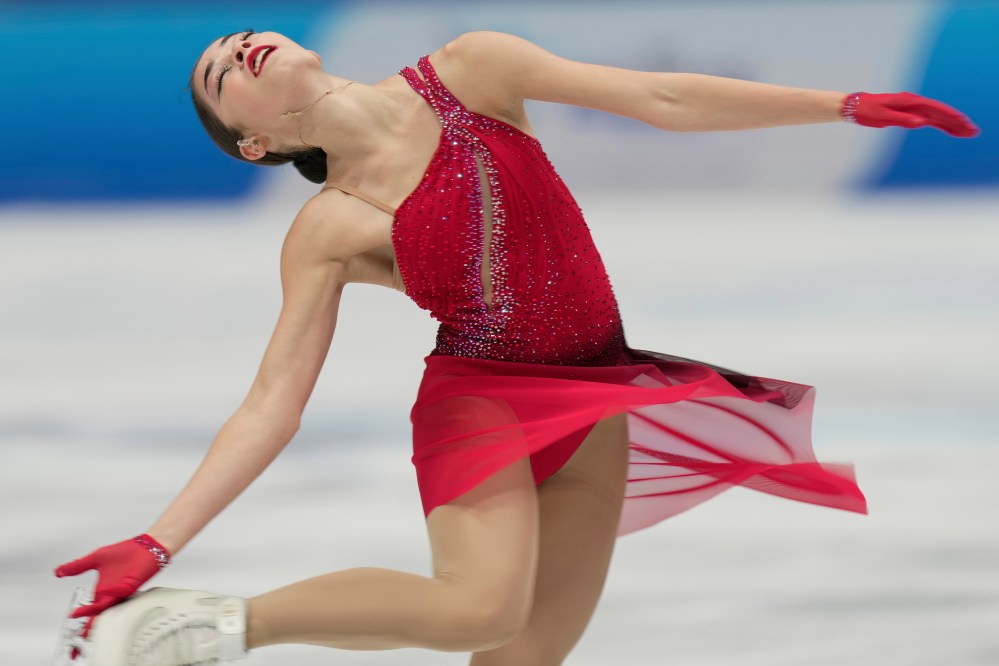
As she readies to skate to Michael Jackson’s music in the short program Tuesday, no one besides Petrosian and her controversial coach, Eteri Tutberidze, can be sure of her form, or whether she’s injury-free.
But if Petrosian can get past skaters like the U.S. “Blade Angels” trio of Amber Glenn, Alysa Liu and Isabeau Levito, and Japanese stars Kaori Sakamoto and Ami Nakai, she’ll shoot to sudden fame as the fourth consecutive Olympic champion from Russia.
Petrosian’s coach also coached Valieva
Petrosian is the latest star produced by Tutberidze, who revolutionized women’s skating a decade ago by getting young girls barely in their teens to perform bigger and bigger jumps, only to have many of them struggle with repeated injuries.
She coached 2018 gold medalist Alina Zagitova, and a trio of standouts in 2022, when Anna Shcherbakova won the gold medal.
But the Beijing Games have been remembered less for Shcherbakova’s triumph and more for the positive doping test turned in by another Tutberidze talent, 15-year-old Kamila Valieva. The case ended ultimately in a doping ban for Valieva that only recently ended, and an investigation into Tutberidze, though it found no evidence of wrongdoing by the Russian coach.
Tutberidze also was criticized for her harsh words toward her students in Beijing, while World Anti-Doping Agency president Witold Bańka said last week that he didn’t “feel comfortable with her presence” at the Milan Cortina Olympics.
As part of the fallout from the Valieva case, the International Skating Union increased the minimum age from 15 to 17 for senior-level athletes. That means Petrosian is one of the oldest women’s skaters that Tutberidze has coached at a major championship.
High scores and high risks
Petrosian has landed quadruple jumps in Russian national events, much like her compatriots were able to do in previous Olympics, and none of the other skaters at the Milan Cortina Games are able to match those high-scoring elements.
The big question is whether she’s fit enough to do it in Milan.
“I can’t turn properly,” Petrosian complained in a Russian documentary following Tutberidze released last week. Tutberidze said Petrosian had been making progress in a difficult program around the new year, but suddenly “everything hurt.”
There’s been no indication of how Petrosian’s condition may have changed in the last month as she readied for the Olympics.
Fitness has been a factor for months. Tutberidze previously told Russian media that Petrosian wanted to give up her place in September’s Olympic qualifier for lower-ranked skaters after an injury but ended up competing because the Russian alternate’s fitness was worse.
Russian flags in Milan
“Let’s imagine it’s just Chelyabinsk.” That was the advice Russian skater Petr Gumennik got from his coach ahead of skating in the men’s event, to pretend that the Olympics were happening in that provincial Russian city.
For a few seconds, it felt as if the competition might indeed be happening in Russia.
“When I went out there I got so much applause, there was such noise, you can’t compare it to anything,” Gumennik said after skating in the short program, where he was 12th. “That’s Olympic support. It was unexpected and it gave me strength and confidence.”
Gumennik was greeted by fans waving personalized banners with his face, calling out “well done” in Russian.
There also was a Russian flag in the stands, even though Olympic organizers have barred it from the Games, where athletes such as Gumennik and Petrosian were vetted for any support of the war before they were allowed to compete as neutral athletes.
As the Russian with the best chance of a gold medal at these Olympics, there may be even more support when Petrosian skates. ___
AP Winter Olympics: https://apnews.com/hub/milan-cortina-2026-winter-olympics