
Total lunar eclipse of the heart
» NEELIN VIEWS
Advertisement
Read this article for free:
or
Already have an account? Log in here »
We need your support!
Local journalism needs your support!
As we navigate through unprecedented times, our journalists are working harder than ever to bring you the latest local updates to keep you safe and informed.
Now, more than ever, we need your support.
Starting at $15.99 plus taxes every four weeks you can access your Brandon Sun online and full access to all content as it appears on our website.
Subscribe Nowor call circulation directly at (204) 727-0527.
Your pledge helps to ensure we provide the news that matters most to your community!
To continue reading, please subscribe:
Add Brandon Sun access to your Free Press subscription for only an additional
$1 for the first 4 weeks*
*Your next subscription payment will increase by $1.00 and you will be charged $20.00 plus GST for four weeks. After four weeks, your payment will increase to $24.00 plus GST every four weeks.
Read unlimited articles for free today:
or
Already have an account? Log in here »
Tomorrow is a day to mark in your calendars and spend some extra time admiring the sky because it is the designated date for the total lunar eclipse of 2026.
A lunar eclipse is an infrequent occurrence that happens when the Earth passes directly between the Sun and Moon, casting a special shadow onto the lunar surface and causing the moon to emit a reddish orange glow. Lunar eclipses occur under very specific factors, such as only happening when the moon is in its full phase, combined with the correct alignment of the orbital planes between the sun, Earth, and moon.
Solar and lunar eclipses are often mistaken for each other, and many people do not know the difference between the two. Solar eclipses happen when the moon is between the sun and Earth and casts a dark shadow on Earth. Solar eclipses happen typically every year and a half. Solar eclipses are the eclipses that are damaging to the naked eye, and when trying to watch them, eye protection is strongly advised. The biggest difference between lunar and solar eclipses is in a solar eclipse the sun appears darker, and in a lunar eclipse, the moon appears darker. Solar eclipses are also rarer than lunar eclipses.
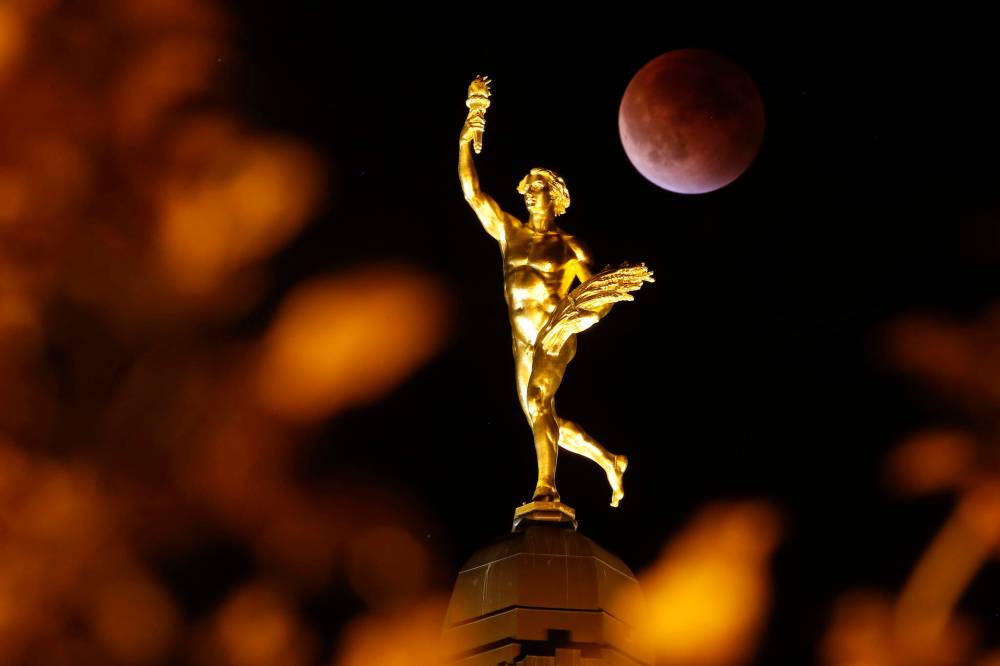
A Lunar eclipse is shown behind the Golden Boy at the Manitoba Legislature in September 2015. A lunar eclipse will happen early Tuesday morning, and Abby Wronowski recommends getting up to witness the spectacle. (John Woods/Winnipeg Free Press files)
Lunar eclipses have a scale used to classify lunar luminosity during an eclipse. The scale has five different categories and was created by Andre Danjon, a French astronomer. The scale is referred to as the Danjon Scale. L=0 is the first class to the Danjon Scale, where the eclipse is dark and it is tricky to identify the moon. L=1 happens when the eclipse is still dark, but the Moon will have a dark brown or grey hue to it. In L=2, the Moon will be a shade of rusty or deep red. For L=3, the moon is a brick-red colour. L=4 is the last class in the Danjon scale, wherein the Moon appears as a bright copper-red or orange colour. Eclipses that appear in this class are a result of the low atmospheric density.
Lunar eclipses, and astrology in general, have been documented as early as the Stone Age. Ancient civilizations living in Babylonia, Greece, and China were in awe of the patterns of lights that decorated the dark, night sky. During the Stone Age, lunar eclipses were seen as bad omens and brought bad luck to the world. Lunar and solar eclipses have been studied for over 3,000 years, and there have even been incidents where eclipses have influenced historical events. The most notable time happened when a solar eclipse helped prove Albert Einstein’s theory of general relativity. On May 29, 1919, Einstein and his team used the time in which the Moon was blocking the Sun to map and view all the stars near the sun. Being able to see the distance from which the stars were located to the sun helped confirm Einstein’s belief that starlight bends around the sun, as well as his theory that massive objects warp the fabric of space-time and distortion is often mistaken for gravity.
Lunar eclipses are uncommon, beautiful phenomena. This Tuesday I recommend taking a moment and waking extra early to try and catch it. According to timeanddate.com, the total lunar eclipse is visible in Brandon from the early hours of 2:24 am to 7:15 am. The eclipse is expected to be finished by 8:20 am. Whether you want to cherish this special moment for the first time, or have been lucky enough to witness a few, the early morning hours of Tuesday will surely be spectacular!
» Abby Wronowski is a Grade 11 student at École secondaire Neelin High School.