
How did Carney become the darling of the global anti‑Trump movement?
Advertisement
Read this article for free:
or
Already have an account? Log in here »
We need your support!
Local journalism needs your support!
As we navigate through unprecedented times, our journalists are working harder than ever to bring you the latest local updates to keep you safe and informed.
Now, more than ever, we need your support.
Starting at $15.99 plus taxes every four weeks you can access your Brandon Sun online and full access to all content as it appears on our website.
Subscribe Nowor call circulation directly at (204) 727-0527.
Your pledge helps to ensure we provide the news that matters most to your community!
To continue reading, please subscribe:
Add Brandon Sun access to your Free Press subscription for only an additional
$1 for the first 4 weeks*
*Your next subscription payment will increase by $1.00 and you will be charged $20.00 plus GST for four weeks. After four weeks, your payment will increase to $24.00 plus GST every four weeks.
Read unlimited articles for free today:
or
Already have an account? Log in here »
Canadian Prime Minister Mark Carney is having a moment.
While every leader in the world has to grapple with the abrupt and arbitrary decision-making of United States President Donald Trump, few have had to do so with such high stakes as America’s neighbour and ostensible ally to the north.
With more than two-thirds of Canadian exports bound for the U.S., bilateral trade is a matter of economic life and death for Canada. Since his return to office in January 2025, Trump has made repeated references to Canada becoming America’s “51st state” in an effort to put economic and political pressure on its northern neighbour.
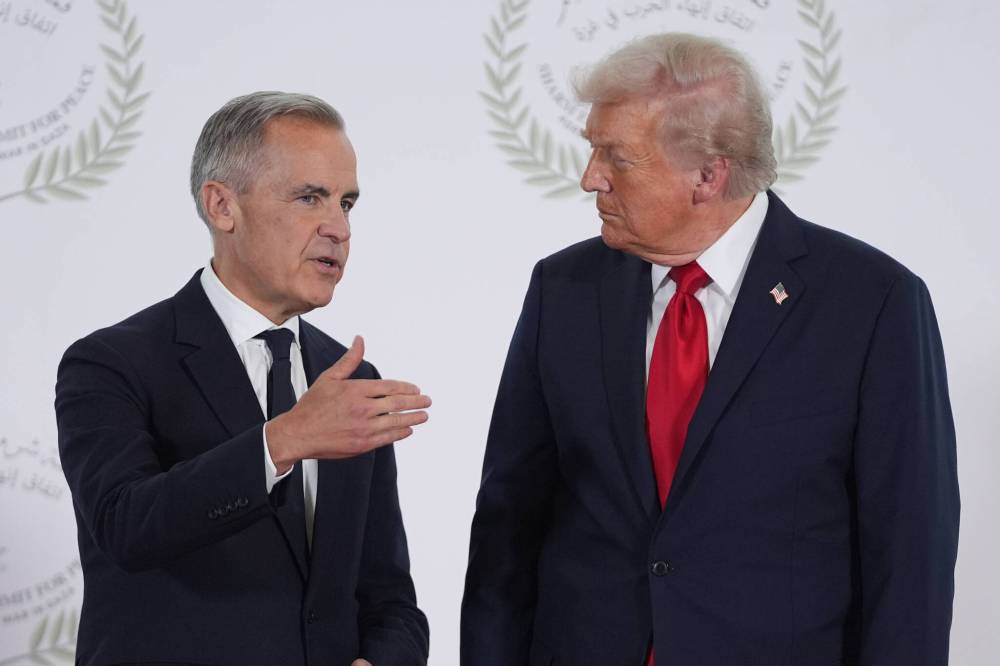
U.S. President Donald Trump (right) greets Prime Minister Mark Carney during a summit on ending the Israel-Hamas war in Sharm El Sheikh, Egypt, in October 2025. (The Associated Press files)
Despite this, Carney has met the challenge with rare candour.
In his recent speech at this year’s World Economic Forum in Switzerland, Carney gave the world a word for the transformations now underway, describing a “rupture” in the international rules-based order.
The speech was remarkable in its honesty on other fronts, as well. Effectively, Carney acknowledged what everyone knows, but no one in a position of power has previously admitted: even before Trump’s return to the White House for a second term, the U.S.-led liberal international order was deeply unfair in its distribution of prosperity and security.
CARNEY’S PEDIGREE
Why was Carney able to say what others would not, or could not, on such a high-profile stage?
In many ways, his background and present role give him unique credibility in the eyes of the wealthy and powerful who gather each year at Davos.
Born and raised in northern and western Canada, Carney’s academic and professional career played out on a larger stage. Following a PhD in economics at the University of Oxford in 1995, he pursued a career in finance and banking that took him to the heights of both the private and public financial world.
After more than a decade working at the American multinational investment bank Goldman Sachs, Carney entered Canadian public service, eventually becoming governor of the Bank of Canada in 2008 under former prime minister Stephen Harper. He went on to become the first non-British head of the Bank of England, serving in that role from 2013 to 2020.
His governorships coincided with tumultuous times in both countries, spanning the sub-prime financial crisis, Brexit and the early days of the COVID pandemic. While not without criticism, Carney’s performance in both countries won significant acclaim, leading to other international leadership roles.
The party’s stunning come-from-behind election victory last year was fuelled significantly by Trump’s 51st state talk and other forms of coercion.
COMMANDING RESPECT
Carney has a remarkable CV by any measure. He has moved from the heights of academia to business, finance and finally, government. In politics, he has been successful in both Liberal and Conservative political environments. That broad credibility ensured that when he spoke from the podium at Davos about a rupture in an already unequal global political system, his words would be taken seriously.
Carney’s role as prime minister of Canada has also played a role in making him the poster boy of a global anti-Trump movement. Since Trump’s return to office, Canada has been on the front lines of America’s movement away from long-held alliances toward a more mercurial, coercive and even predatory foreign policy.
Trump’s penchant for insulting Canadian leaders, threatening Canadian sovereignty and weakening the Canadian economy in the service of American interests makes Canada an important test case that other American partners can learn from.
Within Canada itself, Carney is popular, though his responses to Trump have not always been without criticism. Some have pointed to a recurring gap between rhetoric and action.
Carney’s swift move to endorse the recent U.S. attacks on Iran fit this pattern as well. Yet, such appeasement hasn’t been rewarded with reciprocity by the Trump administration.
SEEKING PARTNERS
As Carney visits the Pacific Rim, including a stop Australia, there’s no question he has put himself — and Canada — in the global spotlight for his handling of Trump.
His speech in Davos sketched out a vision of an alternate global order that Canada and other like-minded countries might collectively pursue as a defence against the chaotic and unstable world unleashed by Canada’s former friend and ally. However, that rhetoric is not yet reality.
Accordingly, on his visit to India, Japan and Australia, Carney is looking to find partners for that vision. He’s seeking opportunities to improve relations, expand trade and co-operate on issues of Pacific security.
The old world order is not coming back. What Carney achieves in his foray to the Pacific Rim may help determine what new order, if any, emerges in its place.
» Stewart Prest is a political science lecturer with the University of British Columbia. This column was first published by The Conversation Canada: theconversation.com/ca.