
Iran war fallout has barely begun
Advertisement
Read this article for free:
or
Already have an account? Log in here »
We need your support!
Local journalism needs your support!
As we navigate through unprecedented times, our journalists are working harder than ever to bring you the latest local updates to keep you safe and informed.
Now, more than ever, we need your support.
Starting at $15.99 plus taxes every four weeks you can access your Brandon Sun online and full access to all content as it appears on our website.
Subscribe Nowor call circulation directly at (204) 727-0527.
Your pledge helps to ensure we provide the news that matters most to your community!
To continue reading, please subscribe:
Add Brandon Sun access to your Free Press subscription for only an additional
$1 for the first 4 weeks*
*Your next subscription payment will increase by $1.00 and you will be charged $20.00 plus GST for four weeks. After four weeks, your payment will increase to $24.00 plus GST every four weeks.
Read unlimited articles for free today:
or
Already have an account? Log in here »
Roughly a month into America’s latest war of choice and the consequences are already profound.
U.S. and Israeli airstrikes have destroyed 15,000 targets inside Iran. Supreme leader Ali Khamenei is dead, replaced by his even more extremist son.
Traffic through the Strait of Hormuz — a vital artery for global energy supplies and other commodities — is paralyzed.
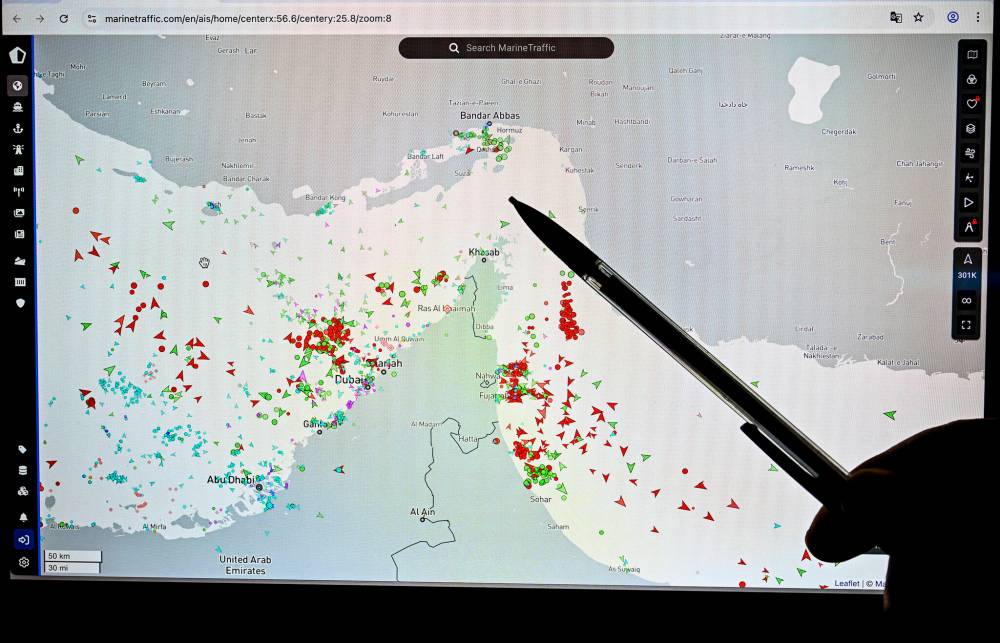
A person points at a page on the Marine Traffic website that shows commercial boats traffic on the edge of the Strait of Hormuz near the Iranian coast on March 4. The impacts of the Iran war are only just starting to show themselves, writes Kyle Volpi Hiebert. (Tribune News Service)
And yet the full butterfly effect of the conflict is only starting to sink in.
Even as U.S. and Israeli officials claim Iran’s missile launchers and munitions stockpiles lay in ruins, Gulf states’ energy infrastructure is still being targeted. Iran’s military regime has told the world to brace for oil prices to hit US$200 a barrel.
“It’s likely that the Iranians are adapting tactics,” a senior fellow at the Carnegie Endowment for International Peace told Bloomberg on March 12. “It’s quite possible that they’re just preserving launchers by slowing down operations and focusing more on Shaheds,” he added, referring to Iran’s cheap, mass-produced drones that regularly evade regional air defences.
“Iran’s strikes cannot be dismissed as acts of scattered retaliation, the flailing lashing out of a dying regime,” echoed security scholar Robert A. Pape recently in Foreign Affairs. “Rather, they represent a strategy of horizontal escalation, a bid to transform the stakes of the conflict by widening its scope and extending its duration.”
Indeed, Reuters has reported the U.S. intelligence community believes Iran’s government remains stable after withstanding numerous decapitation strikes. Sources have meanwhile told CNN that key Trump administration officials badly underestimated the regime’s willingness to disrupt global energy supplies. Plus, it appears there’s no plan for what comes next.
“They do not have an actual, real rationale, endgame or plan for the aftermath of this,” a U.S. government official, speaking on the condition of anonymity, told The Intercept after receiving classified briefings once the war began.
Wealthy Gulf nations have already seen their business models badly wounded. “The Iran war has punctured the notion that towering skyscrap-ers, financial clout and the embrace of luxury and diversity in the Persian Gulf can act as impenetrable shields against the region’s turmoil,” reports the Wall Street Journal. “Even if the missiles and drones stop falling, the lingering risk from a hostile Iran remains a disruptive threat.”
Food security and humanitarian aid operations worldwide also face severe peril given spiking energy and fertilizer prices.
“We are on the edge of a catastrophic surge in global hunger,” the executive director of the UN’s World Food Programme posted on X well over a week ago.
Economically precarious and politically unstable countries that are heavy food and energy importers may soon see an uptick in civil unrest. This includes Bangladesh, Pakistan and many African nations. Ethiopia’s government has already advised its citizens to begin self-rationing their fuel use.
Longer term, the whiplash from global energy price volatility also plays into the hands of both Russia and China.
The Trump administration has temporarily lifted sanctions on Russia to ease energy supply bottlenecks. The Kremlin — which is reportedly providing Iran with intelligence and satellite imagery to optimize its drone attacks — is thus reaping a bonus US$150 million per day in increased oil revenue.
A new war in the Middle East also robs attention from the quagmire in Ukraine. And it is depleting the available quantity of advanced weaponry Kyiv desperately requires. The Financial Times reports the U.S. military expended several years-worth of munitions production in just the opening days of the war.
Current events are a brutal advertisement as well for the energy security that renewable technologies can provide. And for which China is by far the dominant manufacturer and exporter of.
The war is also further damaging the global perception of the U.S. as a reliable actor. A poll taken by Politico in early February already showed more respondents in Canada, Germany, France and the U.K. saying it was now better to depend on China than on the U.S. under Donald Trump.
Things could still change. American officials have started publicly walking back the litany of vague, maximalist goals the Trump administration laid out when bombs were raining down on Tehran earlier this month. Israel has only planned for operations lasting into early April.
But wars are unpredictable beasts.
Writing in 2023, military historian Phillips Payson O’Brien noted how the first year of the Ukraine conflict showed that “war is rarely easy or straightforward — which is why starting one is almost always the wrong decision for any nation.”
It’s a lesson Washington and others keep failing to understand.
» Kyle Volpi Hiebert is a Montreal-based political risk analyst focused on globalization, conflict and emerging technologies. This column was previously published in the Winnipeg Free Press.