
More to economics of war than energy prices, stock markets
Advertisement
Read this article for free:
or
Already have an account? Log in here »
We need your support!
Local journalism needs your support!
As we navigate through unprecedented times, our journalists are working harder than ever to bring you the latest local updates to keep you safe and informed.
Now, more than ever, we need your support.
Starting at $15.99 plus taxes every four weeks you can access your Brandon Sun online and full access to all content as it appears on our website.
Subscribe Nowor call circulation directly at (204) 727-0527.
Your pledge helps to ensure we provide the news that matters most to your community!
To continue reading, please subscribe:
Add Brandon Sun access to your Free Press subscription for only an additional
$1 for the first 4 weeks*
- Enjoy unlimited reading on brandonsun.com
- Read the Brandon Sun E-Edition, our digital replica newspaper
*Your next Free Press subscription payment will increase by $1.00 and you will be charged $20.95 plus GST for four weeks. After four weeks, your payment will increase to $24.95 plus GST every four weeks.
Read unlimited articles for free today:
or
Already have an account? Log in here »
In the aftermath of the 2008 financial crisis, student groups pushed for curriculum change in economics. They wanted to learn about real-world economics beyond the stylized models that embroil students in mathematics.
As an economics professor, my own students have asked me about issues like Gaza and Iran, when textbooks aren’t much help. Based on their input, I’ve revamped the way I teach economics by complementing standard textbook economics with alternate perspectives.
The courses I now teach include the Economics of Racism, the Economics of Inequality and the Economics of Gaza, which has been translated to Arabic by the Iraqi Economists Network.
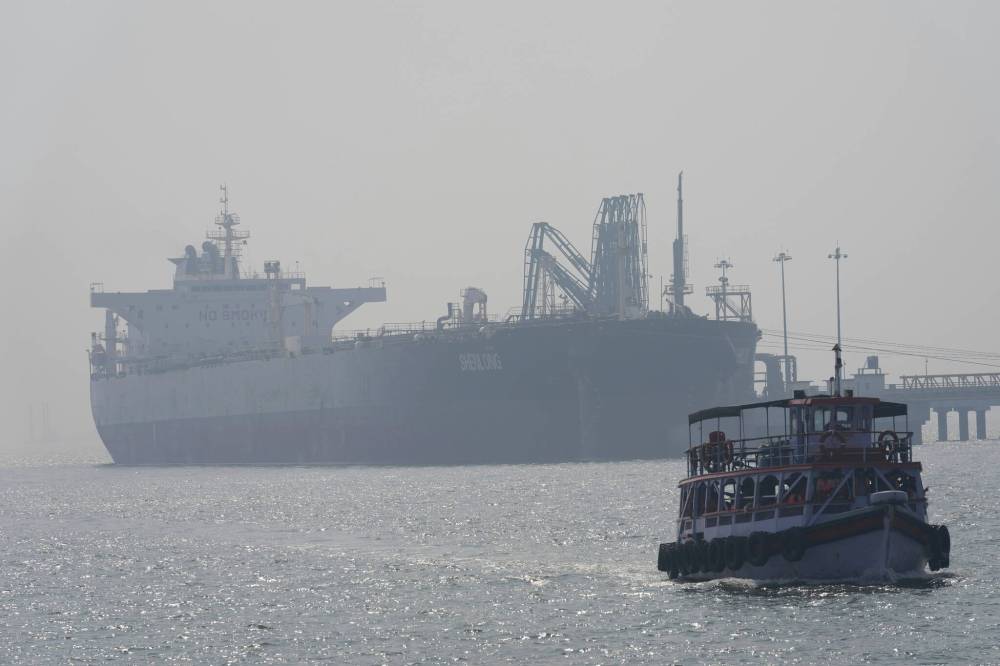
A tanker carrying crude oil from Saudi Arabia at the Mumbai port in India on March 12, after clearing the Strait of Hormuz. (The Associated Press)
These new courses reveal that the economics of war go beyond the impact on energy, stock markets and inflation.
DEMOCRACIES INSTIGATE WAR
It’s usually believed that dictators start wars to legitimize their rule. However, 2024 research suggests that democratically elected leaders often instigate war due to the right-wing populism and nationalism that arise because of inequality and precarity in advanced economies.
This helps shed light on why democratically elected leaders like Donald Trump and Benjamin Netanyahu have initiated wars against theocracies like Iran.
Such democratically elected leaders use propaganda to demonize the enemy and paint conflict as an existential threat, even when it could be solved through diplomacy.
BIG OIL
The military-industrial complex is notably absent from economics textbooks. It’s a system based on the military establishment and arms industry, which wields power and influence over the government.
But its very existence challenges the idea of consumer sovereignty — the military-industrial complex, after all, attempts to generate public support for war to maximize profits, captures the government (where private corporate interests influence government regulation to supersede public interest) and lobbies for large military budgets.
Companies like Lockheed Martin, Boeing, Raytheon and Northrop Grumman profit from conflict because they provide great investment opportunities during wars. Defence stocks soared in value, for example, during Israel’s assault on Gaza. Despite uncertainty, there have also been gains for defence contractors due to the ongoing war in Iran.
In terms of the Gaza situation, large oil companies don’t gain much by the production of oil; it’s the exercise of power and war that benefits them. Energy conflicts like the 1991 Gulf War or the ongoing war in Iran, which reflect control or disruption of resources, are followed by above-average returns for leading oil companies.
In other words, both the military industrial complex and Big Oil profit from war.
UNINTENDED CONSEQUENCES
War also contributes to climate costs, post-war debt burden and refugee flows. It also increases the likelihood of terrorism.
This is reflective of the law of unintended consequences — in other words, bombing to curb terrorism instigates more terrorism. The economics of terrorism shows that the structural root causes of terrorism — like apartheid, occupation and the economic grievances of citizens — must be addressed to truly end terrorism.
The law of unintended consequences also holds in the case of sanctions. In the Russia-Ukraine war, economic sanctions have ended up helping Russia because Russian oligarchs who previously supported integration with the West were forced to invest their massive wealth at home.
Similarly, bombing and sanctions on Iran have only strengthened its resolve to push back. Instead of citizens turning on the Iranian regime, a surge in Iranian nationalism is reportedly taking hold.
THE PETRO-DOLLAR SYSTEM
Students of economics learn that the American dollar serves as the world reserve currency. Its demand arises from the petro-dollar system, where U.S. dollars are required to buy oil. In return for this system, the U.S. supposedly provides the so-called GCC countries — Saudi Arabia, United Arab Emirates, Qatar, Kuwait, Oman and Bahrain — with military protection.
These GCC countries then reinvest the petro-dollars in U.S. financial markets. This helps explain why the war on Iran goes beyond oil or uranium enrichment to the very viability of the petro-dollar system.
This petro-dollar system allows the U.S. to exercise economic power through access to cheap credit and the ability to sanction other countries. The rest of the world is dependent on this system because of its network effects. The analogy here is that of Facebook. Because of its size and scope, it would now be very difficult to replace it with another platform for social networking.
But the petro-dollar system is at risk if competing countries like China and Russia can shift other countries away from the U.S. dollar. Iran then becomes a focal point in this shifting multi-polar world order.
DEMONIZING DISSENTERS
Conflict economics defines genocide as acts committed or conditions generated with intent to destroy in whole or in part a racial or religious group.
It rejects the “mad Nazi thesis” that monsters cause evil, holding that bad acts are perpetrated by ordinary people because of obedience to authority. Malevolent attitudes and norms grow when leaders promote exclusionary ideas.
In the past, workers were labelled as “communists” for demanding labour rights. Today, Muslims are dehumanized as “terrorists” in democracies like the U.S. and India, even though imperial powers apply and withdraw that label based on their own interests at any given time.
War’s economic impact extend far beyond energy prices and stock markets. Studying the economics of war reveals that democracies can start wars and commit human rights abuses, corporations can profit, military force and sanctions can backfire and conflicts are tied to broader extractive systems — not just oil — as some privileged groups justify extreme violence without moral hesitation.
» Junaid B. Jahangir is associate professor, economics, MacEwan University. This column was originally published at The Conversation Canada: theconversation.com/ca.