
Tax cuts don’t solve all problems
Advertisement
Read this article for free:
or
Already have an account? Log in here »
We need your support!
Local journalism needs your support!
As we navigate through unprecedented times, our journalists are working harder than ever to bring you the latest local updates to keep you safe and informed.
Now, more than ever, we need your support.
Starting at $15.99 plus taxes every four weeks you can access your Brandon Sun online and full access to all content as it appears on our website.
Subscribe Nowor call circulation directly at (204) 727-0527.
Your pledge helps to ensure we provide the news that matters most to your community!
To continue reading, please subscribe:
Add Brandon Sun access to your Free Press subscription for only an additional
$1 for the first 4 weeks*
- Enjoy unlimited reading on brandonsun.com
- Read the Brandon Sun E-Edition, our digital replica newspaper
*Your next Free Press subscription payment will increase by $1.00 and you will be charged $20.95 plus GST for four weeks. After four weeks, your payment will increase to $24.95 plus GST every four weeks.
Read unlimited articles for free today:
or
Already have an account? Log in here »
Last weekend, a reporter asked Manitoba Premier Wab Kinew what was “the most important thing a Manitoba government had ever done.” He replied that it was his government’s decision to suspend the province’s 14 cents per litre gasoline tax for all of 2024. He said it was “the most important thing that a provincial government ever did in the history of Manitoba because it gave power back to the middle class and to the low-income folks.”
Wednesday’s editorial in this newspaper (“Kinew gets his history wrong”) reminded readers that there were several better answers that Kinew should have considered. In particular, the editors correctly suggested that the province’s ground-breaking decision in 1916 to give women the right to vote and be elected to the Legislative Assembly was far more significant.
Given the compelling nature and impact of that decision, it is surprising that Kinew would regard a temporary tax cut as more important, and would stubbornly stick to that answer when asked again the next day. Even more surprising is the fact that our premier appears to be one the same page as federal Conservative Leader Pierre Poilievre.
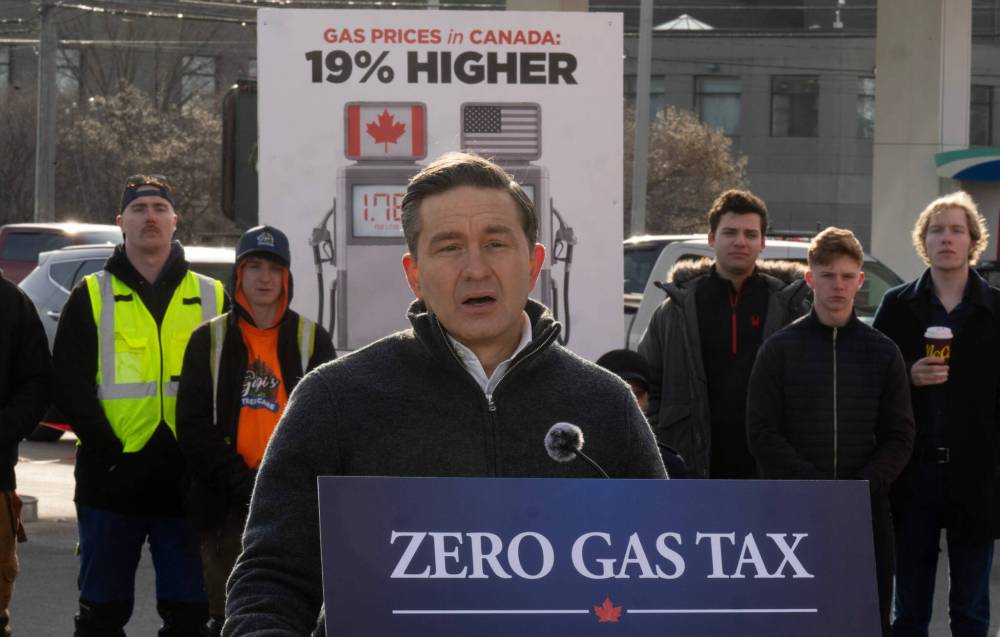
Conservative Leader Pierre Poilievre speaks during a news conference in Ottawa on Thursday. (The Canadian Press)
This week, the Tory leader demanded that the Carney Liberal government immediately drop the federal taxes on gasoline and diesel fuel for the rest of this year, and called for the government to also permanently eliminate the clean fuel standard after 2026. He estimated that lifting the fuel excise tax, clean fuel standard and GST surcharges from gas and diesel would save Canadian motorists approximately 25 cents per litre this year, while costing the government approximately $5.25 billion in tax revenue.
Who would have ever guessed that Kinew and Poilievre would share such enthusiasm for gas tax cuts? Who would have imagined that they would each favour a policy that overwhelmingly benefited drivers of high-consumption vehicles? Who would have thought they would both endorse an approach that could actually increase greenhouse gas emissions from vehicles?
If Poilievre had been paying attention to what happened in Manitoba after the gas tax holiday was implemented in 2024, he would have seen that most if not all of the “savings” from that tax cut weren’t passed on to consumers. Instead, many gas stations kept prices close to the pre-cut level and pocketed the profits. He would also have seen that cutting the gas tax in Manitoba did not result in lower prices for groceries and other merchandise.
The Tory leader would have also seen that the gas tax holiday cost Manitoba more than $340 million in revenues, at a time when it was already running a huge deficit. By stubbornly sticking with the cut, despite the deepening deficit, the Kinew government effectively increased the provincial debt by the amount of the revenues that were not received. That means that the provincial government in effect paid for the tax holiday with more than $340 million in borrowed money that will take years to pay back, with interest.
Poilievre says his tax cut would be paid for by cancelling the proposed high-speed rail line between Toronto and Quebec City, by cutting back on “consultants, bureaucracy, handouts to fake refugees, foreign aid and bureaucracy,” and by getting rid of the “multibillion-dollar gun grab that targets law abiding hunters, farmers and sport shooters.”
In other words, he favours his cut over a long-awaited public transportation project that voters opted for in last year’s election, and which would reduce greenhouse gas emissions by taking countless cars off the road. Beyond that, he would rely on his usual laundry list of “efficiencies” and ideological “savings” to offset the cost of his cuts. He is demanding measures that would have long-term, harmful consequences for the country in response to a situation that is likely temporary.
What is it with politicians who seem to regard tax cuts as the cure-all for every challenge? How can people like Poilievre moan about rising deficits one day, yet demand tax cuts the next, without ever acknowledging that those cuts almost always make deficits grow larger?
Instead of immediately demanding tax cuts in response to high fuel prices, politicians like Kinew and Poilievre could instead be arguing that the current situation is an opportunity for Canadians to collectively change their attitude and behaviour regarding hydrocarbons.
Instead of advocating for cuts to preserve the status quo, they could (and should) regard what’s happening at the nation’s gas stations as an opportunity to encourage the public to drive and travel less, and to consider using car pools and public transportation more often. They could also be suggesting that now is a good time for motorists to consider switching to electric vehicles and hybrids.
Better yet, they could be calling for the Carney government to disburse the unexpected tax windfall it is currently earning (because of the higher-than-expected gas prices, which results in higher-than-expected tax revenues) to Canadians who need help the most. That’s what the federal government has done in the past in response to similar circumstances.
That’s the realistic, reasonable approach that Kinew and Poilievre should be suggesting. The fact Poilievre is not advocating for such a response is not a surprise. The fact Kinew isn’t, however, is a disappointment.