
Want to talk comics? Go online
Advertisement
Read this article for free:
or
Already have an account? Log in here »
We need your support!
Local journalism needs your support!
As we navigate through unprecedented times, our journalists are working harder than ever to bring you the latest local updates to keep you safe and informed.
Now, more than ever, we need your support.
Starting at $15.99 plus taxes every four weeks you can access your Brandon Sun online and full access to all content as it appears on our website.
Subscribe Nowor call circulation directly at (204) 727-0527.
Your pledge helps to ensure we provide the news that matters most to your community!
To continue reading, please subscribe:
Add Brandon Sun access to your Free Press subscription for only an additional
$1 for the first 4 weeks*
- Enjoy unlimited reading on brandonsun.com
- Read the Brandon Sun E-Edition, our digital replica newspaper
*Your next Free Press subscription payment will increase by $1.00 and you will be charged $20.95 plus GST for four weeks. After four weeks, your payment will increase to $24.95 plus GST every four weeks.
Read unlimited articles for free today:
or
Already have an account? Log in here »
Comics are more than a reading experience. They are a culture.
While reading a comic has traditionally been the centrepiece of that culture — with comics being the “social object” that binds and unites the culture, in the words of sociologist Jyri Engeström — the social experience doesn’t end when you put the comic down.
Comics culture has a storied history of conventions, shop conversations, swaps and sale events, collector exhibits and even academic courses on the subject.
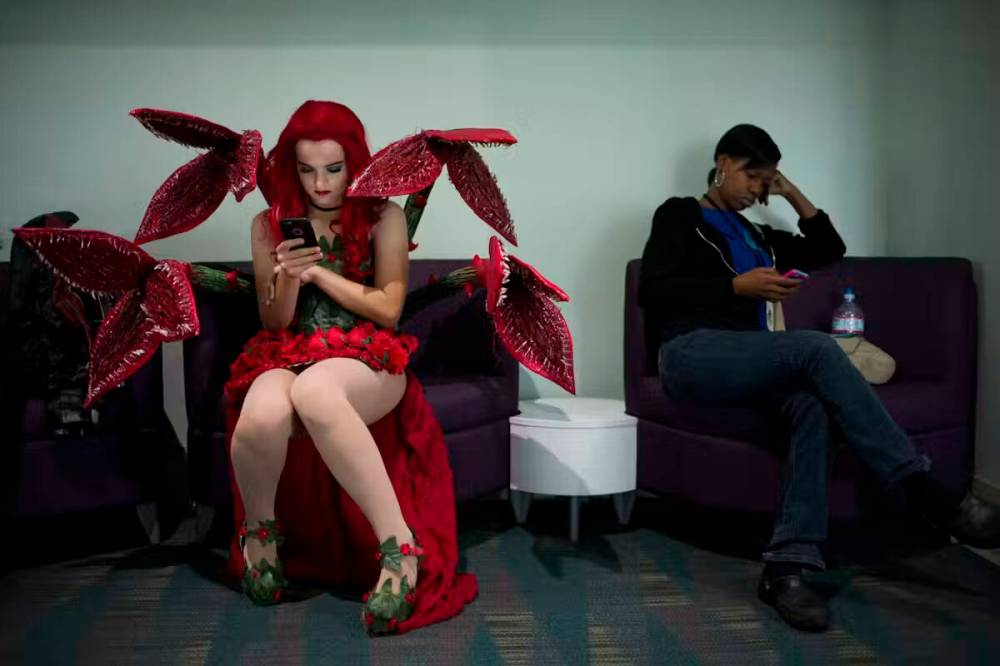
A woman whose character name is Poison Ivy looks at her smartphone while taking a break at Stan Lee’s Los Angeles Comic Con held at the Los Angeles Convention Center in 2016 in Los Angeles. (The Associated Press files)
And now we can add social media and the rise of webcomics — some of which even begin online, and then move to book format. So how do comic fans engage on Instagram and TikTok?
In a new media era, they share their comics experience with others online — debating, reflecting, recommending and enjoying.
As a scholar who specializes in comics media (graphic novels, comics, manga, and so on) and professional communications, I’m also interested in how we might add “learning” to that list since social media represents, arguably, the largest and most potent information dissemination network in human history. And when it comes to comics, there’s no shortage of things to discuss in this new media age.
DIFFERENT ERAS OF COMICS
Without social media, the previous “ages” or eras of English-language comics worked differently. The notion of different ages of comics evolved from discussion among fans, editors and scholars, and these include, as comics scholar Adrienne Resha explains: The Golden (1930s-50s), Silver (1950s-70s), Bronze (1970s-90s) and Modern (1990s-2010s) Ages.
These ages each have their own peculiarities, generic tendencies and political themes, but they can all be united by what Resha terms “corporate mandates and collector markets.”
Our current age of comics (for which Resha proposes the term “The Blue Age”) is one in which comics can be consumed through global digital platforms like Marvel Unlimited, Webtoons, Shonen Jump and so on, all without readers and fans ever purchasing a paper copy.
More importantly, it’s also an age in which comics fans form communities across social media platforms, allowing them to hold all manner of conversations with each other to express and enhance their experiences.
RESPECTFUL OR TOXIC FAN SPACES?
These platforms create what new media expert Henry Jenkins defines as “affinity spaces” — places where readers and fans socialize while communally working through the meaning and importance of the social object (in this case, a comic) that they’ve all read.
While gathering around comics is longstanding and some dedicated comic-book shops persist despite shifts in the publishing industry, many readers now come together online.
The reputability of these online spaces is debatable, though, living as we do in an era of misinformation and disinformation. Online communities, just like real-life communities, can become toxic.
The Comicsgate scandal of 2017-18 that involved online backlash to gendered, racialized and cultural diversity in comics — in real spaces as well as comics storylines and representation — lead to widespread threats of violence.
But there is little doubt that the conversations fans are having about comics, and the affinity spaces surrounding them, are changing, with online conversations making up for losses of the traditional comic-book store.
As Resha notes: “The letters columns that once graced the back pages of comic books have been all but replaced and in some cases augmented by Twitter and, to a lesser degree, Tumblr and Facebook.”
SHAPING COMICS CULTURE
Powerhouse comics publishers have been quick to enter these affinity spaces. Marvel, DC and Image all joined Twitter, now called X, by 2008 to mediate and facilitate conversations about their products and outputs.
Comics artists have done the same. Many now have active followings of their social media accounts, which allow them to promote their work, share works in progress and dialogue with their fans directly.
Social media has drawn fans, creators and publishers into a robust digital conversation that celebrates and shapes the art of comics as we know it.
COMICS SCHOLARSHIP, PUBLIC DISCUSSION
More recently, comics scholarship projects have sought to bring the academic consideration of comics as a medium into the public realm as well.
Such projects include education researcher Zachary Rondinelli’s “Welcome to Slumberland,” my own project “The Claremont Run” related to subverting gender in the X-Men or my co-project with Canadian communications scholar Anna Peppard, “Sequential Scholars.”
These projects, and others like them, allow readers the opportunity to peruse and consider university-level research on comics while they simultaneously weigh fan opinion, creator perspective and publisher mandate, all in the same network.
INFORMED ATTENTION AND ART CIRCULATION
This scholarly perspective adds a unique value to the conversation. In a 2023 article, literary studies researcher and critic Tim Lanzendörfer argues literary studies play an important role in how the public ascribes meaning to literature when scholars engage in public discussion.
The famous essay “A Habitable World” by author and comic scriptwriter Carter Scholz named some benefits of this process:
“So a commercial art form absolutely needs critical attention if it is to survive as an art. Otherwise, it gets its direction only from seeing what sells this month or this year; such observations are prone to error, impossible to interpret and worse than useless to the artist.”
His essay precedes the comic “Music for Mechanics” that he scripted, part of the acclaimed “Love and Rockets” series drawn by the Hernandez brothers.
SHARING LOVE OF THE MEDIUM ONLINE
If comics are going to survive and to thrive as an art form, embracing social media can create an enhanced and empowered comics culture, one that is informed by varied stakeholders — like fans, creators, publishers, educators, critics and scholars — interacting with each other and spreading the good word about comics, so to speak, collectively.
And this might be the power of The Blue Age of comics — to leverage the information-sharing potential of social media to create an online experience of shared affinity for comics that is visual, networked, accessible (convenient even) and informed. For researchers across fields, this could also mean thinking about leveraging the accessibility of comics to contribute to the public good.
If you haven’t read a comic in The Blue Age, or simply haven’t attempted to share your love of the medium online, now’s a good time to jump back in. It’s an entirely new experience.
» J. Andrew Deman professor of English at the University of Waterloo. This column was originally published at The Conversation Canada: theconversation.com/ca.