
New era of book clubs reshaping how we read
Advertisement
Read this article for free:
or
Already have an account? Log in here »
We need your support!
Local journalism needs your support!
As we navigate through unprecedented times, our journalists are working harder than ever to bring you the latest local updates to keep you safe and informed.
Now, more than ever, we need your support.
Starting at $15.99 plus taxes every four weeks you can access your Brandon Sun online and full access to all content as it appears on our website.
Subscribe Nowor call circulation directly at (204) 727-0527.
Your pledge helps to ensure we provide the news that matters most to your community!
To continue reading, please subscribe:
Add Brandon Sun access to your Free Press subscription for only an additional
$1 for the first 4 weeks*
- Enjoy unlimited reading on brandonsun.com
- Read the Brandon Sun E-Edition, our digital replica newspaper
*Your next Free Press subscription payment will increase by $1.00 and you will be charged $20.95 plus GST for four weeks. After four weeks, your payment will increase to $24.95 plus GST every four weeks.
Read unlimited articles for free today:
or
Already have an account? Log in here »
Reading is experiencing a resurgence among Gen Z and millennials, many of whom are actively seeking alternatives to “doomscrolling” and the mental fatigue associated with constant social media use.
In North America, an estimated 57 to 61 per cent of Gen Z and millennials identify as readers, averaging 3.5 to 4.5 books per year, with a preference for physical books. Younger readers are also more likely to purchase books in a bookstore and be active library users, which is notable in an era dominated by digital media.
Although reading is often viewed as a solitary activity, it can also foster meaningful connections with others. Participation in a reading community can reduce social isolation, alleviate loneliness and increase a sense of belonging and connectedness — something younger generations report struggling with.
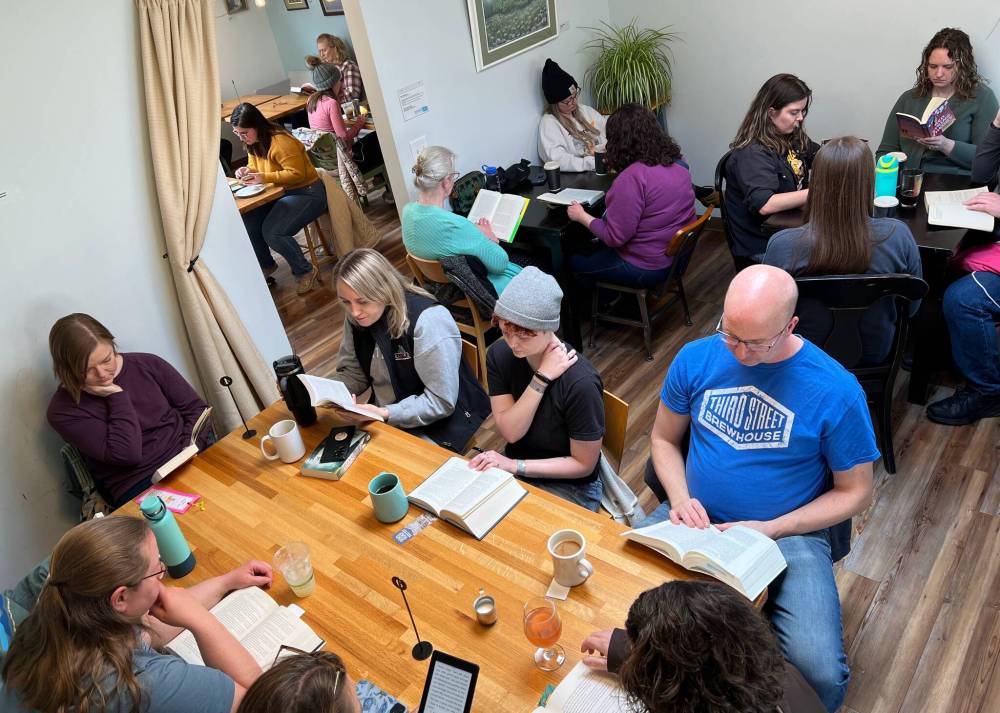
At a March 2024 meeting of the Silent Book Club’s Minneapolis chapter, two dozen people gathered at Cream & Amber in Hopkins, Minn., to quietly read books of their own choosing. (Tribune News Service files)
Book clubs can serve as a natural extension for those seeking the benefits of reading and community. Among younger adults, interest in book clubs is growing: about 21 per cent of Gen Z and 29 per cent of millennials report belonging to one, but they’re putting their own spin on them.
A BRIEF HISTORY OF BOOK CLUBS
Book clubs aren’t new. They can be traced back at least to the 16th century, when groups — often women — gathered for education and debate, often about religious texts.
In later centuries, reading groups became important spaces for women’s intellectual lives at times when formal education was limited.
In more recent popular culture, however, book clubs have often been portrayed through the lens of the so-called “wine mom” stereotype. These clubs are typically depicted as gatherings of mothers using the meeting as a rare night off from parenting, where alcohol and socializing take precedence and discussion of the book itself becomes secondary.
While this portrayal can be reductive and overlooks the real emotional and intellectual value those clubs provide, it has nonetheless shaped perceptions of what book clubs are and who they are for.
NEW GENERATION REWRITES THE RULES
Gen Z and millennials are moving away from, or at least expanding beyond, the “wine-and-gossip” model to better fit their lives, values and energy levels.
One of the fastest-growing formats is the silent book club, where members gather in public spaces such as libraries or cafés to read their own books quietly. After about an hour, readers may choose to socialize with the others or leave.
It gives members an opportunity to read as part of a community without the other demands associated with book clubs of the past. Silent book clubs now span 60 countries with more than 2,000 chapters worldwide.
In addition to silent clubs, niche book clubs have grown among younger readers, including groups centred on specific identities such as queer, BIPOC, Indigenous and disability-focused clubs, or interests like genre-specific clubs.
BOOK CLUBS GOING DIGITAL
Social media has reshaped how readers find each other and decide what books to read. Hashtags like #BookTok and #Bookstagram are now influencing club selections more, favouring genres such as fantasy, romance and horror, rather than celebrity-endorsed bestsellers.
Unlike traditional local clubs, digital platforms can act as virtual hubs where readers join discussion groups, share recommendations and participate in other activities without geographic limits.
These clubs often place a greater emphasis on understanding the book with facilitated discussions, and sometimes include a question-and-answer format with the author.
For many young adults, this flexibility makes book clubs more accessible and better suited to busy and mobile lifestyles. If you’re struggling to find the time and energy to attend in-person clubs, a digital one might be just what you’re looking for.
READING FOR MENTAL HEALTH
This reading resurgence matters because Gen Z and millennials report higher rates of anxiety and depression than previous generations. Many are actively seeking low-cost, sustainable ways to support their mental health, and reading fits that bill.
The therapeutic use of books, known as bibliotherapy, is supported by clinical guidelines. The Canadian Network for Mood and Anxiety Treatments recommends books as a supportive, second-line treatment for certain mild to moderate emotional difficulties.
Book clubs amplify these positive effects. One survey found that 98 per cent of respondents said it improved their mental health and helped them cope during difficult periods.
Given this connection, I created and run the Reading for Well-Being Community Book Club at Carleton University, which focuses on evidence-based books about mental health and personal growth. The club operates digitally and is open beyond campus, and roughly half of participants are Gen Z or millennials.
FINDING A BOOK CLUB THAT SUITS YOU
For those looking to engage more deeply with reading, book clubs offer a flexible way to connect with like-minded readers and build community. Here are some tips for how to start:
• Identify your reading interests and type of community connection desired. Consider the genres you enjoy, how often you’d like to meet and the type of social connection you’re seeking.
• Explore online communities such as Goodreads, Bookclubs and Book Club Hub, which host a wide range of virtual and in-person groups.
• Consider trying alternative formats, such as hybrid or silent book clubs, if a traditional book club doesn’t work for you.
• Check your local libraries and independent bookstores, many of which host free, community-focused book clubs.
• Start your own. If you can’t find a book club that suits your needs, resources from organizations like public libraries or tips from professionals can help you create your own.
Engaging with reading in these ways not only stimulates your mind but also helps you build community, belonging and mental well-being.
» Joanna Pozzulo is the Chancellor’s Professor in psychology at Carleton University. This column was originally published at The Conversation Canada: theconversation.com/ca