
Alto won’t make a big dent in Canada’s GHG emissions
Advertisement
Read this article for free:
or
Already have an account? Log in here »
We need your support!
Local journalism needs your support!
As we navigate through unprecedented times, our journalists are working harder than ever to bring you the latest local updates to keep you safe and informed.
Now, more than ever, we need your support.
Starting at $15.99 plus taxes every four weeks you can access your Brandon Sun online and full access to all content as it appears on our website.
Subscribe Nowor call circulation directly at (204) 727-0527.
Your pledge helps to ensure we provide the news that matters most to your community!
To continue reading, please subscribe:
Add Brandon Sun access to your Free Press subscription for only an additional
$1 for the first 4 weeks*
*Your next subscription payment will increase by $1.00 and you will be charged $20.00 plus GST for four weeks. After four weeks, your payment will increase to $24.00 plus GST every four weeks.
Read unlimited articles for free today:
or
Already have an account? Log in here »
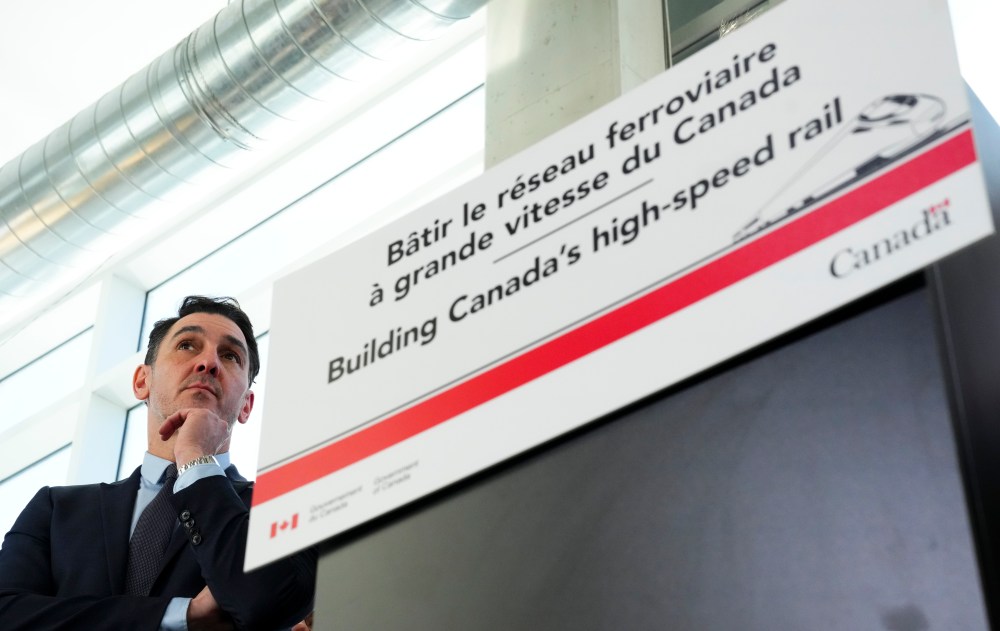
In February 2025, the federal government announced Alto, a high-speed rail line that will eventually connect Toronto to Quebec City. In November, the government said it would introduce new legislation to speed up the project.
One of its proposed benefits is that electrified, high-speed rail will help Canada reduce emissions and meet its climate targets. Alto says the project will help prevent many short-haul flights and remove the carbon emissions equivalent to 100,000 cars from the road each year.
But Alto is unlikely to meaningfully reduce Canada’s greenhouse gas (GHG) emissions. There are indeed benefits from high-speed rail development, including bolstered regional connectivity and economic growth. However, a significant reduction in emissions is not a realistic outcome.
CLAIMED EMISSIONS REDUCTIONS
Alto — the federal Crown corporation developing the project — said that by getting passengers out of vehicles, “we can collectively remove up to 90 billion vehicle kilometres travelled from the roads over the project’s lifecycle, equivalent to approximately 100 thousand cars’ worth of travel removed annually from the roads.”
While 39 million tonnes may sound large, it’s a relatively small GHG reduction from the point of view of a national-scale infrastructure project lasting more than 60 years. It’s akin to only 0.65 megatonnes of CO2 per year of the project through to the mid-2080s.
For reference, Canada’s annual emissions today are about 1,000 times greater than that. When framed in the context of existing annual emissions, the claimed reductions are modest.
INDUCED DEMAND
Alto’s expected reduction in vehicle and air travel is likely an overestimate. Research into 210 projects in 14 nations found that ridership forecasts for high-speed rail are often higher than what eventually comes to pass. This gets at another challenge with high-speed rail’s energy impacts: induced demand.
One of the real benefits of high-speed rail development is economic growth. This arises because a new high-speed train makes new forms of economic activity possible.
It reduces the time it takes to travel between cities, making greater connectivity possible, while also increasing tourism opportunities. In theory, it also expands the distance that workers are willing to commute, which could create new housing development opportunities in regions that otherwise would not have experienced them.
Nevertheless, these same benefits potentially undermine some of the environmental arguments for high-speed rail. These new economic opportunities induce new transport demand — not only for the new train, but for other modes of travel as well.
Research in this area suggests that about 20 per cent of high-speed rail traffic could be made up of new travellers who would not have made the trip otherwise. That does leave up to 80 per cent of high-speed rail travellers switching from another mode of transportation. However, there are a couple of reasons why that may not result in significant GHG reductions in Canada.
First, many travellers will be those who would have taken the conventional train and who will merely switch to the high-speed train instead. This would indeed mark a lower emissions journey given that VIA Rail’s current trains are diesel-powered. But it’s not as substantive a reduction as switching from air travel, for example.
In addition, sales of electric vehicles are expected to increase rapidly in the coming years. If EVs become more commonplace, or even the norm, the government must consider whether a diverted automobile trip in the decades to come would be diverting a passenger from a (GHG-emitting) combustion engine or a (non-emitting) electric one.
Much of the diverted automobile traffic for high-speed rail — by the time the train line is built — will likely come from EVs. That leaves diverting traffic from aircraft as the main way to reduce transport emissions. Yet even this sector is also expected to electrify in the coming decades.
In fact, it is precisely the short-haul flight market within the busy Québec City-Windsor corridor where small electric aircraft are set to debut in Canada. Airlines have already put in orders for electric planes, which may even enter into service before the first rail link is built.
EMISSIONS FROM CONSTRUCTION
Another significant effect that could increase GHG emissions would be the construction of the rail infrastructure itself. This would not be inconsequential: 1,000 kilometres of dedicated tracks within a swath of land several dozen metres wide, featuring overpasses and tunnelling to ensure there are no grade crossings with roads, not to mention the need for overhead power lines.
The sheer amount of concrete, steel and copper required to build Alto will be immense, and would contribute to Canada’s GHG emissions during construction.
This is not to say Alto shouldn’t be built, nor that it’s a bad idea. The construction and operation of a high-speed rail line would generate growth and socioeconomic value for Canada.
It would create tens of thousands of construction jobs, billions of dollars in new opportunities annually and could help revive Canada’s suffering steel sector (currently dealing with tariff pressures from the United States).
Such infrastructure could very well be operated without producing much GHG emissions, and fit well within Canada’s aims for a future net-zero society. But this doesn’t mean that introducing a high-speed train itself would substantially help in Canada’s near-term climate mitigation efforts. It won’t.
» Ryan M. Katz-Rosene is an associate professor in the School of Political Studies at the University of Ottawa, with cross-appointment to geography, environment and geomatics.
» This column was originally published at The Conversation Canada: theconversation.com/ca