
After the flames, wildfires can pollute drinking water for years
Advertisement
Read this article for free:
or
Already have an account? Log in here »
We need your support!
Local journalism needs your support!
As we navigate through unprecedented times, our journalists are working harder than ever to bring you the latest local updates to keep you safe and informed.
Now, more than ever, we need your support.
Starting at $15.99 plus taxes every four weeks you can access your Brandon Sun online and full access to all content as it appears on our website.
Subscribe Nowor call circulation directly at (204) 727-0527.
Your pledge helps to ensure we provide the news that matters most to your community!
To continue reading, please subscribe:
Add Brandon Sun access to your Free Press subscription for only an additional
$1 for the first 4 weeks*
- Enjoy unlimited reading on brandonsun.com
- Read the Brandon Sun E-Edition, our digital replica newspaper
*Your next Free Press subscription payment will increase by $1.00 and you will be charged $20.95 plus GST for four weeks. After four weeks, your payment will increase to $24.95 plus GST every four weeks.
Read unlimited articles for free today:
or
Already have an account? Log in here »
When people think about wildfires, they usually think about flames, smoke and evacuations. However, for many communities, some of the most important damage begins after the fire has passed.
Most wildfires leave behind a barren, blackened landscape, and within this changed environment, important impacts can leave their mark. Trees and other vegetation that once slowed rainfall and held soil in place are gone. Ash and burned debris cover the ground. Soil can become more vulnerable to erosion.
Then, the rain comes. When that happens, streams, rivers and water reservoirs receive a sudden pulse of ash, sediment and fire-suppressant chemicals washed off the land. For communities that depend on those waters for drinking water, wildfires can quickly become a long-term water-quality problem.
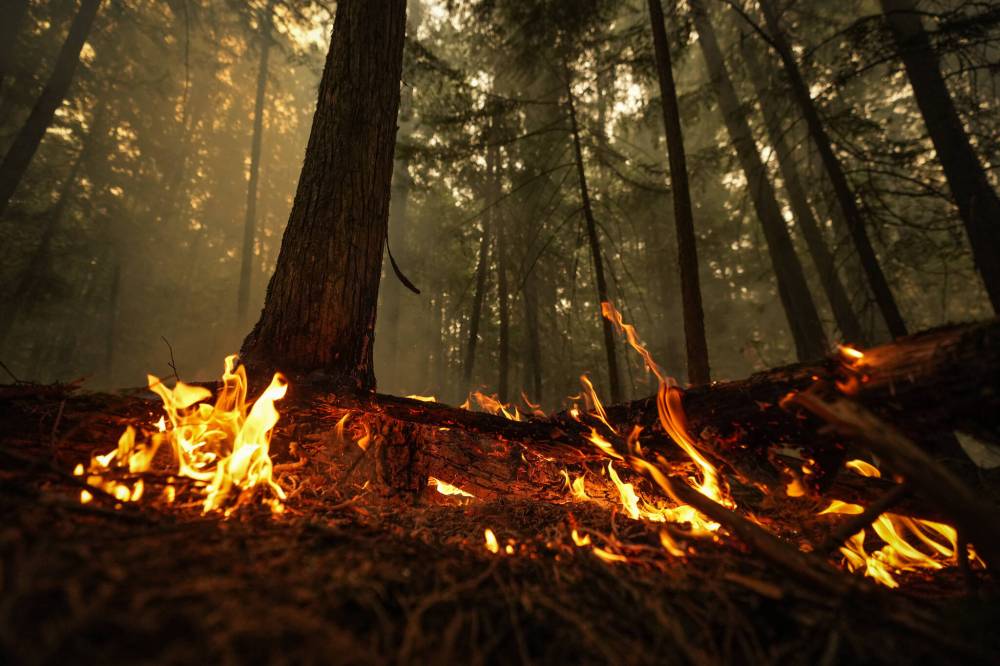
In the wake of a wildfire, trees and other vegetation that once held soil in place are burned. Ash and debris cover the ground and can easily get swept into waterways by rain. (The Canadian Press files)
This risk is often overlooked when governments and communities think about wildfires. Our recent review of 23 studies across 28 watersheds brings together existing knowledge on how wildfire-related contaminants affect water sources.
One of the clearest lessons is that the impacts of wildfire do not stop at the edge of the burn scar. They can travel downstream, into the waters that people rely on every day.
More contaminants in water
One of the first signs of trouble after a wildfire is often turbidity — the cloudiness caused by suspended particles in the water.
High turbidity can make drinking water much more difficult to treat. Fine particles can interfere with processes, clog filters and make disinfection less effective. After a fire, the problem is often worsened by storms that flush large amounts of ash, soil and organic material into waterways over a short period of time.
Wildfires can also increase levels of contaminants such as polycyclic aromatic hydrocarbons (PAHs), some of which are carcinogenic or suspected carcinogens. Many PAHs can attach to ash, soot and fine particles, allowing them to move through a watershed when water runs off. Some lower-molecular-weight PAHs may also occur in dissolved form, creating additional challenges for monitoring and water treatment.
In some cases, chemicals used in fire suppression can also affect water quality: some fire retardants contain phosphates, which can add too many nutrients to water bodies if they get into streams or reservoirs.
Wildfires also make landscapes more vulnerable to erosion, which can release sediments, metals, dissolved organic matter and other contaminants into lakes, rivers and reservoirs.
Not every wildfire affects water in the same way. The size of the impact depends on many factors: how severely the area is burned, how steep the terrain is, what kinds of soil and vegetation are present, how close the burned area is to streams and reservoirs, and how soon heavy rain falls after the fire. In many cases, the fire creates the conditions for water contamination, but the first major storm that follows delivers the blow.
There are still those other persistent factors that can lead to contamination, even years after the wildfire. This is one reason wildfire risk is becoming harder to manage in a warming world.
That broader perspective matters for water policy. If governments treat wildfire only as an emergency response problem, they will miss what happens before and long after the flames. They will also miss opportunities to reduce long-term contamination of drinking water.
What can be done?
The first step is to recognize water protection as part of wildfire preparedness. Utilities and governments should know which watersheds are most vulnerable to severe fire and post-fire runoff. Fire-risk planning, watershed management and drinking-water planning are often handled separately. That needs to change.
The second step is better monitoring. After a major fire, communities need timely information about what is entering their water sources. Without timely monitoring, utilities are left reacting after water quality has already deteriorated.
The third step is stronger support for drinking water treatment systems, especially in smaller and rural communities. Large cities may have more backup options, flexible treatment systems and capacity. Smaller communities often do not. Yet they may face some of the greatest risks when fire affects the watersheds they depend on.
Wildfire policy should be guided by fairness as well as science. Not all communities are equally able to absorb a shock to their water supply. Communities with fewer financial resources, older infrastructure or limited treatment capacity may face longer disruptions and higher risks.
Protecting drinking water after wildfire isn’t just an environmental issue. It’s also a public health and equity issue.
As Canada heads into another wildfire season, we should widen our understanding of what wildfires leave behind. The flames may last days or weeks, but the effects on water can last far longer. If we want communities to be truly resilient, we need to protect not only the air people breathe, but also the water they depend on.
» Qingshi Tu is an assistant professor in the department of wood science at the University of British Columbia. Loretta Li is a professor of environmental systems engineering, geo-environmental engineering and geotechnical engineering at UBC. Raul de Leon Rabago is a master of applied science student in civil engineering and environmental systems engineering at UBC.
» This column was originally published at The Conversation Canada: theconversation.com/ca