
Indigenous defenders of national unity
Advertisement
Read this article for free:
or
Already have an account? Log in here »
We need your support!
Local journalism needs your support!
As we navigate through unprecedented times, our journalists are working harder than ever to bring you the latest local updates to keep you safe and informed.
Now, more than ever, we need your support.
Starting at $15.99 plus taxes every four weeks you can access your Brandon Sun online and full access to all content as it appears on our website.
Subscribe Nowor call circulation directly at (204) 727-0527.
Your pledge helps to ensure we provide the news that matters most to your community!
To continue reading, please subscribe:
Add Brandon Sun access to your Free Press subscription for only an additional
$1 for the first 4 weeks*
- Enjoy unlimited reading on brandonsun.com
- Read the Brandon Sun E-Edition, our digital replica newspaper
*Your next Free Press subscription payment will increase by $1.00 and you will be charged $20.95 plus GST for four weeks. After four weeks, your payment will increase to $24.95 plus GST every four weeks.
Read unlimited articles for free today:
or
Already have an account? Log in here »
On Sept. 18, 1813, British major-general Henry Procter started retreating from Fort Malden in Amherstburg, Ont., south of what is now Detroit, following the defeat to the Americans at the Battle of Lake Erie.
For Tecumseh, the Shawnee leader of the Indigenous allies, this was unacceptable.
In arguably the most remarkable speech of the War of 1812, Tecumseh told Procter that retreating would be like a “fat animal that carries its tail upon its back, but when affrighted, drops it between its legs and runs off.”
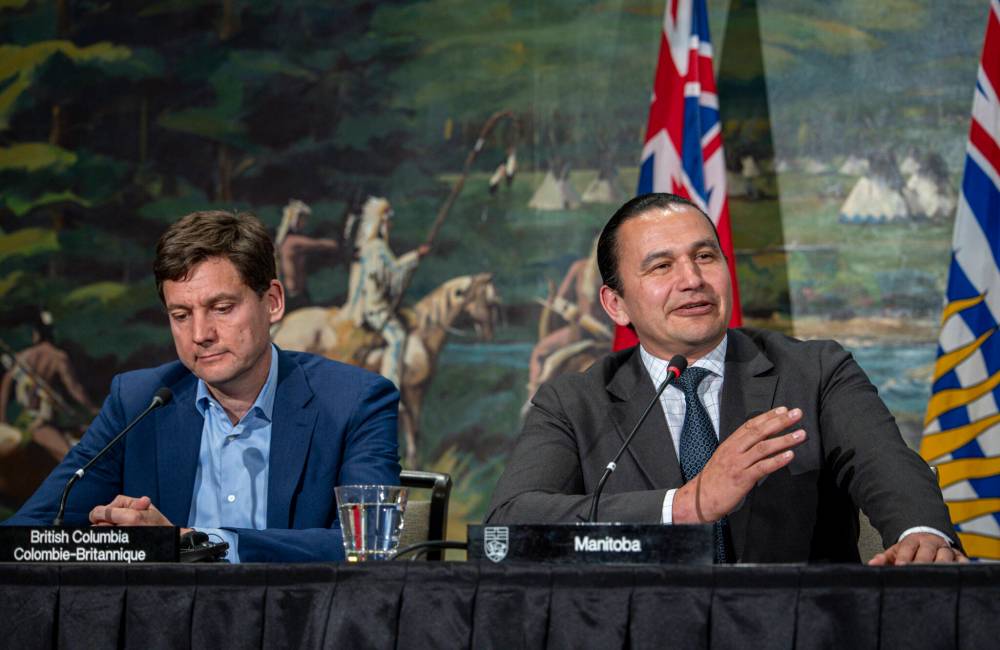
Manitoba Premier Wab Kinew (right) speaks as B.C. Premier David Eby listens during the closing news conference of a meeting of western premiers in Kananaskis, Alta., on May 26. (The Canadian Press files)
Tecumseh called on the British to fulfil their promise to stay alongside their Indigenous relations and face the invading American forces together.
Procter and his British troops were convinced — sort of.
One month later, 100 kilometres east at Moraviantown, Procter and Tecumseh made their final stand together at the Battle of the Thames.
There, the British fought briefly alongside their Shawnee, Odawa, Anishinaabe, Potawatomi and Wendat relations, but then Procter ordered the troops to abandon Tecumseh and several hundred warriors and let them fight alone against the Americans.
Tecumseh was killed after fighting right to the end for his land and his people.
For his deceitful actions, Procter was court-martialled in December 1814 by lieutenant-general Sir George Prevost, the governor-in-chief of British North America and commander of the British and Canadian forces. Proctor was found guilty of being “erroneous in judgment and deficient in energy” and his career ended in disgrace.
In the meantime, the confederacy created and led by Tecumseh atrophied and many Indigenous nations were hesitant to trust the British — and Canadians — again.
I tell this story whenever anyone questions the commitment Indigenous Peoples have made, and continue to make, to this country.
It’s a story, in fact, that’s told every single day in Canada. From the War of 1812 to today, no one has stood up for this country and worked for unity in this place more than Indigenous Peoples.
If you need proof, ask yourself who invited newcomers in to their homes? Who showed them where to find the food and medicine? Who invited whom into treaty?
More recently, and despite violent policies and practices, it is First Nations, Inuit and Métis Peoples who show up — as much, if not more than anyone else in this country — whether it be for a world war, a decision about the Earth or the environment, or a U.S. president calling Canada the 51st state.
This is especially true when conflicts occur between Indigenous Peoples and Canadians.
When you see one: ask yourself who carries the drums, tells stories and gives speeches and who carried guns, court injunctions and arrest warrants.
Ask yourself who is invested in peace, justice and bringing this country together and who is interested in ignoring peoples’ rights, isolating people one doesn’t agree with and creating conflict rather than conversation.
This brings me to Premier Wab Kinew.
All week, journalists have reported Kinew “fact-checked” and “called out” in a “testy exchange” (note: their words) Alberta Premier Danielle Smith on her erroneous claims about the constitutional duty of Canadian governments to consult with First Nations on decisions involving Indigenous and treaty rights.
This isn’t the primary reason Kinew intervened, however.
The fact Smith doesn’t understand — or worse, care — that her government is part of the Crown’s role in treaties and wants to undermine Indigenous and treaty rights and over 40 years of Supreme Court decisions on the subject is alarming — but unsurprising.
It’s pretty typical behaviour for a premier.
Kinew’s comments could equally be levied, for example, against B.C. Premier David Eby’s attempts to reverse Indigenous rights recognized under B.C. and Canadian law.
Eby, however, isn’t starting a process to break up Canada.
“Now is the time to work together,” Kinew said to Smith at the final news conference after western and territorial premiers met.
“Why don’t we hold off on this referendum talk for a year or two, so we can get these pipelines under construction?” Kinew said. “Because at the end of the day, we want Canada to succeed.”
For weeks, Kinew has responded to the question of Alberta separatism by saying that Indigenous Peoples have more reason to want to separate.
Yet, he — like First Nations from coast to coast to coast — knows there is inherent value in this 159-year-old project, imperfectly designed by the ancestors of Indigenous Peoples and Canadians and complicatedly handled by all of us today.
As during the thousands of winters and wars faced by Indigenous Peoples in this place and the hundreds of confederacies and conflicts since the birth of Canada, the only lesson truly learned is that life only continues if a community sticks together despite the temptations of fear, division and selfishness.
Abandoning one another in the face of conflict is cowardice.
» Niigaan Sinclair is Anishinaabe and a columnist at the Winnipeg Free Press.