
Manitoba’s role in a distant Ebola outbreak
Advertisement
Read this article for free:
or
Already have an account? Log in here »
We need your support!
Local journalism needs your support!
As we navigate through unprecedented times, our journalists are working harder than ever to bring you the latest local updates to keep you safe and informed.
Now, more than ever, we need your support.
Starting at $15.99 plus taxes every four weeks you can access your Brandon Sun online and full access to all content as it appears on our website.
Subscribe Nowor call circulation directly at (204) 727-0527.
Your pledge helps to ensure we provide the news that matters most to your community!
To continue reading, please subscribe:
Add Brandon Sun access to your Free Press subscription for only an additional
$1 for the first 4 weeks*
- Enjoy unlimited reading on brandonsun.com
- Read the Brandon Sun E-Edition, our digital replica newspaper
*Your next Free Press subscription payment will increase by $1.00 and you will be charged $20.95 plus GST for four weeks. After four weeks, your payment will increase to $24.95 plus GST every four weeks.
Read unlimited articles for free today:
or
Already have an account? Log in here »
Across parts of Central and East Africa, a familiar threat has returned. The Bundibugyo strain of Ebola, one of the rarer and generally less fatal variants of the virus, has emerged again in the Democratic Republic of the Congo and Uganda.
It is a strain that rarely makes international headlines. It should. Because the story of how a disease moves from a remote forest to the agenda of every health ministry on Earth is a story that every Manitoban has reason to understand.
The risk to Manitobans of direct infection remains very low. That is not the point.
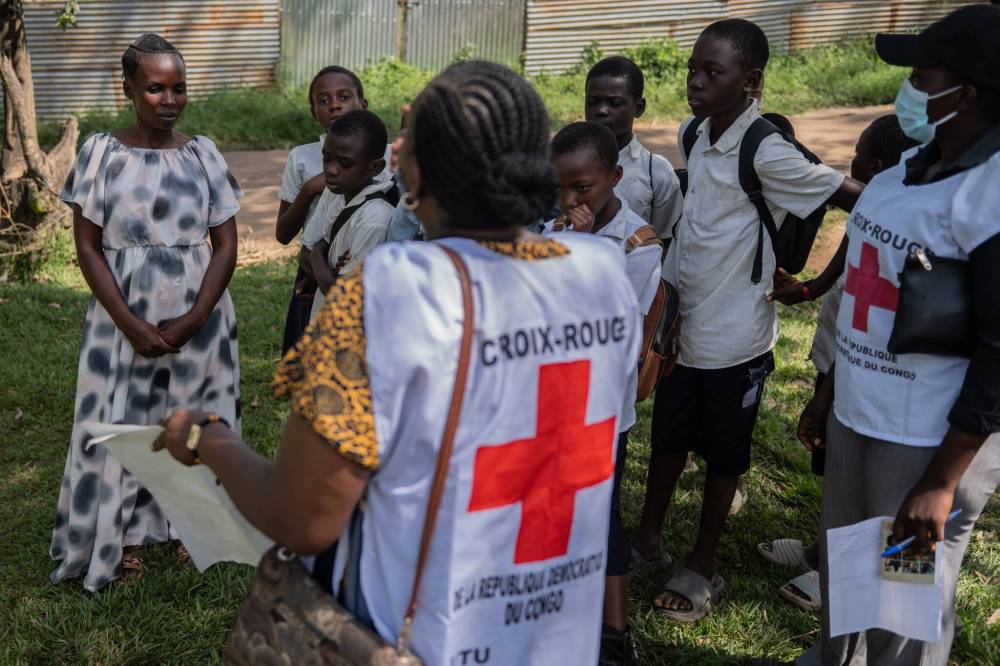
Vanny Birungi, a Red Cross volunteer, speaks to people during a house-to-house sensitization campaign amid the Ebola outbreak in Bunia, Congo, last month. (The Associated Press files)
The point is that geography is no longer the shield it once was. COVID-19, mpox, avian influenza, measles and Ebola have all demonstrated that a disease emerging in one region can quickly become a crisis for communities everywhere.
What is unfolding in Central Africa today is not merely a humanitarian emergency. It is a live exam on whether the world has genuinely learned anything from the ones that came before it.
The first people touched by this outbreak are not data points. They are families, health-care workers, traders crossing borders and children living in communities already under enormous pressure. Their suffering may feel distant from Manitoba. But many of the forces behind this outbreak are the same forces that have contributed to major infectious disease emergencies over the past two decades and those forces do not honour borders or passports.
The mechanism is worth understanding. Armed conflict pushes populations into crowded and under-resourced conditions. Rapid urbanization brings people into closer contact with one another and with wildlife at the shrinking edges of wild landscapes.
In many parts of Central Africa, a hunter handles a freshly killed animal at dawn. By midday, a regional market has drawn together livestock, people and goods from across a wide area. By evening, a health-care worker without adequate protective equipment is caring for someone running a fever of unknown origin.
These are not dramatic worst-case scenarios. They are the ordinary circumstances in which pathogens find their way from one species to another and where outbreaks are born.
This is what public health professionals mean by the One Health approach: the recognition that human health, animal health and environmental health are not parallel systems that occasionally intersect. They are a single system.
As ecosystems face growing pressures from development, land-use change and other environmental shifts, opportunities for diseases to cross into human populations may become more frequent and more difficult to predict.
These are not abstract concerns for Manitoba. They are, in a very direct sense, our concerns.
What unfolds in a remote village in Central Africa can quietly shape the work happening inside a Winnipeg laboratory, a connection most people would never think to make.
Yet some of the world’s most important Ebola research happens in Winnipeg. The National Microbiology Laboratory works at the highest levels of biosafety, studying some of the most dangerous pathogens known to science, including Ebola.
When the world needs to understand a new or resurgent threat, Manitoba scientists are frequently among those providing the answers. We are not observers of global health emergencies. In many cases, we are part of the response.
Beyond the laboratory, Manitoba is woven into global movement in ways that make these questions immediate rather than academic.
Our universities draw students from dozens of countries. Our health-care system depends on internationally trained professionals with deep roots in regions where outbreaks occur. Our businesses run on supply chains that span continents. Our families maintain ties across borders that no quarantine notice can neatly sever.
The idea that global health events happen elsewhere, to other people, in circumstances unrelated to our own, has never been accurate. Today it is simply untenable.
For too long, investments in global health were treated as generosity, admirable but optional. That framing has to change. Supporting disease surveillance, laboratory infrastructure and outbreak response capacity in vulnerable regions is not charity extended to strangers. It is among the most cost-effective investments a country can make in the health of its own population.
The current Ebola outbreak should not provoke fear. It should provoke clarity about what health security actually requires. It is not assembled under pressure after a crisis has landed. It is built steadily, over years, through scientific collaboration, sustained funding and the kind of unglamorous international cooperation that earns no headlines until the moment it is desperately needed.
The next major public health threat is not a question of if, but when and where. Whether it becomes a contained outbreak or a global catastrophe will not be determined by where it starts. It will be determined by how well the world is watching, how quickly it moves and whether countries have chosen to invest in collective preparedness or to wait and hope.
Manitoba has a national laboratory that works on that problem every day. We have scientists, researchers and public health professionals who have given careers to it. We have communities connected to every corner of a world where these risks are real and present.
This has never been someone else’s responsibility. It has always been ours.
» Daniel Ajiroba is a Winnipeg-based public health and policy professional and former public health inspector with experience in environmental public health and health systems policy. This column previously ran in the Winnipeg Free Press.