
A puzzling penchant for unforced errors
Advertisement
Read this article for free:
or
Already have an account? Log in here »
We need your support!
Local journalism needs your support!
As we navigate through unprecedented times, our journalists are working harder than ever to bring you the latest local updates to keep you safe and informed.
Now, more than ever, we need your support.
Starting at $15.99 plus taxes every four weeks you can access your Brandon Sun online and full access to all content as it appears on our website.
Subscribe Nowor call circulation directly at (204) 727-0527.
Your pledge helps to ensure we provide the news that matters most to your community!
To continue reading, please subscribe:
Add Brandon Sun access to your Free Press subscription for only an additional
$1 for the first 4 weeks*
- Enjoy unlimited reading on brandonsun.com
- Read the Brandon Sun E-Edition, our digital replica newspaper
*Your next Free Press subscription payment will increase by $1.00 and you will be charged $20.95 plus GST for four weeks. After four weeks, your payment will increase to $24.95 plus GST every four weeks.
Read unlimited articles for free today:
or
Already have an account? Log in here »
Poor communications can sink a politician faster than a lead anchor and yet, more than a year into his mandate, Prime Minister Mark Carney continues to make avoidable communications mistakes.
On Feb. 28, hours after an attack on Iran by U.S. and Israeli forces, he said that “Canada supports the United States acting to prevent Iran from obtaining a nuclear weapon and to prevent its regime from further threatening international peace and security.” Just four days later, however, after the massive loss of civilian lives became clearer and many other world leaders expressed concern that the attacks may have violated international law, Carney was forced to retreat from his remarks.
He claimed his earlier support of the attacks had come “with regret.” He added that “We were not informed in advance, we were not asked to participate,” and emphasized that “Prima facie, it appears that these actions are inconsistent with international law.”
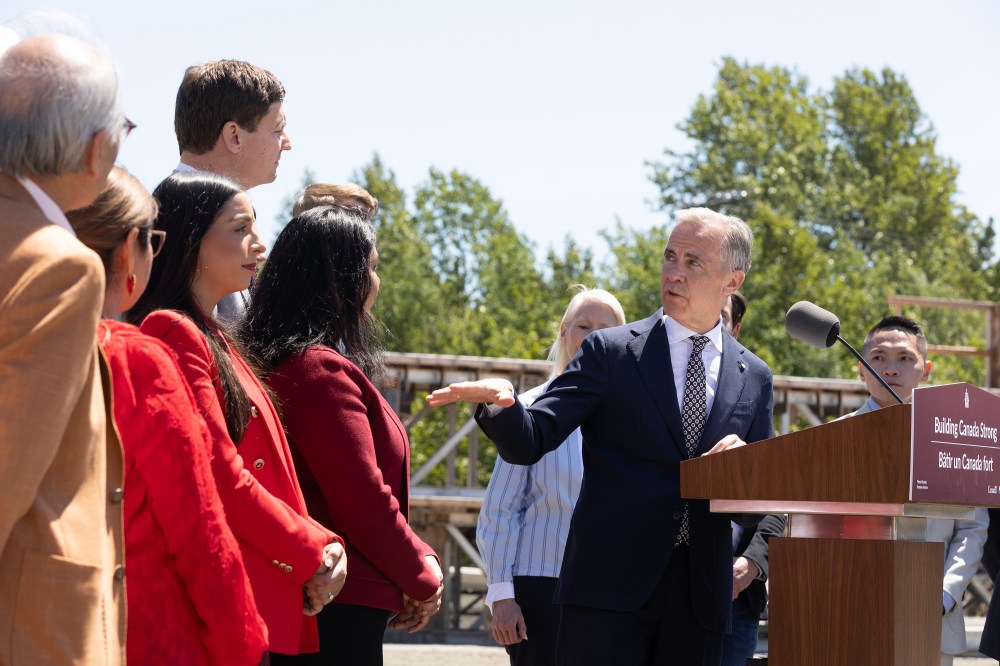
Earlier this month, during an interview with a CNN reporter on the sidelines of the G7 summit, the PM characterized the U.S.-Iran conflict as “worth it,” arguing that Iran was the world’s “biggest exporter of terror” and is “hell bent” on having a nuclear weapon. He praised the tentative ceasefire agreement between the two countries, saying it was “anchored” around the goal of preventing Iran from acquiring a nuclear weapon.
His praise of that agreement, and the objective he believed it accomplished, stood in stark contrast to comments by many leading American politicians, who uniformly characterized it as an embarrassing defeat for America that puts Iran in a more powerful position than it was prior to the war. To make matters worse, it is now clear that the purported “agreement” between the two nations is merely tentative in nature, that the Strait of Hormuz is still subject to blockades, and that high-stakes questions regarding Iran’s nuclear ambitions and capabilities are still being negotiated.
In short, and contrary to Carney’s remarks to CNN, the agreement has done next to nothing to ensure that Iran will not have a nuclear weapon, nor does it even restore the situation to its pre-conflict state. Given that reality, it is surprising that Carney would provide such a favourable spin of the situation.
That’s not all. Last week, a press release from Carney’s office said the federal and B.C. governments plan to “leverage innovative financing tools to convert more than 2,200 vacant condo units in priority growth areas into affordable homes.” The plan was immediately interpreted — and immediately condemned — by pundits and opposition politicians as a billion-dollar scheme to bail out condo developers who had made millions, if not billions, of dollars in profits during the condo boom a few years ago, but are currently facing huge losses due to thousands of unsold units.
On Thursday, Carney backtracked from those remarks, acknowledging his government had botched its explanation of the plan — and then he mangled that explanation even further. He said that the plan aims to help aspiring homebuyers by offering the units to Canadians on a “rent to own” basis. He clarified that the federal government would only contribute up to 10 per cent of the approximately $1.45 billion required to convert the units into affordable housing, while the B.C. government would cover the balance of the cost.
On the other hand, however, he repeatedly used the word “potentially” when discussing the scheme, emphasized it had been initiated by the B.C. government, and admitted there isn’t even a detailed agreement on the table yet.
Is there a deal or not? It is a bailout for condo developers or not? If it’s happening in Vancouver, what about other urban markets with a glut of unsold condos? Stay tuned for yet another clarification.
Those are just a few examples, but they paint a puzzling picture. There have been many occasions when Carney has shown himself to be a gifted communicator — his speech to the World Economic Forum in Davos, for example — and yet there have been other occasions when he has said things that have later required correction. How can he be so good, then so muddled?
This is a problem that must be fixed, and fast. Carney became prime minister, and enjoys a high approval rating, because of his perceived competence. Communication skills play an critical role in creating that perception, however. If the PM continues to say things that aren’t totally true, and is then required to clarify or correct his remarks, it will eventually harm that “competence perception” — and that will inevitably cause a drop in his favourability, in his party’s support in the polls and in the odds of his government being re-elected.
All of that can be avoided, firstly, by slowing down and not feeling the need to offer comments before all the facts are known and settled and, secondly, by being less “off the cuff” and more willing to canvass the views of others before speaking.
A political leader’s commitment to transparency is not a race to a microphone. To the contrary, it is an obligation to deliver complete and accurate facts, even if it means waiting a few more hours for additional information. If our rookie prime minister can bear that in mind, we should see fewer unforced gaffes and fewer clarifications.