
Canada side-swiped by Trump’s Cuba policy
Advertisement
Read this article for free:
or
Already have an account? Log in here »
We need your support!
Local journalism needs your support!
As we navigate through unprecedented times, our journalists are working harder than ever to bring you the latest local updates to keep you safe and informed.
Now, more than ever, we need your support.
Starting at $15.99 plus taxes every four weeks you can access your Brandon Sun online and full access to all content as it appears on our website.
Subscribe Nowor call circulation directly at (204) 727-0527.
Your pledge helps to ensure we provide the news that matters most to your community!
To continue reading, please subscribe:
Add Brandon Sun access to your Free Press subscription for only an additional
$1 for the first 4 weeks*
- Enjoy unlimited reading on brandonsun.com
- Read the Brandon Sun E-Edition, our digital replica newspaper
*Your next Free Press subscription payment will increase by $1.00 and you will be charged $20.95 plus GST for four weeks. After four weeks, your payment will increase to $24.95 plus GST every four weeks.
Read unlimited articles for free today:
or
Already have an account? Log in here »
Canada’s decades-long relationship with revolutionary Cuba has always been a three-country affair — with the United States frequently settling for the spurned third-wheel.
Since the early 1960s, successive U.S. governments have strenuously objected to Canadian trade and commercial engagement with the island. Officials in Washington have always believed that the Canadians were trying to make a “quick buck” at America’s expense, while simultaneously seeking to undermine the U.S. blockade of Cuba.
For almost 70 years now, Canada has had to negotiate the thorny issue of the U.S. trade embargo. Added to that was the anti-Cuba Cuban Democracy Act of 1992 and the still active 1996 Helms-Burton Law. Complicating matters further for Ottawa have been the various additions and subtractions to the unrelenting U.S. efforts to strangle the Cuban economy — particularly during the presidency of Barack Obama.
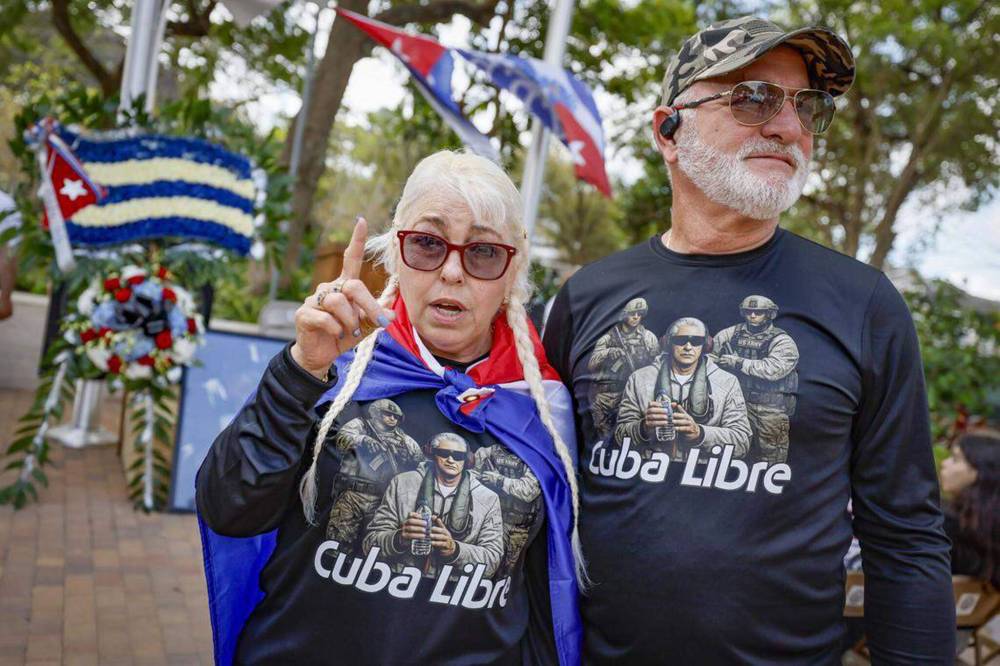
Jeraldyn Harold and Omar Hernandez wear Cuba Libre T-shirts with an illustration showing Cuban President Miguel DÌaz-Canel, detained by U.S. soldiers, during a Proof of Life of Our Brothers ceremony at the Bay of Pigs Monument in the Little Havana area of Miami, in March 2026. (Tribune News Service)
In January, U.S. President Donald Trump imposed a near-ironclad (some Russian oil is getting through), illegal fuel embargo against Cuba, using American naval vessels and U.S. Coast Guard ships. Additionally, he signed an executive order in early May to expand U.S. economic warfare, or what some call “secondary sanctions,” against those materially assisting the Cuban government.
Under the International Emergency Economic Powers Act (which was ruled unconstitutional by the U.S. Supreme Court earlier this year for justifying U.S. trade tariffs), Trump wants to go after “any foreign person” and non-American company (or financial institution) that operates in specific sectors of the Cuban economy — such as mining, defence, financial services and energy. This is the first time, I believe, that the U.S. has sought to punish non-U.S. companies that have heretofore insulated their commercial activities in Cuba from their involvement in the U.S. marketplace.
Cuban President Miguel Díaz-Canel was quick to respond on X: “The international community must take note and, together with the people of the United States, determine whether such a drastic criminal act will be allowed.” He then went on to add pointedly: “No aggression, no matter how powerful, will force Cuba to surrender.”
A week later, U.S. Secretary of State Marco Rubio specifically identified Moa Nickel SA (a joint Canadian-Cuban mining entity) as subject to the May 1 presidential Executive Order 14404. U.S. sanctions, then, will now apply to Toronto-based Sherritt International Corp., which has been operating its nickel and cobalt Moa Bay mine in eastern Cuba for several decades. Those punitive measures could include an inability to access U.S. financial institutions, the freezing of American property and assets and travel restrictions on company personnel.
For the most part, Sherritt has been fairly tight-lipped about these recent developments. It did issue a statement before Rubio singled out of the company, in which it noted that the executive order “creates conditions that materially alter the corporation’s ability to operate in the ordinary course.” It has since suspended operations in Cuba (and been sold to a Texas-based real estate company), watched its share price plummet, and must now carefully plot its next move.
Clearly, Rubio is calling the shots here and he senses a real opportunity to topple the Cuban government. These latest anti-Cuba steps are strictly designed to discourage any foreign investors from ever contemplating putting investment funds into Cuba.
In addition, the measures under the new executive order are intended to cut the country and its people off from any source of revenue generation. The specific targeting of the mining and energy sectors is designed to deny the Cuban government access to dollars to fund its beleaguered social safety net.
To be sure, this is a blatant attempt by the Trump White House to ratchet up its extraterritorial efforts and to further internationalize the U.S. blockade of Cuba. Accordingly, non-American companies such as Sherritt may have to shut down their Cuba operations indefinitely or face the severe repercussions of U.S. sanctions law.
One wonders how the Carney government will respond to this latest attempt to punish Canadian companies (including airlines and hotels) for doing business in Cuba. It bears repeating that Canada has always had a normal bilateral relationship with Havana that has differentiated Ottawa’s engagement and dialogue strategy toward Cuba with America’s penchant for obsessive punishment and estrangement.
What Trump is doing is essentially attacking Canadian sovereignty and our right to chart an independent foreign policy toward Cuba. And I can’t imagine that the Canadian business community would want the governing Liberals to remain silent about this.
My worry, though, is that Prime Minister Mark Carney is not going to pick a fight with the Trump team just as Canada embarks upon a renegotiation of the CUSMA trilateral trade pact. It’s the same old, same old: Canada is not going to sacrifice its interests for the sake of the Cubans — or even risk standing up to the Americans.
Perhaps this is just another sign that Carney’s “elbows up” retort was never anything more than a slogan or applause line. But at some point, if Canada hopes to demonstrate its true autonomy and independence, it will have to do so through actions and deeds and not just empty words.
» Peter McKenna is professor of political science at the University of Prince Edward Island in Charlottetown. This column previously appeared in the Winnipeg Free Press.