
Britain gets new prime minister — again
Advertisement
Read this article for free:
or
Already have an account? Log in here »
We need your support!
Local journalism needs your support!
As we navigate through unprecedented times, our journalists are working harder than ever to bring you the latest local updates to keep you safe and informed.
Now, more than ever, we need your support.
Starting at $15.99 plus taxes every four weeks you can access your Brandon Sun online and full access to all content as it appears on our website.
Subscribe Nowor call circulation directly at (204) 727-0527.
Your pledge helps to ensure we provide the news that matters most to your community!
To continue reading, please subscribe:
Add Brandon Sun access to your Free Press subscription for only an additional
$1 for the first 4 weeks*
- Enjoy unlimited reading on brandonsun.com
- Read the Brandon Sun E-Edition, our digital replica newspaper
*Your next Free Press subscription payment will increase by $1.00 and you will be charged $20.95 plus GST for four weeks. After four weeks, your payment will increase to $24.95 plus GST every four weeks.
Read unlimited articles for free today:
or
Already have an account? Log in here »
Number 10 Downing Street is welcoming its seventh premier in a decade. Andy Burnham, the charismatic ex-mayor of Manchester, is the latest to grip the poisoned chalice of U.K. leadership. He takes over from Sir Keir Starmer, who was forced out after only two years in office.
Starmer rode to power on a landslide 2024 election win. But his lofty campaign promises instantly buckled under the pressure of governing a nation mired in economic malaise. Amid sinking poll numbers, the knives quickly came out among his anxious Labour party peers.
Starmer’s predecessors have faced similar fates ever since Conservative prime minister Theresa May quit in tears in 2019. Burnham might be next. If so, he’ll be another casualty of two catastrophic blunders that have haunted Britain for nearly two decades.
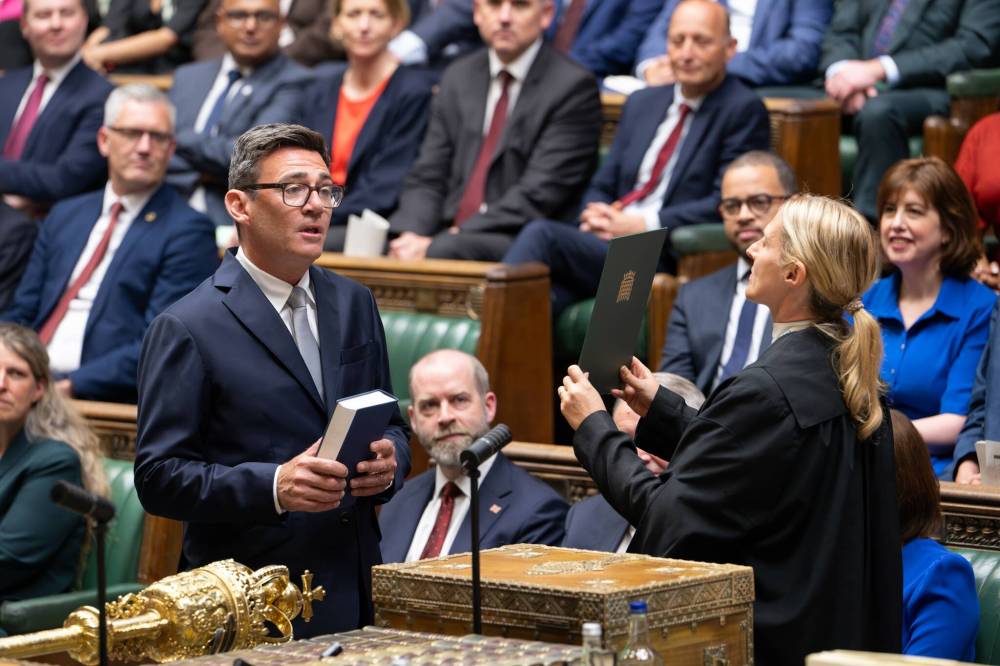
Andy Burnham (front left) is sworn-in as an MP in the House of Common in London, England, on June 22. (The Associated Press files)
The first was embracing austerity as a remedy to the fallout of the 2008 financial crisis. Deep public spending cuts were made across the board — child benefits, education, housing, disability and more. Financing for health care was frozen.
The overall effect has been spiralling deprivation and metastasizing inequality, especially outside of London.
“The austerity measures introduced in 2010 are likely to impact the British population for many years,” reads a 2024 analysis from the London School of Economics. Researchers linked the cuts to a decline in life expectancy and a three per cent mortality rate increase from 2010 to 2019. Things could also get worse, they warn, as the negative effects of the welfare reforms compound over time.
The second self-defeating blow came in 2016, with the vote to leave the European Union.
The Centre for Economic Policy Research estimates that by 2025, Brexit had shrunk GDP by between six and eight per cent. Investment, employment and productivity have all been hurt, their study says, “reflecting a combination of elevated uncertainty, reduced demand, diverted management time and increased misallocation of resources.”
Over 10 per cent of the population of 70 million currently sits on a health-care services backlog. Citizens and businesses are paying the highest electricity rates in the world. It took nearly two weeks to dispatch a naval destroyer to defend a U.K. military base in Cyprus in March after it was struck by an Iranian missile. One in six households suffer food insecurity. Major infrastructure projects are being abandoned.
The U.K.’s precipitous decline has also been politically corrosive. Populist attacks, toxic anti-immigrant messaging and rioting by far-right agitators have become commonplace.
“One generation ago, Britain was a major global power,” observed a writer from The Atlantic after a recent reporting trip. “Today, it is a middling one, gripped by sclerosis.”
These are the currents that new Prime Minister Andy Burnham will be swimming upstream against. Still, he will have many enviable assets to work with.
London is among the world’s top capital markets and dwarfs others in Europe. The BBC, which broadcasts worldwide in 42 languages, is consistently ranked as the globe’s most popular and trusted legacy news source. Britain remains a top-tier destination for creatives, skilled workers and international students as well. This has become especially important as the U.K. charts its own course around artificial intelligence — an unexpected benefit of being liberated from the EU’s regulatory regime.
Oxford and Cambridge have fashioned themselves as vital tech havens for companies and founders seeking to escape the China-U.S. dichotomy. The government-backed AI Security Institute is also recognized as the world’s most capable scientific agency investigating the risks posed by advanced AI.
Plus, steadfast support for Ukraine has produced a raft of major partnership agreements with Kyiv. These will expedite Britain’s access to key emerging defence and security technologies.
In a June essay, Brendan Simms, the director of the Centre for Geopolitics at the University of Cambridge, described what he considered to be the world’s sole great powers. The U.K. was a curious choice to make the list, alongside America, China and Russia. Meanwhile Brazil, France, Germany, India and Japan were absent.
Simms’ argument was that a great power needed four fundamental qualities: military might, economic heft, soft power and resilience. The last amounts to “how much pain a society and its economy can absorb.”
Britain has displayed resilience in droves over the past 300 years. Most notably, it endured the loss of American colonies and its empire collapsing, only to repel a German invasion and spearhead the Allied victory over the Nazis.
Burnham now has the chance to harness this trait to steer the U.K. in a more positive direction. Or be just the newest leader to prolong its pain.
» Kyle Volpi Hiebert is a Montreal-based political risk analyst focused on globalization, conflict and emerging technologies. This column was previously published in the Winnipeg Free Press.