
Survey shows drop in support for gender diversity
Advertisement
Read this article for free:
or
Already have an account? Log in here »
We need your support!
Local journalism needs your support!
As we navigate through unprecedented times, our journalists are working harder than ever to bring you the latest local updates to keep you safe and informed.
Now, more than ever, we need your support.
Starting at $15.99 plus taxes every four weeks you can access your Brandon Sun online and full access to all content as it appears on our website.
Subscribe Nowor call circulation directly at (204) 727-0527.
Your pledge helps to ensure we provide the news that matters most to your community!
To continue reading, please subscribe:
Add Brandon Sun access to your Free Press subscription for only an additional
$1 for the first 4 weeks*
- Enjoy unlimited reading on brandonsun.com
- Read the Brandon Sun E-Edition, our digital replica newspaper
*Your next Free Press subscription payment will increase by $1.00 and you will be charged $20.95 plus GST for four weeks. After four weeks, your payment will increase to $24.95 plus GST every four weeks.
Read unlimited articles for free today:
or
Already have an account? Log in here »
For a long time, Canadian attitudes toward gender diversity moved in one direction: progressive acceptance. In May 2026, however, Statistics Canada released new findings showing that, compared to 2018, significantly fewer people in 2025 are supportive of diverse gender expressions and transgender people.
From October 2024 to June 2025, survey data was collected from 48,547 people 15 years of age and older in Canada as part of the Survey of Safety in Public and Private Spaces. The survey was completed either online (self-administered) or by phone (by an interviewer) and collected information on Canadians’ experiences in public, at work, online and in their intimate relationships. The survey was conducted to ensure representation by geographical region, age and gender.
Two questions focused on gender identity and expression. Survey respondents were asked the extent to which they agreed with these statements: 1. People should be able to express their gender however they choose. 2. I would support a family member if they came out as transgender.
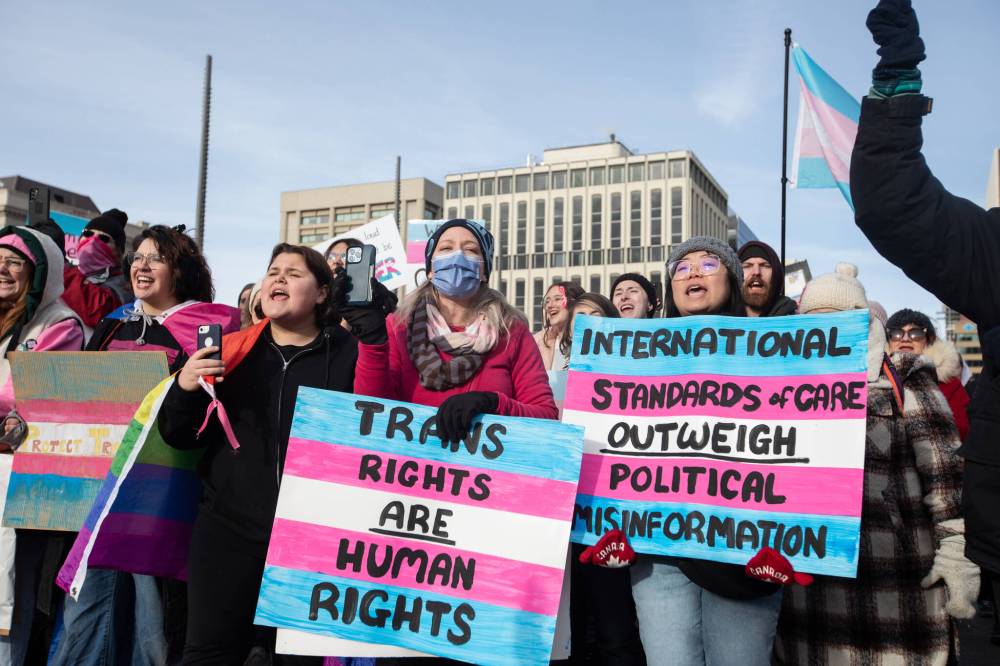
Protesters gather at the Alberta legislature during a rally for trans rights in Edmonton in February 2024. Leah Hamilton and Corrine L. Mason write that when political leaders like Alberta Premier Danielle Smith “weaponize trans-exclusionary framing, support for trans rights drops significantly.” (The Canadian Press files)
Compared to 2018, significantly fewer people in 2025 agreed that individuals should be free to express their gender however they choose. While the majority of Canadians do support diverse gender expressions, support has decreased.
As Statistics Canada reports: “These changes were the most substantial among all eight gender-based violence, gender expression and gender equality statements included in the survey.” The agency notes these attitude shifts have coincided with a period of heightened public debate over the rights of transgender and gender diverse people.
THE NUMBERS BEHIND THE SHIFT
Importantly, support fell among women and men. The percentage of women supporting a diversity of gender expressions fell from 85 per cent in 2018 to 77 per cent in 2025. Support among men was even lower, falling from 78 per cent in 2018 to 70 per cent in 2025.
The decline was steepest in Saskatchewan, where support for diverse gender expressions among women fell 14 percentage points, from 83 per cent in 2018 to 69 per cent in 2025.
Among 15- to 24-year-olds, there was a striking difference in support for diverse gender expressions between women (82 per cent supportive) and men (68 per cent supportive).
Results are similar for the survey question about whether Canadians would support a family member if they came out as transgender. In 2018, 80 per cent of women said they would be supportive; this decreased to 77 per cent. Among men, in 2018, 72 per cent said they would be supportive; this dropped to 65 per cent in 2025. Note that comparisons from 2018 to 2025 on this survey item should be interpreted with caution because the wording changed.
These findings are consistent with polling data from the Ipsos Global LGBTQ+ Pride Report indicating that, from 2023 to 2024, Canadians became more divided and less supportive of specific measures that support transgender people, like government-issued documents that include an option other than “male” or “female.”
THE POLITICAL AND SOCIAL CONTEXT
Public opinion about gender diversity reflects broader social norms and systems that can normalize discrimination and hate.
The political landscape of 2SLGBTQIA+ rights in Canada shifted in recent years. Even as the federal government expanded recognition of these rights, including through the 2022 Federal 2SLGBTQI+ Action Plan, several provinces moved in the opposite direction.
Between 2023 and 2025, New Brunswick, Saskatchewan and Alberta passed legislation restricting the rights of trans and gender-diverse individuals to access a safe school environment. Alberta also implemented restrictions to gender-affirming health care for youth and participation in sport for trans women and girls.
During this time frame, anti-trans sentiment and discourse became louder and more visible. This includes discourse by political leaders as well as online dehumanization and mis- and disinformation.
Trans and gender-diverse people only make up 0.33 per cent of the population in Canada. While no similar statistics exist for Canada, 41 per cent of Americans say they know a trans person, and only 27 per cent have had regular conversations with a trans person. This makes public messaging a significant influence on public attitudes.
When political leaders, like Alberta Premier Danielle Smith, weaponize trans-exclusionary framing, support for trans rights drops significantly. For example, when the inclusion of trans girls and women is presented as a risk to cis gender women and girls, it has detrimental impacts on public attitudes.
Decreased support for trans people and diverse gender expressions also corresponds with an increase in outright hostility, including hate crimes.
Egale Canada’s recent analysis of 2024 police-reported hate crime data from Statistics Canada illustrates that incidents targeting gender identity and expression are rising. Reported hate crimes targeting trans and gender-diverse individuals have nearly tripled since 2020.
WHAT ACTIONS CAN BE TAKEN?
There are concrete actions that public figures, like politicians and other decision-makers, can take that will prevent public opinion from becoming even more hostile toward trans and gender-diverse individuals.
First, start with meaningful consultation with 2SLGBTQIA+ organizations when developing laws and policies affecting trans and gender-diverse communities, paying particular attention to those most impacted.
Increase public education and prevention initiatives that promote acceptance while countering anti-2SLGBTQIA+ mis-, dis- and malinformation, including transphobic narratives.
Provide expanded access to 2SLGBTQIA+-affirming gender-based violence and mental health supports, including culturally competent services, provider training and crisis intervention.
At a local level, 2SLGBTQIA+ communities and organizations are responding to the rise in hate. It is important to allocate dedicated funding to community organizations to strengthen their capacity to respond to the escalating levels of anti-2SLGBTQIA+ hate and the negative impacts of the spread of mis-, dis- and malinformation.
As the federal government implements its “AI for All” strategy, it needs to strengthen platform accountability and advance responsible AI governance in order to combat the spread of anti-2SLGBTQIA+ hate and misinformation that can lead to hate incidents.
The recent decline in public support for gender diversity — coupled with a reduction of fundamental human rights by provincial governments — is creating a hostile climate for 2SLGBTQIA+ people, specifically those who are trans and gender diverse.
This shift in public opinion illustrates the power political leaders have to shape public discourse and the responsibility they hold to ensure individual and societal safety for everyone in Canada.
» Leah Hamilton is a professor in the faculty of business and communication studies at Mount Royal University. Corinne L. Mason is a professor of women’s and gender studies at Mount Royal University. Brittany Jakubiec, the director of research at Egale Canada, also contributed to this piece.
» This column was first published at The Conversation Canada: theconversation.com/ca