
Province must dig deeper to break wait-time logjam
Advertisement
Read this article for free:
or
Already have an account? Log in here »
We need your support!
Local journalism needs your support!
As we navigate through unprecedented times, our journalists are working harder than ever to bring you the latest local updates to keep you safe and informed.
Now, more than ever, we need your support.
Starting at $15.99 plus taxes every four weeks you can access your Brandon Sun online and full access to all content as it appears on our website.
Subscribe Nowor call circulation directly at (204) 727-0527.
Your pledge helps to ensure we provide the news that matters most to your community!
To continue reading, please subscribe:
Add Brandon Sun access to your Free Press subscription for only an additional
$1 for the first 4 weeks*
- Enjoy unlimited reading on brandonsun.com
- Read the Brandon Sun E-Edition, our digital replica newspaper
*Your next Free Press subscription payment will increase by $1.00 and you will be charged $20.95 plus GST for four weeks. After four weeks, your payment will increase to $24.95 plus GST every four weeks.
Read unlimited articles for free today:
or
Already have an account? Log in here »
It was the kind of announcement that should have brought universal applause.
Instead, on Tuesday, when Premier Wab Kinew announced his government had recruited more than 4,700 net new health-care professionals and support workers, the proclamation was met with quite a few rolling eyes.
Unions representing health-care staff reacted more with disdain than gratitude. The Manitoba Nurses Union continued its inexplicable war of attrition with the Kinew government, with president Darlene Jackson openly questioning the veracity of the premier’s math.
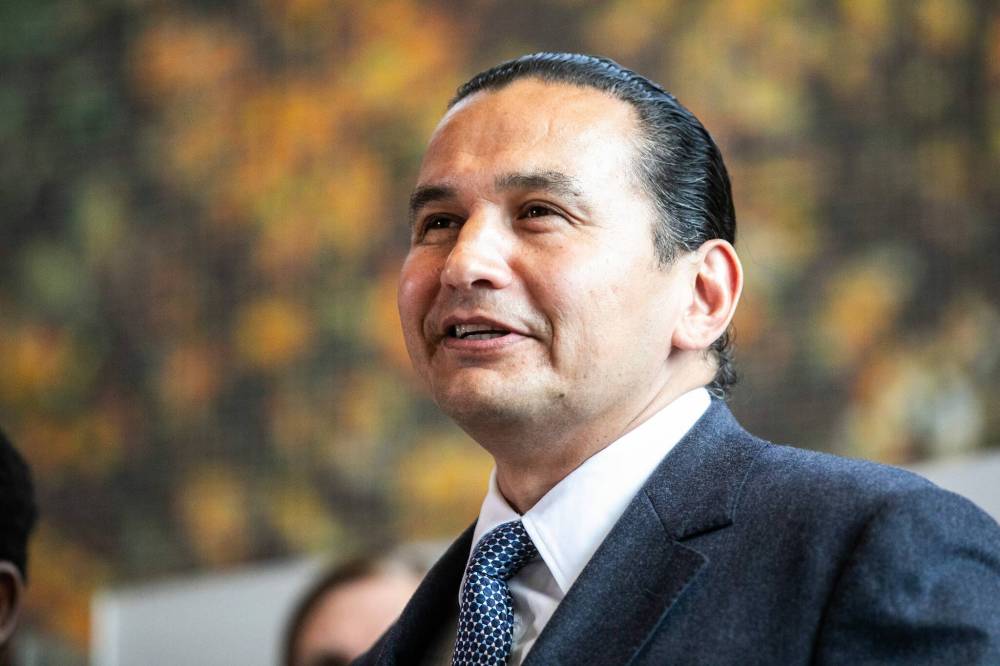
The province has added 4,725 net new health-care workers, Premier Wab Kinew told reporters on Tuesday. (Mikaela MacKenzie/Winnipeg Free Press)
Why all the grumpiness? Jason Linklater, president of the Manitoba Association of Health Care Professionals, probably said it best.
“The metric that matters is whether Manitobans wait less time for care tomorrow than they did yesterday,” he said.
Indeed.
The Kinew government’s good-news announcement is tempered with the knowledge that emergency department wait times remain stubbornly high. And it’s not just Manitoba; there isn’t a single province that can say it has achieved a lasting reduction in the amount of time it takes to get treatment at a hospital ER.
Despite massive increases in funding, the provinces are trapped in a doom loop of increased demand and acuity and health officials don’t necessarily know what to do about it.
Many provinces, including Manitoba, are attempting to deal with wait times in part by building more capacity in emergency medicine by adding or expanding new ERs and recruiting the staff needed to treat increasing numbers of patients.
Those are not the wrong things to be doing. But it appears that expanding ER capacity is not, on its own, going to reduce wait times. What will?
National health-care organizations, including the Canadian Medical Association and the Canadian Institute for Health Information, have consistently argued the real problem is the lack of downstream capacity for patients who no longer need emergency or hospital treatment but require some sort of ongoing, long-term care and oversight.
A June 2026 report published by CIHI noted that more patients — and more gravely ill patients — than ever before are showing up at ERs. However, the report noted that there are still “insufficient connected community resources, and little continuing and long-term care.”
The CIHI report makes it clear that a desperate shortage of hospital beds, personal-care home beds and home care means patients no longer needing emergency treatment are being warehoused in ERs, lengthening the wait times.
The Kinew government has done a lot of positive things on the health file since the 2023 election, but areas such as home care — generally considered to be a cost-effective way of helping people who are in hospitals but could be at home with a bit of support — have suffered from a lack of overall attention.
Kinew said his government has added more than 2,700 new home-care aides since 2023 and implemented a new centralized scheduling system to get more help to more people. Neither initiative seems to have improved the overall quantity or quality of home care.
A year ago, the MNU released a report indicating that the centralized scheduling was resulting in too many cancelled, delayed or ill-timed home-care visits. The Winnipeg Regional Health Authority substantiated those concerns by reporting that the number of scheduled appointments that were cancelled in 2025 had doubled from the previous year.
Nothing, including home care, is a fix-all for wait times. Long-term care beds and hospital palliative beds — both of which have received additional funding from the Kinew government — have to be part of a solution.
But home care has to be a priority.
Unfortunately, it’s an area that has been largely undervalued by governments because it’s not an insured service under the Canada Health Act. For reasons that are still hotly debated, the architects of universal health care did not view fully insured home care as a priority.
That means the provinces do not get additional money from Ottawa for home care via transfer payments. And that, many believe, has left home-based care as the poor cousin of the public health-care system. That reality is revealed quite graphically by data on how much the provinces spend on home and community care as a percentage of total health spending.
The exact numbers fluctuate year to year, but as a rule, most provinces spend about five per cent of their total health budgets on home and community care; long-term care facilities routinely consume more than 10 per cent of total spending, and hospitals receive 25 per cent or more.
It’s a distribution of resources that clearly has to change.
A massive expansion of home care would be difficult; finding qualified nurses and aides would be a challenge. That, however, doesn’t alter the fact that there is higher demand for home care that what is available. That should be a concern for all Manitobans, young and old.
One thing is clear: if the government simply continues to build more and bigger ERs and staff them with hundreds of doctors, nurses and support staff, we’re never going to get ahead of the wait-times problem.
» Dan Lett is a Winnipeg Free Press columnist.