
Knowing history — and not repeating it
Advertisement
Read this article for free:
or
Already have an account? Log in here »
We need your support!
Local journalism needs your support!
As we navigate through unprecedented times, our journalists are working harder than ever to bring you the latest local updates to keep you safe and informed.
Now, more than ever, we need your support.
Starting at $15.99 plus taxes every four weeks you can access your Brandon Sun online and full access to all content as it appears on our website.
Subscribe Nowor call circulation directly at (204) 727-0527.
Your pledge helps to ensure we provide the news that matters most to your community!
To continue reading, please subscribe:
Add Brandon Sun access to your Free Press subscription for only an additional
$1 for the first 4 weeks*
- Enjoy unlimited reading on brandonsun.com
- Read the Brandon Sun E-Edition, our digital replica newspaper
*Your next Free Press subscription payment will increase by $1.00 and you will be charged $20.95 plus GST for four weeks. After four weeks, your payment will increase to $24.95 plus GST every four weeks.
Read unlimited articles for free today:
or
Already have an account? Log in here »
Prime Minister Mark Carney summed up the current bilateral trade predicament nicely: “We cannot accept what they’ve offered, and we will not give what they’ve asked.”
Interestingly, there are many similarities between what happened in the fall of 1987 and the trade war happening today between Canada and the United States. It has the same feel to it. And some of the same concerns, for me.
Of course, it’s a very different era and environment today. The circumstances are also not the same. And then there’s U.S. President Donald Trump.
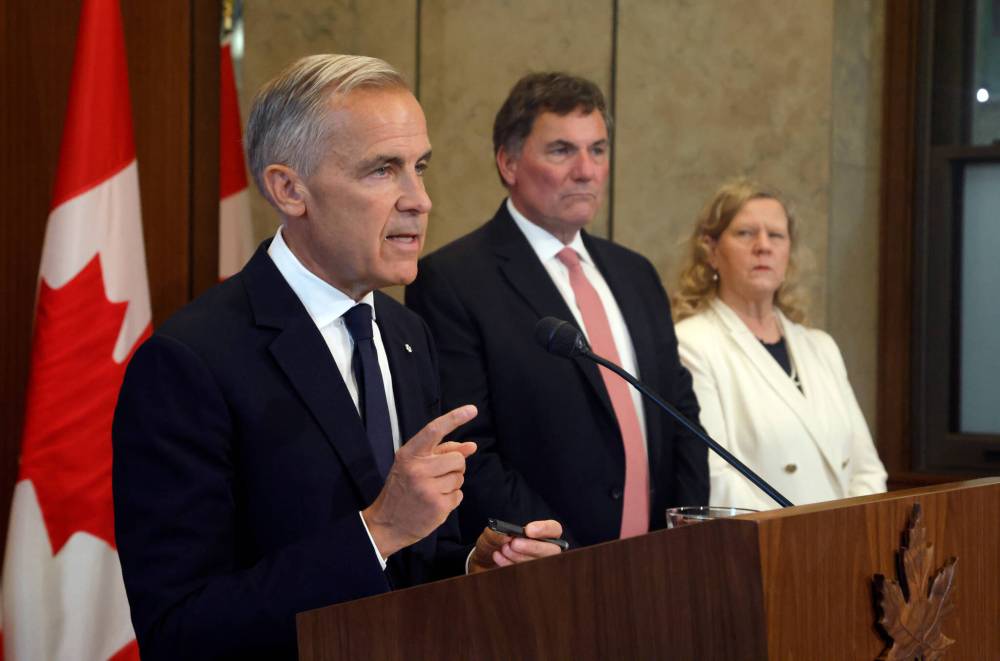
Prime Minister Mark Carney speaks about Canada’s response to new U.S. tariffs as Canada-U.S. Trade Minister Dominic LeBlanc and chief trade negotiator Janice Charette listen during a news conference on Parliament Hill in Ottawa on Aug. 22. (The Canadian Press files)
But I can’t help but wonder if the recent turn of events in Canada-U.S. trade relations will resemble those of October 1987. That’s when Canada chose to return to the free trade negotiations and eventually cobble together a deal with the Ronald Reagan administration.
Does that mean that a final trade agreement will eventually be hammered out between the two sides today? I don’t know for sure. But there’s a pretty good chance that it will if what happened in 1988 is any guide.
The intense bilateral negotiations of the mid-1980s — like those of the past couple of weeks — favoured the Americans because they knew that Canada wanted a bilateral free trade agreement (FTA) more than the U.S. did. And they milked that for whatever it was worth and got Canada to make a host of concessions up front on energy, foreign investment and cultural protections — not unlike what they did to the Carney government.
The Canadian side, just like the recent set of trade negotiations, had very little leverage at its disposal (or at least a willingness to use whatever purchase that it had) back in the 1980s. Clearly, the U.S. side was playing us over the last few months just like they did 40 years ago.
It is worth highlighting that the U.S. negotiating team, under the able leadership of Peter Murphy, had correctly predicted that the Canadians would make a big deal of Simon Reisman (Canada’s chief trade negotiator) publicly walking away from the bargaining table in late September 1987. They also rightly predicted that Canada was all hat and no cattle — that it was little more than a PR stunt and a feeble bluff. They saw Reisman’s move coming a mile away and simply waited patiently knowing that the Canadians would come crawling back to the trade negotiations.
When Brian Mulroney’s Progressive Conservative government did return to the negotiations, there was some positive movement on the U.S. side. But it was very minimal, in my view. And, at the very last minute, just before U.S. trade negotiating authority was about to expire, the Americans grudgingly agreed to a less than adequate dispute-settlement mechanism.
It was not, however, the holy grail that Mulroney had promised the Canadian public — namely, a means of circumventing harmful U.S. trade remedy protections (i.e., countervailing duties and safeguard provisions) and thus “secure access” to the U.S. marketplace.
Basically, the binding dispute settlement panels would have to base their administrative rulings on U.S. and Canadian trade law. And that is precisely why Canada is in the mess that it finds itself today — having to contend with Sections 232, 338 and 301 of U.S. trade law.
It is instructive to note that the only reason Canada was able to get even a flawed dispute settlement regime was because the Americans had a free trader in the White House. More importantly, Mulroney’s close personal relationship with President Reagan was utilized to secure those bilateral trade panels.
Still, it wasn’t the best deal for Canada, when you consider all the gains and losses of the FTA negotiations.
Carney’s government shouldn’t make the same mistake that Mulroney made back in 1987. He simply wasn’t prepared to play hardball with the U.S. by withholding access to Canada’s natural resources as the club to extract concessions from our American friends.
I believe that Canada would have been in a much stronger bargaining position today if we had brought out the heavy artillery or the “nuclear option” 18 months ago.
Right now, the Americans don’t take us seriously, believe that we can be pushed around, and that the Carney Liberals are ripe for the picking (over and over again).
Whether through product restrictions, an export tax or even an outright embargo, we have to threaten (at least temporarily) cutting off Canadian exports of oil and gas, potash, critical minerals and electricity to the U.S.
It’s the only thing that Trump understands and respects.
I’m convinced that the U.S. strategy today, like it was in the late 1980s, will be to sit tight (and undoubtedly to tighten the screws), let the Canadians stew and dither (while they conclude a trade pact with Mexico), and wait for Carney to signal his intentions to resume negotiations.
That, of course, would be a huge mistake without first arming ourselves with the nuclear deterrence mentioned above.
Oh, how I wish that we had a Reagan-like U.S. president occupying the Oval Office today.
Wishful thinking, I’m afraid.
» Peter McKenna is professor of political science at the University of Prince Edward Island in Charlottetown. This column firts appeared in the Winnipeg Free Press.