
Wab Kinew as ‘communicator in chief’
Advertisement
Read this article for free:
or
Already have an account? Log in here »
We need your support!
Local journalism needs your support!
As we navigate through unprecedented times, our journalists are working harder than ever to bring you the latest local updates to keep you safe and informed.
Now, more than ever, we need your support.
Starting at $15.99 plus taxes every four weeks you can access your Brandon Sun online and full access to all content as it appears on our website.
Subscribe Nowor call circulation directly at (204) 727-0527.
Your pledge helps to ensure we provide the news that matters most to your community!
To continue reading, please subscribe:
Add Brandon Sun access to your Free Press subscription for only an additional
$1 for the first 4 weeks*
- Enjoy unlimited reading on brandonsun.com
- Read the Brandon Sun E-Edition, our digital replica newspaper
*Your next Free Press subscription payment will increase by $1.00 and you will be charged $20.95 plus GST for four weeks. After four weeks, your payment will increase to $24.95 plus GST every four weeks.
Read unlimited articles for free today:
or
Already have an account? Log in here »
Premier Wab Kinew and his party have been riding high in the polls longer than normal for a government one year or less away from its first re-election contest. One reason is his ubiquitous, dominating communications presence as NDP leader and premier.
The argument here is that Kinew has supplemented his prerogatives as premier and party leader (such as appointing cabinet ministers and approving party nominations) with the skillful use of communications to advance his policy agenda, boost his personal popularity and maintain the competitive advantage of his party over the opposition Progressive Conservatives.
Communications has always been a significant part of politics and policy making. However, in the contemporary political and media environments, communications considerations have moved from the background to the foreground of decision-making by political parties, including when they are performing in the role of government. Campaigning and governing now overlap in what has been described as a permanent election campaign.
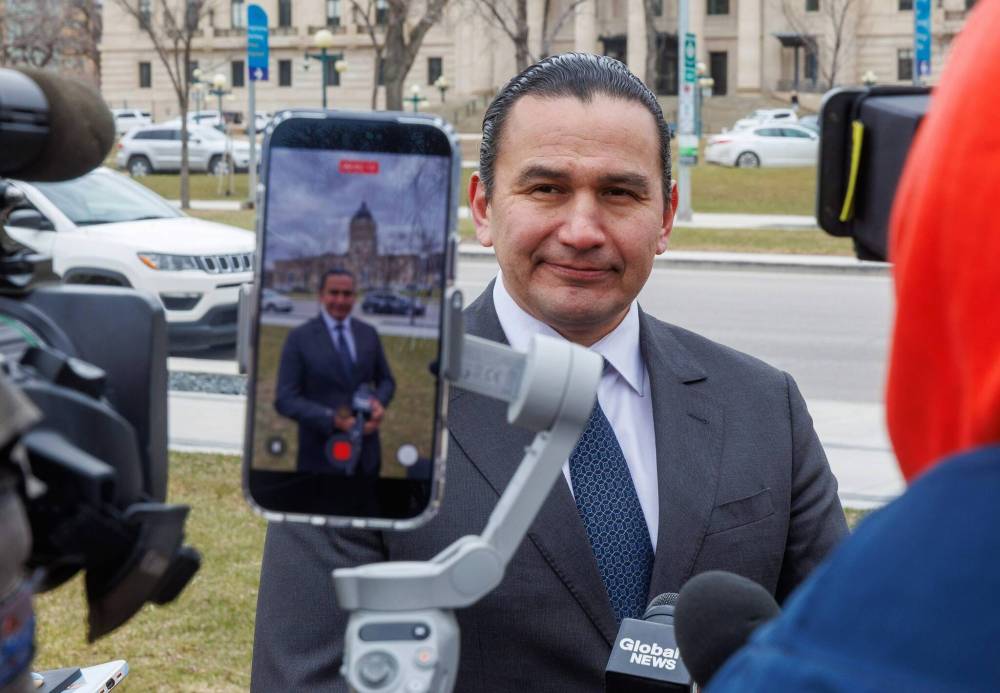
Premier Wab Kinew’s social media staff use an iPhone to capture his scrum with the media after speaking at the National Day of Mourning event at the Workers Memorial in Memorial Park in April . (Mike Deal/Winnipeg Free Press files)
Political parties use communications strategies for several purposes: to establish an image of the leader which makes a positive emotional connection with voters; to promote a coherent message and to keep party members on message; and to gain favourable media coverage for its policies and other actions on almost a daily basis.
Traditional media focus mainly on the statements, actions, personality traits, and operating styles of party leaders. As a result, for many people the image of the leader becomes the personification of a party and of a government.
In delivering speeches, interacting with advocacy groups, and dealing with the media, premiers have the freedom to make policy pronouncements on behalf of governments. Cabinet ministers and the public service are then expected to translate those pronouncements into practice.
Communications by premiers can be contested. There can be disagreements within cabinet and caucus over policy directions and responses to breaking news. However, efforts are always made to ensure that the governing party presents a unified image to the outside world. This is done through a strong emphasis on “team play,” the use of rewards or penalties to encourage party solidarity and reliance on secrecy to prevent disclosure of internal debates.
The leader of the official opposition, together with the designated critics in what is called the shadow cabinet, will challenge the actions and inactions of the premier and the government. However, the opposition operates under a number of constraints, including the inability to actually initiate policies and to command comparable media attention.
The media can be a resource as well as a critic for a premier. Skillful use of the legacy and social media provide opportunities to identify concerns, define issues, shape public opinion and help to advance a policy agenda. There can also be hidden attempts to influence the media, such as leaks, “floating trial balloons” and spinning information.
Not all leaders have a strong aptitude for media relations and wider communications activities. Some are naturally gifted and their skills have been refined through experience.
Wab Kinew stands out in this regard. He is in some ways a non-traditional politician, who has nevertheless demonstrated the judgment and skills needed to succeed in the tough, often nasty world of contemporary politics.
His character and philosophy have been shaped by Indigenous spirituality in his upbringing. A troubled period during his young adult years brought ambition, focus and discipline. Experience as a musician, broadcaster, and author enabled him to refine his innate communications talents.
Kinew is clearly an intelligent person who exhibits a good grasp of complex issues. Yet he does not talk “over the heads” of general audiences. He knows the value of a vivid phrase. A sense of humour and a beaming smile convey an image of a “happy warrior” who is undaunted by difficult circumstances. He makes extensive use of social media. He is fluent in English, French and Ojibwe.
Kinew recognizes that communication is a two-way process. Early in his term, he undertook with his health minister a “listening tour” with the health community. His government has made use of EngageMB for online consultations on several topics. He has demonstrated good instincts in terms of reading and responding to varied situations, issues and audiences.
Kinew knows the importance of “occasion,” those defining moments in public life when fundamental values are at stake. Eloquence in such moments enables him to make a strong emotional connection with audiences of varied backgrounds.
Kinew is also capable of bringing people together around a shared purpose. He became party leader after a high-profile fight over leadership and ideology that deepened the political setback for the NDP in the 2016 election.
To some extent he redefined the image of the party as less stringently left wing and more pragmatic.
As premier he has a relatively small communications staff. His communications do not seem “manufactured” to serve PR purposes. When a minister has struggled with an issue, he has stepped in to limit damage to the government’s reputation.
He relies on polls, does not get too far ahead of public opinion, but is also prepared on occasion to take political risks. For example, he acted courageously when calling for a landfill search for missing Indigenous women at a time when the PC government claimed it was dangerous, too expensive and likely to be futile.
In summary, through the presentation of himself and his ideas, he is capable of demonstrating such highly prized leadership attributes as honesty, authenticity, empathy, compassion, judgment, credibility and courage.
Partisan competition depends significantly on contrasts between leaders. Kinew and his party have clearly benefited from the divisions within the PC party and the seeming inability of its leader Obby Kahn to make a strong connection with regular voters.
Kahn and other critics accuse Kinew making bold promises and failing to deliver, especially on health-care reform. The premier has also been criticized for being at times excessively defensive, combative and disrespectful towards his political opponents, the media and other critics.
Such criticisms have not damaged Kinew’s reputation.
With a 63 per cent approval rating in a September 2026 poll, he stood first among premiers, none of whom reached 50 per cent approval. Factors beyond communications account for his top standing, but his considerable communications skills must be part of the explanation for why he and his party seem headed for certain victory in the next election.
» Paul G. Thomas is professor emeritus of Political Studies at the University of Manitoba. This column was originally published in the Winnipeg Free Press.