
Manitoba suffragists won the vote for women
Advertisement
Read this article for free:
or
Already have an account? Log in here »
We need your support!
Local journalism needs your support!
As we navigate through unprecedented times, our journalists are working harder than ever to bring you the latest local updates to keep you safe and informed.
Now, more than ever, we need your support.
Starting at $15.99 plus taxes every four weeks you can access your Brandon Sun online and full access to all content as it appears on our website.
Subscribe Nowor call circulation directly at (204) 727-0527.
Your pledge helps to ensure we provide the news that matters most to your community!
To continue reading, please subscribe:
Add Brandon Sun access to your Free Press subscription for only an additional
$1 for the first 4 weeks*
- Enjoy unlimited reading on brandonsun.com
- Read the Brandon Sun E-Edition, our digital replica newspaper
*Your next Free Press subscription payment will increase by $1.00 and you will be charged $20.95 plus GST for four weeks. After four weeks, your payment will increase to $24.95 plus GST every four weeks.
Read unlimited articles for free today:
or
Already have an account? Log in here »
An informative new book about a leading early Manitoba feminist illustrates the challenge of describing and remembering the fight for women’s rights. The book, by Canadian law professor and historian Robert E. Hawkins, is “She Won the Vote for Women: The Life and Times of Lillian Beynon Thomas.”
Lillian Beynon was born in Ontario in 1874. As a teenager she moved with her family to the Hartney area of Westman. She became a teacher and taught in rural schools like Lauder and Chain Lakes before locating in 1906 to Winnipeg to work as a journalist. She became the women’s page editor at the Manitoba Free Press, covering topics from homemaking hints to larger social and political questions.
A letter from a reader alerted Beynon to the lack of a dower law in Manitoba. Such a law protects a wife from losing her interest in the family home if it were sold by her husband. Beynon became involved in a campaign to enact a dower law. That initiative’s failure convinced Beynon that women needed the vote to bring about change.
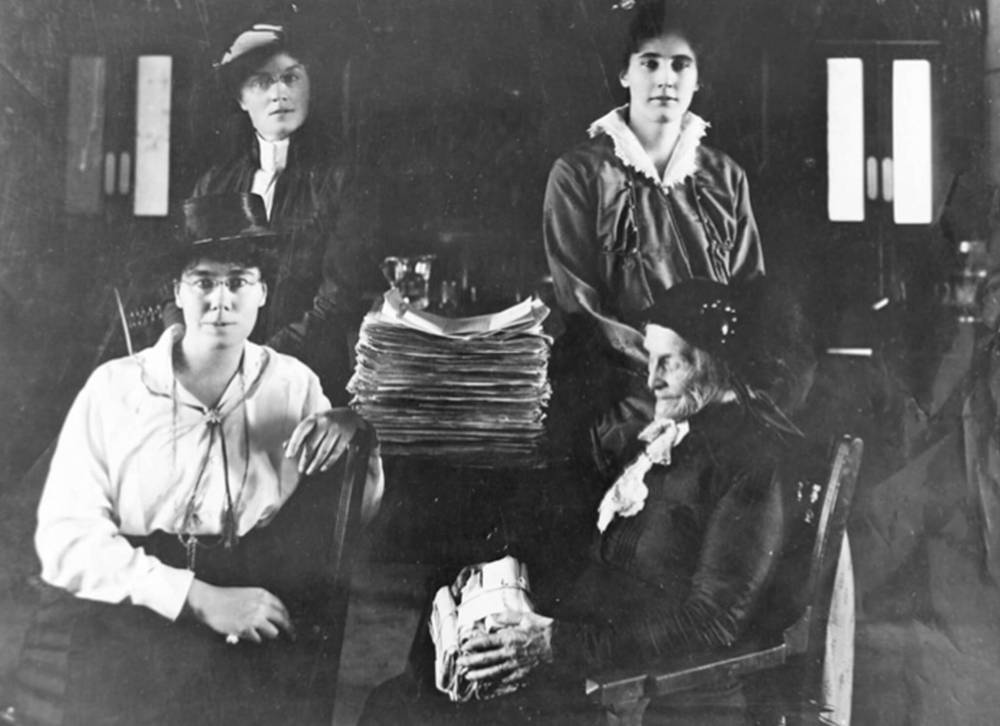
A photo taken December 23, 1915 of the presentation of the final petition for women’s suffrage by the Political Equality League. The four women pictured are Lillian Beynon Thomas (top left), Winona Dixon (top right), Dr. Mary Crawford (bottom left) and Amelia Burritt. Beynon Thomas is the focus of a book recommended David McConkey. (Archives of Manitoba)
In 1911, Beynon, 37, married Free Press colleague, journalist Vernon Thomas. Thereafter, she used the name Beynon Thomas. The couple did not have any children.
Along with her husband and a few others, Beynon Thomas organized the Political Equality League in 1912. The goal was women’s suffrage; their campaign was an astounding success. In 1916, Manitoba became the first jurisdiction in Canada where women gained the right to vote.
By 1917, Beynon Thomas and her husband experienced problems arising from their opposition to the First World War. They found refuge and work in New York City.
In the early 1920s, they returned to Winnipeg. Beynon Thomas withdrew from journalism and political action to concentrate on creative writing. She wrote a novel, plays, short stories and radio and TV dramas. She died in 1961 at 87.
Author Hawkins does a good job penning a biography of Beynon Thomas and chronicling the campaign that won the vote for women. The book is available at the Brandon Public Library. But the book has limitations, showing the difficulty recounting the struggle for women’s rights.
Here’s an example. The WCTU was an important component of the suffrage movement. The initials WCTU stand for the Woman’s Christian Temperance Union. But whenever using the full name, Hawkins mistakenly writes “Women’s.” It’s a minor error, but surprising for a law professor composing an authoritative biography.
A larger concern: should Beynon Thomas and her fellow feminists be called suffragists or suffragettes? Although the distinction is blurred today, at the time they called themselves suffragists. In contrast, the term suffragette was used by British campaigners and it implied radical — even violent — action. Canadian feminists rejected violence and employed persuasion, humour and citizen engagement.
Yes, humour. Great fun and great success was had in “A Women’s Parliament,” a performance staged in 1914 in Winnipeg and Brandon. The play portrayed a legislature run by women debating whether men should be allowed to vote. Beynon Thomas conceived and produced it; Nellie McClung starred in it as the female premier pooh-poohing the idea of men voting.
By their tactics and their laughter we should call them suffragists. So, it is annoying that Hawkins continually writes “suffragette.” The same faux pas is repeated in a review of the book in the Manitoba Historical Society’s journal Prairie History.
But what about an article titled “Reminiscences of a Manitoba Suffragette,” which Beynon Thomas wrote for the Manitoba Historical Society in 1959? But she did not use the word “suffrage” or any related word in the article itself. Because an editor often writes titles, “Suffragette” was likely the wording of an editor, not Beynon Thomas.
Hawkins concludes that despite her remarkable accomplishments, Beynon Thomas “has been almost completely overlooked by history.” This is a “significant gap in the history of the campaign to win the vote for women.”
The author points out that Beynon Thomas is not remembered today like McClung: neither in popular recollection nor by a statue on the grounds of the Manitoba Legislative Building. Hawkins addresses this discrepancy by recognizing Beynon Thomas as the key strategist of the suffrage campaign.
Recalling McClung reminds us of something of special interest to those of us in Westman. Two of the leading feminists of the time — Beynon Thomas and McClung — had roots in southwestern Manitoba. (Also: Francis Marion Beynon and Jessie Turnbull McEwen, along with, locally, Aleta Clement.)
The struggles and successes of early women’s rights campaigners can be hard to describe and for us to remember. But the lives of those often-forgotten feminists have much to say to us today. A good book exploring this issue is “She Won the Vote for Women.”