
A tale of two conversations
Advertisement
Read this article for free:
or
Already have an account? Log in here »
We need your support!
Local journalism needs your support!
As we navigate through unprecedented times, our journalists are working harder than ever to bring you the latest local updates to keep you safe and informed.
Now, more than ever, we need your support.
Starting at $15.99 plus taxes every four weeks you can access your Brandon Sun online and full access to all content as it appears on our website.
Subscribe Nowor call circulation directly at (204) 727-0527.
Your pledge helps to ensure we provide the news that matters most to your community!
To continue reading, please subscribe:
Add Brandon Sun access to your Free Press subscription for only an additional
$1 for the first 4 weeks*
- Enjoy unlimited reading on brandonsun.com
- Read the Brandon Sun E-Edition, our digital replica newspaper
*Your next Free Press subscription payment will increase by $1.00 and you will be charged $20.95 plus GST for four weeks. After four weeks, your payment will increase to $24.95 plus GST every four weeks.
Read unlimited articles for free today:
or
Already have an account? Log in here »
Brandon’s municipal election is being fought over vibrancy, communication and planning. None of those things will keep water out of a basement.
The public record tells a different story than the campaign does. FIPPA responses, work orders, council minutes and the city’s own financial reports point to a city that has been deferring the cost of its infrastructure for decades — and to a drainage system its own consultants said was over capacity.
Start with the city’s own 2023 Sustainable Funding Model report. MNP found that Brandon’s property-tax rates were, on average, 47 per cent below those of five comparable Canadian municipalities: Fredericton, N.B., Grande Prairie, Alta., Medicine Hat, Alta., North Bay, Ont., and Prince Albert, Sask. Brandon’s cumulative property-tax increase since 2017 was 3.9 per cent, compared with 13.8 per cent among those municipalities.
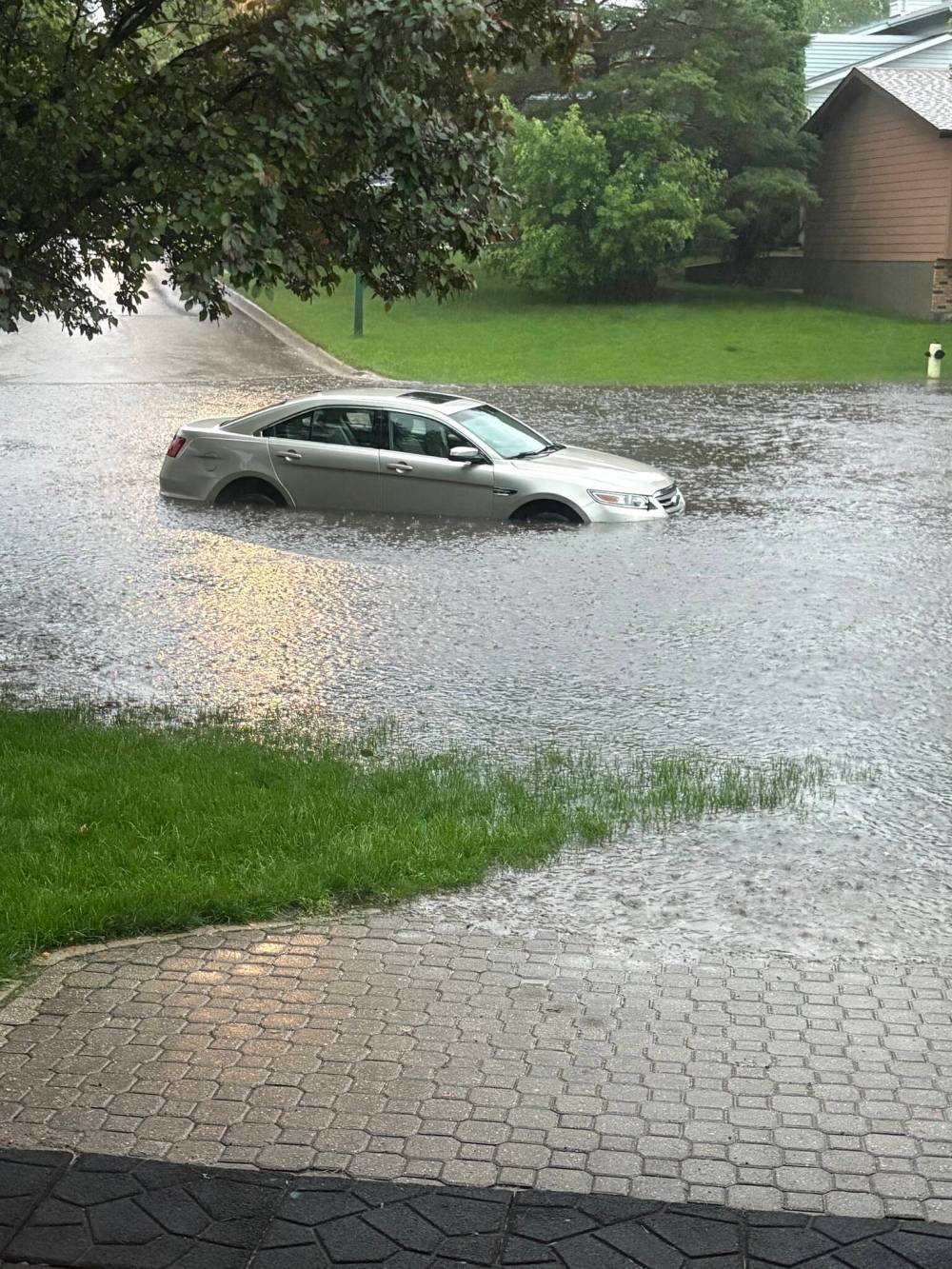
A vehicle owned by Dwayne Stone’s son is partially engulfed by flooding in the Lynx Crescent area during a major storm in late June. Chris Komarnicki writes that the city’s infrastructure issues have developed over decades. (Supplied)
MNP identified a significant infrastructure investment requirement and projected substantial pressure on the city’s reserves. The report offered two ways to fund the city’s own $680-million capital plan. The first required property-tax increases of roughly 13 per cent annually through 2027, then about three per cent annually through 2033. The second kept increases lower by deferring capital projects, with reserves projected to decline to roughly $7 million by 2029.
The city then followed neither. It approved 9.4 per cent in 2024 and 6.9 per cent in 2025, each time below what the report said was needed, with provincial grants and one-time surplus draws helping to bridge the gap. In 2026, council cut the proposed 10.6 per cent increase to 6.7 per cent using another $1 million from the province and $1 million from surplus. Coun. Kris Desjarlais (Ward 2) said in 2025 that council had already focused on infrastructure growth over asset management. The mayor now calls the MNP report “a guideline rather than a fixed plan.”
The deferral was not a compromise. It was a choice to fund the city’s own plan on a slower timeline and rely on provincial funding and municipal reserves to help cover the difference — a path slower than the slowest option MNP presented, sustained by one-time money rather than the tax increases the report said were needed. Former city manager Ron Bowles described the situation plainly: “After many years of the city choosing to keep taxes low, we’re in a tight spot.” He also identified infrastructure pressures associated with climate change, including the capacity of Brandon’s storm drainage system.
The question now is what those increases have produced in infrastructure capacity and maintenance. June 29, 2026 provides a useful test. Brandon received 80.9 millimetres of rain at the municipal airport that day, including 78.3 millimetres in approximately three hours, according to Environment and Climate Change Canada’s historical data. The city reported localized overland flooding and subsequently requested Disaster Financial Assistance from the Manitoba government.
The significance of the storm goes beyond the damage it caused. Extreme rainfall events test the assumptions used to design drainage infrastructure: rainfall intensity, duration, runoff, storage capacity and acceptable levels of risk. That makes the timing particularly important.
Brandon is already revisiting those engineering assumptions. In December 2025, the city released draft municipal servicing standards to inform municipal engineering design throughout 2026. Formal adoption is anticipated in the first quarter of 2027. The draft land-drainage standard specifically addresses design rainfall, including intensity-duration-frequency data and design rainstorms. It sets out the methodology by which stormwater systems are to be designed and evaluated. So the June storm arrived while Brandon was already revisiting the standards that determine how its drainage infrastructure is designed. That raises a basic question: Does the rainfall Brandon experienced in June 2026 change the engineering benchmark the city should be designing for, and what existing infrastructure needs to be reassessed as a result?
The question matters because the city’s drainage system is already the subject of a major multi-year reconstruction program. The Southeast Brandon Drainage Improvements Project identifies deficiencies in the existing drainage network. City documents describe inadequate capacity in parts of the system and risks associated with overland flooding, including the potential for water to enter the wastewater system.
The project involves new land-drainage sewers and stormwater retention ponds and has been divided into multiple phases. Phase 3 includes another stormwater pond and land-drainage sewers. One component is the naturalized stormwater pond east of the Brandon Municipal Cemetery. Construction began in late 2025. The project is intended to address flooding problems around Sycamore Drive and 18th Street, with completion expected in October 2026. The tender price was approximately $4.55 million. The Cemetery Pond was designed in accordance with the city’s naturalized stormwater pond guidelines, which were developed in 2018, seven years before the current servicing standards review.
The issue also extends into routine maintenance. The city’s 2025 stormwater budget allocated $182,500 for repairs and operations and maintenance, along with another $200,000 for drainage-area cleanup. Residents have been raising drainage concerns for years. In July 2020, residents of Linden Lanes appeared before council regarding drainage problems involving the Willowdale ditch and surrounding infrastructure.
Coun. Shawn Berry (Ward 7) subsequently reported that the area had not been cleaned up. He referred to an uncleared culvert at 26th Street, vegetation at the culvert ends and grass that required cutting. He said residents and he had requested the work numerous times. The issue continued into 2022. A ward meeting concerning the ditch was described as heated, and residents said the last proper dredging had occurred in 2012.
Then came the June 2026 storm. Dwayne Stone, a Lynx Crescent resident, told The Brandon Sun that water reached approximately three feet in the area within 10 minutes. He said his family had lived there for eight years and had experienced approximately $40,000 in basement damage during an earlier flood. He said he had been seeking action from the city to address the drainage problem. City director of engineering services Kyle Winters acknowledged the area was a concern. He said it was “maybe not as high of a priority at this time as some of the other drainage issues that the city has.”
Municipal governments have to prioritize infrastructure. The question is how those priorities are established, how known deficiencies are tracked and how residents can determine when an identified problem has been addressed. Section 294.1 of Manitoba’s Municipal Act defines a municipal drain broadly. It includes a culvert, drain, drainage ditch, dike or floodway constructed or maintained by a municipality. Subsection 294.1(3) states: “A municipality must maintain every drain within its boundaries to a standard that is appropriate for the use to which the municipality expects the drain to be put.” That is a statutory obligation.
The FIPPA records I have reviewed raise questions about whether the city is meeting that obligation in some locations. The records indicate that searches for ditch-maintenance records from 2020 through 2026 did not produce records responsive to the request. Work orders submitted on April 10, 2026, concerning gravel removal and drainage obstructions remained incomplete. An April 16 work-ticket note states: “Culvert end open but buried below ditch ground level; will not flow properly.”
These records require careful interpretation. The absence of records does not establish that no maintenance occurred. An incomplete work order does not establish that the entire drainage system was inadequately maintained. The records do establish that specific drainage deficiencies were identified and that at least some requested work remained outstanding. That creates a legitimate question about the city’s compliance with the maintenance standard established by the Municipal Act.
There is another important piece of context for this election. Both mayoral candidates — incumbent Jeff Fawcett and challenger Len Isleifson — have experience inside Brandon’s municipal government. Both men have therefore sat at the council table during the past 25 years.
For both candidates, I think the election ultimately comes down to three questions: First: What does “fiscal stability” mean if Brandon is still carrying a major infrastructure deficit and residents are still experiencing drainage failures? Second: Does the June 2026 rainfall event change the engineering standard Brandon should now design for, and what does that mean for infrastructure already in the ground? Third: How will the next mayor ensure that the city’s existing drainage infrastructure is actually maintained to the standard required by law?
Brandon’s infrastructure problem did not begin with the 2026 election. It has developed over decades. The MNP report documented the financial side of that history. The city’s drainage plans document the engineering side. Residents have documented the consequences at street level. The June 2026 storm demonstrated what happens when an extreme rainfall event meets an infrastructure system that the city already acknowledges requires major investment. At the same time, Brandon is revising the engineering standards that will govern future municipal infrastructure.
The municipal election is Oct. 28. Fawcett and Isleifson have both spent time inside the system they are now asking voters to entrust with the city’s future. The campaign is talking about vibrancy, communication and planning. The city’s own records are talking about reserves, drainage capacity, infrastructure projects, maintenance obligations and flood risk. I think Brandon voters deserve to hear the candidates address the gap between those two conversations.
» Chris Komarnicki is a former military administrator, now a concerned citizen and local welder.