
The new normal in Canadian politics
Advertisement
Read this article for free:
or
Already have an account? Log in here »
We need your support!
Local journalism needs your support!
As we navigate through unprecedented times, our journalists are working harder than ever to bring you the latest local updates to keep you safe and informed.
Now, more than ever, we need your support.
Starting at $15.99 plus taxes every four weeks you can access your Brandon Sun online and full access to all content as it appears on our website.
Subscribe Nowor call circulation directly at (204) 727-0527.
Your pledge helps to ensure we provide the news that matters most to your community!
To continue reading, please subscribe:
Add Brandon Sun access to your Free Press subscription for only an additional
$1 for the first 4 weeks*
- Enjoy unlimited reading on brandonsun.com
- Read the Brandon Sun E-Edition, our digital replica newspaper
*Your next Free Press subscription payment will increase by $1.00 and you will be charged $20.95 plus GST for four weeks. After four weeks, your payment will increase to $24.95 plus GST every four weeks.
Read unlimited articles for free today:
or
Already have an account? Log in here »
“Nothing happening, all at once.”
Welcome to the new normal of Canadian politics, where normality is the new normal. Routine and stable are in; disruptive and excessive are out. Exhibits A and B are the Alberta referendum and the British Columbia election. Voters opted for stability over volatility.
The opposite of being normal is being different from the norm. In politics that means different from where we’ve been and what we’ve come to expect. Two competing trends have dominated our politics for the past decade and a half — progressivism and populism. Think Justin Trudeau and liberal, progressive identity politics in Canada, and Donald Trump and conservative, populist MAGA politics in America. We are now experiencing a swing away from both those trends.
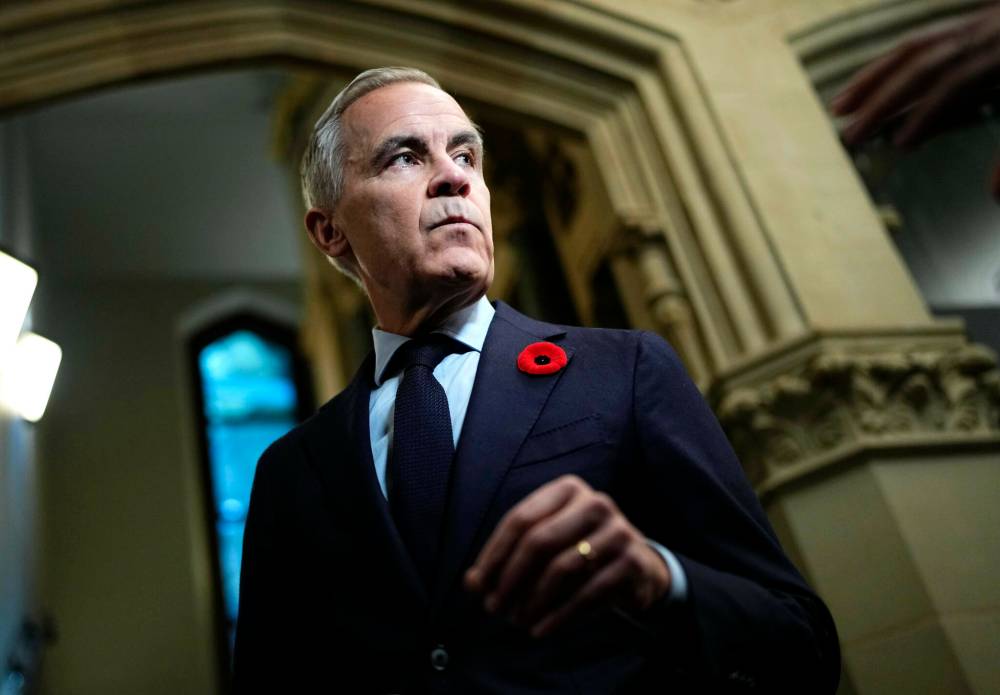
Prime Minister Mark Carney speaks before a meeting of the Liberal caucus on Parliament Hill in Ottawa, on Wednesday. Prime Minister Mark Carney is Exhibit C (for Carney) of today’s “new normal.” (The Canadian Press)
Representing this “new normal” are Prime Minister Mark Carney, for one, and newly elected British Columbia premier, Lorne Doerksen, for another. Both are considered normal because they talk and act like adults in a childish political world. Their political flair is to not have any political flair. They stand out for not standing out.
Representing the “old normal” are Conservative leader Pierre Poilievre and Alberta premier Danielle Smith. Once ascendant, today’s moment finds them in active political decline. It’s not their political personalities necessarily being rejected (although Poilievre tries hard), it’s their political approaches. Too often loud and too often divisive for voters’ senses and sensibilities. Their version of common sense comes across as nonsense to those uninitiated in the code or cult of true believers. Fewer voters are listening.
Justin Trudeau found out what happens when that happens.
Though he’s already been mentioned, the largest exhibit for normality is Exhibit C, for Carney. It manifests itself in the persistent popularity of the prime minister and approval of his political approach. He has blanketed the country with a reassuring style, tone, and focus. He has a serious mien to him, rather than seriously mean to others. Canada would likely have won the Alberta independence referendum without Carney as prime minister. But with him, the country won bigger.
The contradiction in all this is obvious. Trends end. Pendulums swing. Normal becomes old and out-of-date at some point. Which means it can and will change in the future, harnessed perhaps by forces and personalities not yet known. When it does, our lived political experiences will change with it.
There’s a power to normality that defies political gravity because it is the real political gravity. We seek normality because the cost and stress of continual disruption of what we have come to know and accept is too much to constantly bear.
This is not a left-right thing. It is a human thing. Many Alberta separatists expressed frustration with “how things had become” and longed for “what once was.” Their disruptiveness was based on a “return to normality.” Trouble is, normality is all in the eye of the beholder.
There is no golden rule that things will automatically return to how it was before. The pandemic taught us that. The lingering lesions that scarred society are visible in our polarized politics, fed by institutional distrust and rampant misinformation. Wounds were opened that remain salted, not sutured.
Craving normality is understandable in the wake of COVID, Trump and Trudeau. Add AI, inflation and war and you quickly realize that in a world of incipient change, normality is not guaranteed.
We cannot embed normality in our politicians. But we can embed it in our democratic institutions and governance. They must become the bastions of normality in turbulent times. That means reliable and responsive, competent and predictable. Peace, order and good government, anyone?
Boring, sure, bland, definitely. But if our institutions become cockpits of chaos, we are lost. If they remain or, better still, improve as mainstays of the civic norms and behaviour exhibited by most of us and demanded by all of us, then Canada can navigate through the turbulence and come out ahead.
Canadian sovereignty, national security and economic resilience are today’s big needs. We know what needs to be done, not yet how it is to be done. This gap between the “what” and “how” is the difference between success and failure. Given the stakes, as the saying goes, failure is not an option. But the hard, heavy work of succeeding is nowhere near done. Our governing institutions are not fit-for-purpose even as we confront a moment of clear purpose.
Better government performance with faster execution of projects, and better delivery of services is the most important example of normality we can have right now. Once in place, that must become an ongoing, expected and demanded standard of normality for citizens and taxpayers.
Now that’s “new normal” worth creating and holding onto. Especially when the next “new normal” comes at us. As it will.
» David McLaughlin is a former clerk of the executive council and cabinet secretary in the Manitoba government.