
Poilievre still not ready for prime time
Advertisement
Read this article for free:
or
Already have an account? Log in here »
We need your support!
Local journalism needs your support!
As we navigate through unprecedented times, our journalists are working harder than ever to bring you the latest local updates to keep you safe and informed.
Now, more than ever, we need your support.
Starting at $15.99 plus taxes every four weeks you can access your Brandon Sun online and full access to all content as it appears on our website.
Subscribe Nowor call circulation directly at (204) 727-0527.
Your pledge helps to ensure we provide the news that matters most to your community!
To continue reading, please subscribe:
Add Brandon Sun access to your Free Press subscription for only an additional
$1 for the first 4 weeks*
- Enjoy unlimited reading on brandonsun.com
- Read the Brandon Sun E-Edition, our digital replica newspaper
*Your next Free Press subscription payment will increase by $1.00 and you will be charged $20.95 plus GST for four weeks. After four weeks, your payment will increase to $24.95 plus GST every four weeks.
Read unlimited articles for free today:
or
Already have an account? Log in here »
If Pierre Poilievre thinks a Democratic takeover of the U.S. Congress suddenly gives Canada the upper hand in negotiating a tariff-free trade deal with Donald Trump, he might want to spend a little more time understanding how American politics actually works before aspiring to run this country.
The leader of the Conservative Party of Canada’s reaction to the Democrats’ stunning midterm election victory this week is another example of why he continues to look more like a campaign politician than a prime minister in waiting.
American voters delivered a humiliating rebuke to Trump and his economic policies, including his damaging tariff regime. Democrats have taken control of both the Senate and House of Representatives. That’s a significant political development and it could eventually create new opportunities for Canada.
But it doesn’t suddenly change the balance of power in Canada’s trade negotiations with Washington.
Canada doesn’t negotiate trade agreements with American voters. It negotiates with the U.S. government. And Trump remains president, with two more years in office and considerable executive powers that he has already demonstrated he’s willing to use against Canada.
That’s a rather important distinction Poilievre seems to have missed.
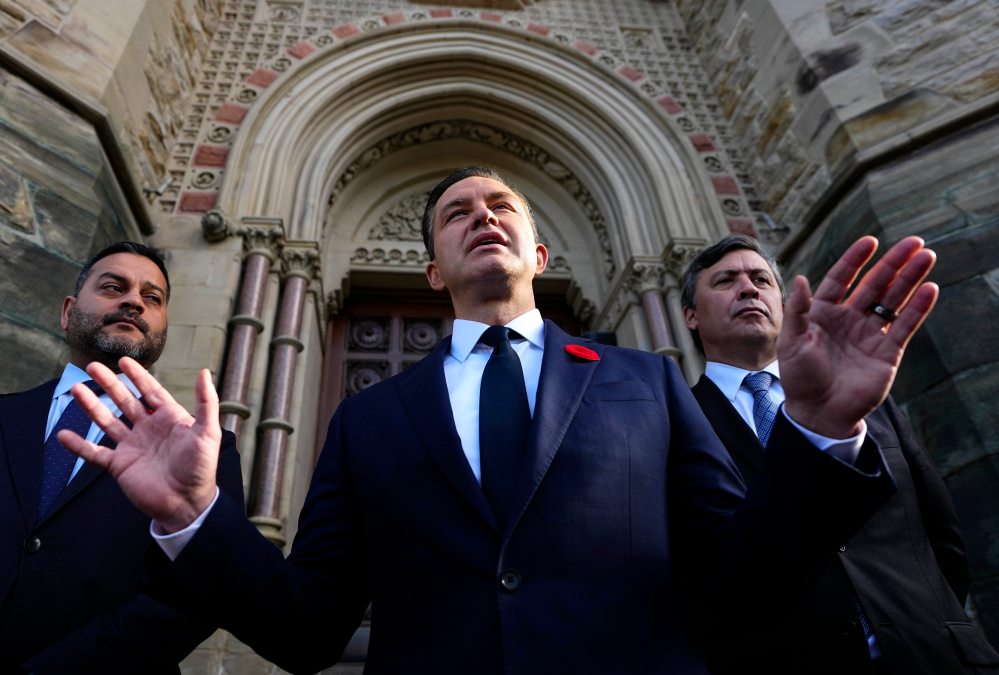
The Conservative leader said Canada should leverage the goodwill of American voters to pressure the Trump administration and Congress into removing all tariffs.
“Americans hate these tariffs,” he said.
Well, yes. Many Americans do. The election results suggest Trump’s trade policies have become a serious liability for his party.
But it’s not the only reason Republicans lost control of Congress. There was also the war in Iran, high fuel and grocery prices, widespread corruption in the White House and Trump’s violent crackdown on immigrants.
American voters, including in traditional Republican states such as Texas and Kansas, stood up and said “enough.”
Trade Minister Dominic LeBlanc offered a more sensible response, correctly pointing out that Canada’s trade negotiations are taking place with Trump and his cabinet, not the incoming Congress.
“They remain in office today,” said LeBlanc. “And those are the people with whom we’ll be having those conversations.”
The Democrats won’t take control of the new Congress until January. And even when they do, Trump will retain significant authority over trade policy.
He has already used executive powers multiple times to impose tariffs on Canadian products, including steel, aluminum and automobiles, without needing congressional approval.
A Democratic majority doesn’t take those powers away.
Congress can challenge the president, scrutinize his policies, investigate past abuses and even pass legislation to roll back tariffs. But Trump can veto that legislation.
Trump still controls the White House. He still controls his administration. And he still has the ability to make Canadian businesses and workers pay a steep economic price if he doesn’t get what he wants.
In fact, there’s a reasonable argument to be made that Trump’s political vulnerability could make his behaviour even more erratic. A president as unstable and unpredictable as Trump, who has just suffered a major electoral setback, may be inclined to pick more fights, not fewer.
Poilievre’s comments also overlook the fact that not all Democrats are opposed to protectionist trade policies. Some have supported tariffs or remained conspicuously silent on them. The Democratic Party isn’t suddenly Canada’s political ally just because it won an election.
Canada needs to build relationships with Democrats, Republicans, governors and members of Congress. It needs to use every available avenue to advance its interests. But it shouldn’t confuse American dissatisfaction with Trump with an endorsement of Canada’s negotiating demands.
Prime Minister Mark Carney appears to understand that distinction. He indicated earlier this week that the White House has shifted its position on some of Canada’s key negotiating demands, saying the Americans are asking for less and offering more. That’s encouraging.
But there is still considerable work to do, with the automobile sector expected to remain a major sticking point. Previous negotiations have broken down over the auto industry, triggering further tariffs on both sides. It’s hardly a file that can be resolved simply by pointing to the results of an American election.
Poilievre could have used this moment to demonstrate some political maturity. He could have acknowledged the significance of the American election while explaining why Canada needs to remain focused on negotiating with the administration that is still in power.
He could have outlined a thoughtful strategy for building relationships with the incoming Democratic Congress without pretending it suddenly gives Canada the upper hand.
Instead, he reached for an easy political soundbite.
And that’s the problem with Poilievre. He often seems more interested in finding the most politically convenient response than demonstrating the judgment and sophistication Canadians should expect from someone who wants to lead the country.
Being prime minister requires more than slogans, political attacks and simplistic answers to complicated problems. It requires understanding the realities of international relations, recognizing the limits of Canada’s leverage and knowing when political circumstances actually create an opportunity and when they don’t.
It requires an ability to resist the temptation to turn every political development into a partisan talking point.
» Tom Brodbeck is a Winnipeg Free Press columnist.