
‘Grand Theft Auto’ messaging damages police public image
Advertisement
Read this article for free:
or
Already have an account? Log in here »
We need your support!
Local journalism needs your support!
As we navigate through unprecedented times, our journalists are working harder than ever to bring you the latest local updates to keep you safe and informed.
Now, more than ever, we need your support.
Starting at $15.99 plus taxes every four weeks you can access your Brandon Sun online and full access to all content as it appears on our website.
Subscribe Nowor call circulation directly at (204) 727-0527.
Your pledge helps to ensure we provide the news that matters most to your community!
To continue reading, please subscribe:
Add Brandon Sun access to your Free Press subscription for only an additional
$1 for the first 4 weeks*
- Enjoy unlimited reading on brandonsun.com
- Read the Brandon Sun E-Edition, our digital replica newspaper
*Your next Free Press subscription payment will increase by $1.00 and you will be charged $20.95 plus GST for four weeks. After four weeks, your payment will increase to $24.95 plus GST every four weeks.
Read unlimited articles for free today:
or
Already have an account? Log in here »
The release of the latest “Grand Theft Auto” (GTA) video game instalment is, in no uncertain terms, a seismic cultural event.
Released on Nov. 19, “Grand Theft Auto VI” has smashed retail sales records generating billions in sales. Controversy has followed the release of each instalment of the video game franchise with criticisms concerning graphic violence including “virtual rape” and the encouragement of street crime and vehicle theft.
The release of “GTA VI” has inspired a tsunami of viral memes and trends, and Canadian police services are attempting to capitalize on the cultural phenomenon. Police in Toronto, Peel, York, Edmonton, Regina and elsewhere have incorporated “GTA” imagery into social media posts.
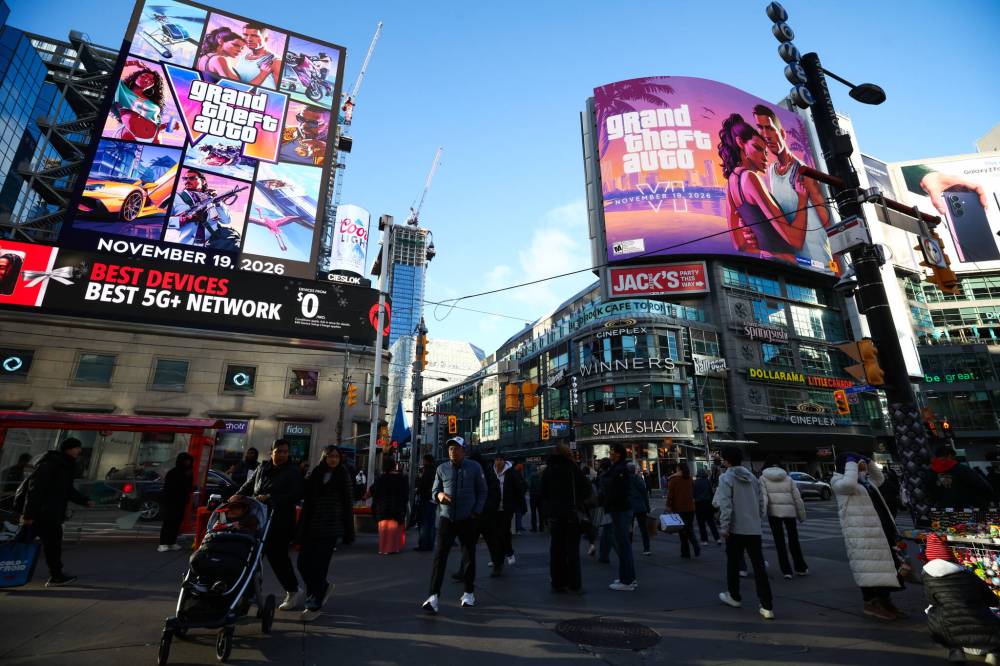
Billboards for "Grand Theft Auto VI" are seen in downtown Toronto earlier this month. Tandeep Sidhu and Christopher J. Schneider write that use of "GTA" imagery in recent Canadian police social media posts raises some serious image concerns. (The Canadian Press files)
The primary purpose of police use of social media is to manage and control their public image to sustain the appearance of institutional legitimacy. In doing so, police efforts to keep up with viral trends including the use of meme strategies is nothing new.
However, use of “GTA” imagery in recent Canadian police social media posts raises some serious image concerns for police.
Notably, appealing to “GTA VI” illustrates an apparent double standard in police messaging by inadvertently celebrating some of the same violence that police are tasked with protecting the public from. The use of “GTA”-style imagery also symbolically contradicts routine police messages that emphasize officer and public safety even while there is no discernible link between video games and real-world violent behaviour.
Players of “GTA VI” are tasked with completing a narrative story but can also explore the game’s virtual world beyond its storyline. In each aspect of the game, violence against police is both expected and encouraged. For example, an integral aspect of the “GTA” subculture is to inflict substantial violence on the public and to kill police officers to trigger a “six star” wanted level. This sees players attempting to survive a shootout with police, who begin employing more specialized equipment and units to stop the player as the wanted level increases.
Escalating the violence, chaos and lawlessness is apparently all part of the fun.
As noted in one “GTA”-themed Edmonton police social media post, “You play the game. We’ll handle the real missions.” Here we have police ostensibly encouraging symbolic street violence in the game, which includes violence against police.
A signature part of “GTA” gameplay concerns stealing cars (it is literally the name of the game!).
Another “GTA”-themed post made by Peel Regional Police in part reads: “enjoy the game and have fun but keep criminal activity and stunt driving where they belong [in the game].” According to Peel police Deputy Chief Nick Milinovich, “auto theft is not just property crime; it is a violent, predatory business.” The promotion of organizational police values that both encourage and discourage illegal behaviour and violence is inconsistent symbolic messaging to the public.
“GTA VI” has also already been criticized for its violent and sexualized imagery. As one reviewer aptly pointed out, Chapter 3 in the game is titled “Tits Ass Drug Money.”
Given the recent push to increase the representation of women in policing, the use of such imagery of a video game criticized for its misogynistic presentation of women sends mixed messages to the public not the least of which trivializes violence against women which includes systemic issues of gendered violence in the profession of policing itself.
Other “GTA”-themed posts such as one made by the Regina police emphasize an imagery that is consistent with a publicly unpopular militarized “Hollywood” version of police that showcases officers in tactical gear, armoured vehicles and body armour. “The missions on your screen end when you turn off the console. Ours continue 24/7,” reads the Regina police post on Instagram.
“GTA VI” is fictional entertainment. The police are not. There are effective ways to present and manage the police image to the public, but promoting “GTA” iconography is not one of them.
Police messaging ought to remain consistent especially if they expect the public to continue to take their expressed commitments to community safety seriously.
» Tandeep Sidhu is an assistant professor in the department of sociology and criminology at the University of Manitoba. His research critically engages with the intersection between racialization and policing. Christopher J. Schneider is a professor of sociology at Brandon University and is author of “Policing and Social Media: Social Control in an Era of Digital Media,” second edition (Lexington, 2024).