
Don’t want to slip and fall off the mountain? There’s an app for that.
Advertisement
Read this article for free:
or
Already have an account? Log in here »
We need your support!
Local journalism needs your support!
As we navigate through unprecedented times, our journalists are working harder than ever to bring you the latest local updates to keep you safe and informed.
Now, more than ever, we need your support.
Starting at $15.99 plus taxes every four weeks you can access your Brandon Sun online and full access to all content as it appears on our website.
Subscribe Nowor call circulation directly at (204) 727-0527.
Your pledge helps to ensure we provide the news that matters most to your community!
To continue reading, please subscribe:
Add Brandon Sun access to your Free Press subscription for only an additional
$1 for the first 4 weeks*
- Enjoy unlimited reading on brandonsun.com
- Read the Brandon Sun E-Edition, our digital replica newspaper
*Your next Free Press subscription payment will increase by $1.00 and you will be charged $20.95 plus GST for four weeks. After four weeks, your payment will increase to $24.95 plus GST every four weeks.
Read unlimited articles for free today:
or
Already have an account? Log in here »
CALGARY – When clinging to the side of a rock wall hundreds of metres in the sky, avoiding a single misstep can save your life.
Turns out there’s an app to help with that.
Ben Pearman, a rock climber since age 18, said the idea of the app came to him while his group was trying to determine the best way to climb the south face of Mount Yamnuska in southern Alberta’s Bow Valley.
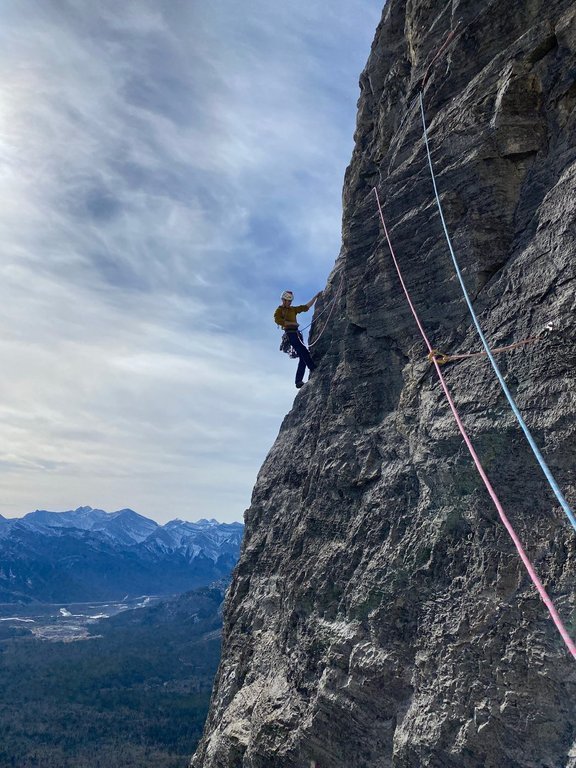
“You get up there and the whole thing looks sort of like a planar surface from far away, like one big sheer cliff,” Pearman said in an interview.
“The scale just swallows you. And you’re like, ‘Oh man, it’s really easy to get lost here.'”
The sheer limestone wall of this climbing route is known as Red Shirt, and Pearman said it’s the “crown jewel” of climbing in the Rocky Mountains.
The 29-year-old is a master’s student in the University of Calgary’s Department of Computer Science. He decided to turn a climbing map into a project, creating the ThreeTopo app for climbers.
He used a drone to shoot detailed photos of the 240-metre-tall climb and created a three-dimensional digital copy of that section of the rock face.
The app examines the potential for new navigation and conveys the information to climbers. Pearman said it was also important to make it so climbers could use it one-handed when they consult it at safe points during the climb.
As an example, a climber could ask the app for information on the best way forward while at one particular spot in the climb.
The app could reply: “You’ll want to start traversing left from the anchor. Once you hit the corner, start heading upwards until you reach a bolt. As soon as you get to that bolt, you need to traverse hard left, passing a pin to reach an anchor on the face.”
In the past, said Pearman, that kind of practical information came only in the form of cryptic, decades-old typewritten notes from other climbers.
Miles Abesdris, who was in a group of experienced climbers asked to test the app, said it can take some of the scary unknowns out of trad climbing.
Trad — or traditional climbing — involves the lead climber placing temporary, removable gear into the rock. They then clip in a rope to catch a fall. The second climber comes up behind and removes the devices, leaving nothing behind.
“The first little while, (trad climbing) is somewhat horrifying, but you kind of become very comfortable there after a while,” said Abesdris, 38.
“Your hands and feet are great, but you’ve got to know where to go, right?
“There’s weaknesses in the rock. And you kind of follow the weaknesses and you kind of get a Spidey sense of where to go over the years — but sometimes you can be wrong.”
Pearman intends to make his app publicly available. He hopes other climbers will follow suit by detailing data on other popular North American routes from B.C. to Nevada, making the sport safer.
“I know a bunch of people who have had to be rescued by helicopter,” he said.
“Everyone I know has gotten off route at some time.”
This report by The Canadian Press was first published Sept. 6, 2026.