
‘He was such a great person’
91-year-old woman unearth poems, artifacts from father's time at war
Advertisement
Read this article for free:
or
Already have an account? Log in here »
We need your support!
Local journalism needs your support!
As we navigate through unprecedented times, our journalists are working harder than ever to bring you the latest local updates to keep you safe and informed.
Now, more than ever, we need your support.
Starting at $15.99 plus taxes every four weeks you can access your Brandon Sun online and full access to all content as it appears on our website.
Subscribe Nowor call circulation directly at (204) 727-0527.
Your pledge helps to ensure we provide the news that matters most to your community!
To continue reading, please subscribe:
Add Brandon Sun access to your Free Press subscription for only an additional
$1 for the first 4 weeks*
- Enjoy unlimited reading on brandonsun.com
- Read the Brandon Sun E-Edition, our digital replica newspaper
*Your next Free Press subscription payment will increase by $1.00 and you will be charged $20.95 plus GST for four weeks. After four weeks, your payment will increase to $24.95 plus GST every four weeks.
Read unlimited articles for free today:
or
Already have an account? Log in here »
Hey there, time traveller!
This article was published 18/08/2014 (4279 days ago), so information in it may no longer be current.
George Oliver was 22 when he enlisted to go to war 100 years ago today — a choice that would bring out both the poet and the warrior inside of him.
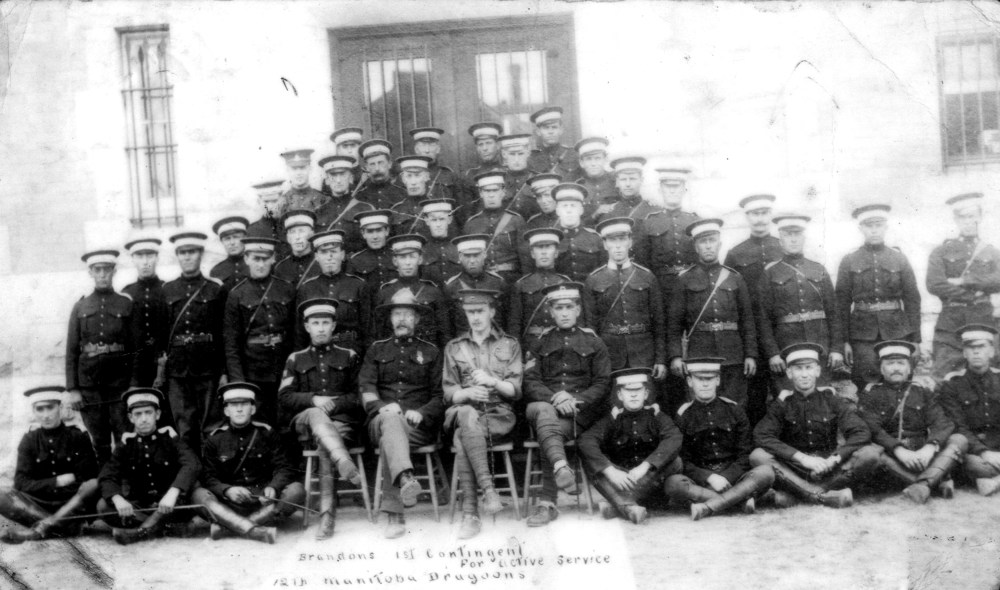
Only five days after he signed up, he was part of the first Brandon contingent for active service as a member of the 12th Manitoba Dragoons.
On the day of the troops’ departure, news reporters of the day described the city as awash with patriotism, enthusiasm and loyalty.
The city streets were alive with cheering crowds as Brandon’s men paraded in the morning of Sunday, Aug. 23, 1914. The men, including Oliver, boarded a train destined for Valcartier in Quebec for training before heading overseas to Plymouth, England, in October.
But the reality and anxiety of war was evident.
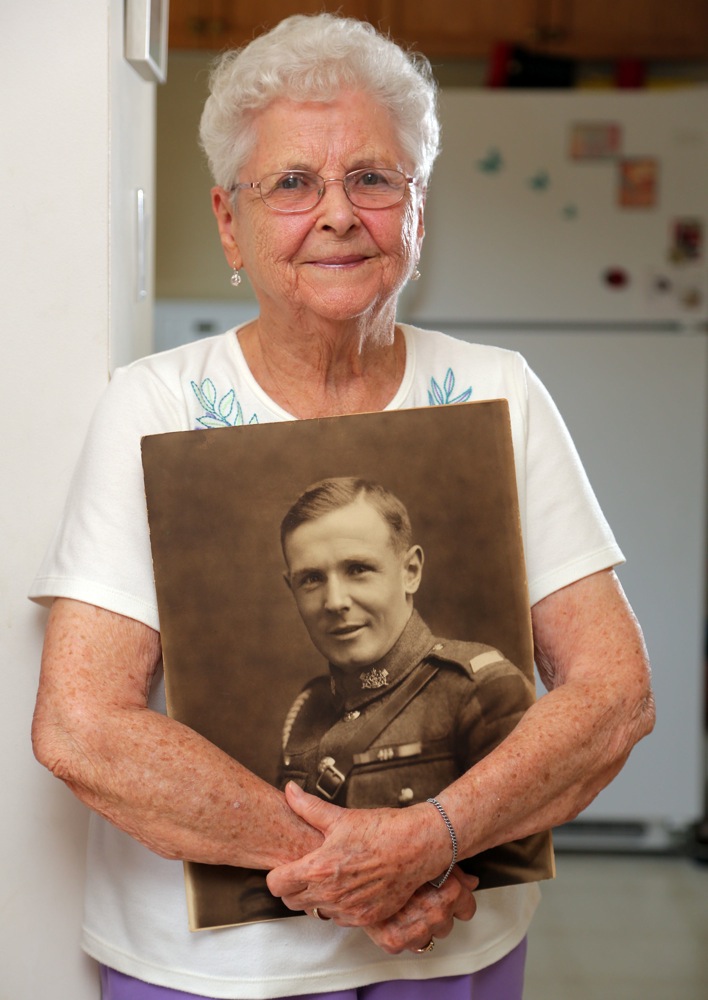
Oliver’s daughter, Isabel Shaw, 91, has lived in Brandon her whole life. She never knew of her father’s time at war until he died in 1968. He, like so many of his fellow soldiers, rarely spoke of his experiences, especially with his young daughter.
After his death, Shaw unearthed several key artifacts from her father’s time in Europe — medals, letters, poems and service documents — that paint a picture of a man who seemed to take on a whole other persona than the man Shaw knew as Dad.
It was the waning days of September 1918 when Oliver, a signaler, was inside of an attack east of the Canal Du Nord in France while he was stringing telephone wire along the front lines, a job described as a dance with death. A machine-gun nest was sweeping the western bank of the canal. After phoning his brigade to inform them of the nest, Oliver rushed, revolver in hand, shot four of the enemy crew and took a fifth prisoner.
“I doubt if he would ever tell us that he had shot four people,” Shaw said, reminiscing about her memories of her father. “I was absolutely shocked … I had no idea.
“I could just never imagine him doing anything like that, but of course it, it was either him or them.”
For that, Oliver received the Distinguished Conduct Medal. He is one of only 1,947 Canadians to receive the medal, which is second only to the Victoria Cross for valour by non-commissioned soldiers in the face of the enemy.
“He did splendid work,” notes a book documenting all the medals received by Canadians during the Great War.
Oliver proved to be a decorated soldier, but war also seemed to force him to find a creative outlet, well-documented in his wartime diary, which included many poems.
His romantic prose appears to be a product of his surroundings, since Shaw said she never knew her father to write.
“When you and I, my love, may part, Will sorrow break thy tender heart?,” read one poem, dated Nov. 19, 1914. “I, in some foreign land to roam, Lay down, as some have done, All that I have got to say. Night bids me part — I cannot stay. With this, my love, make up your mind. You will in this a question find.”
It’s assumed he was asking Isabella Borthwick to marry him. The two wed in 1917 in Scotland, where they were childhood friends. All of the poems were to his future bride.
Oliver was one of the most decorated soldiers to deploy from Brandon in the First World War, receiving the Military Medal with two bars, the Serving Brother Order of St. John the 1914-15 Star, the British Wartime Medal 1914-20, the Victory Medal 1914-19 and the Service Medal of the Order of St. John.
He is only one of five Canadians during the First World War to have won the Distinguished Conduct Medal and the two-barred Military Medal. All of his medals have been donated to the Royal Canadian Artillery Museum in Shilo.
“That was my dad,” Shaw said.
Following his discharge in 1919, Oliver returned to Brandon, where he became a rural linesman for the Manitoba Telephone System.
His life at war was erased as a topic of conversation. He adamantly kept the six-year chapter of his life largely to himself.
“A lot of the men never talked about war experiences,” Shaw said. “I think they felt it was better to forget and leave it all behind rather than bring it out.”
“He talked once about the rain and the mud and that’s about all I ever heard.”
But small mementos of a man long passed away give a peek into the war lives of Brandonites.
“He was such a great person and people should know people like him lived in Brandon,” Shaw said.
» gbruce@brandonsun.com
» Twitter: @grjbruce