
Patriotism swept through Brandon in first weeks of war
Advertisement
Read this article for free:
or
Already have an account? Log in here »
We need your support!
Local journalism needs your support!
As we navigate through unprecedented times, our journalists are working harder than ever to bring you the latest local updates to keep you safe and informed.
Now, more than ever, we need your support.
Starting at $15.99 plus taxes every four weeks you can access your Brandon Sun online and full access to all content as it appears on our website.
Subscribe Nowor call circulation directly at (204) 727-0527.
Your pledge helps to ensure we provide the news that matters most to your community!
To continue reading, please subscribe:
Add Brandon Sun access to your Free Press subscription for only an additional
$1 for the first 4 weeks*
- Enjoy unlimited reading on brandonsun.com
- Read the Brandon Sun E-Edition, our digital replica newspaper
*Your next Free Press subscription payment will increase by $1.00 and you will be charged $20.95 plus GST for four weeks. After four weeks, your payment will increase to $24.95 plus GST every four weeks.
Read unlimited articles for free today:
or
Already have an account? Log in here »
Hey there, time traveller!
This article was published 19/08/2014 (4297 days ago), so information in it may no longer be current.
“Please, your honour, I was excited over the war last night and got drunk.”
That was a “first-class excuse” in police court in August 1914, according to newspaper reports in the Brandon Daily Sun.
Instead of the traditional $2 fine, the understanding magistrate — perhaps himself swept up in patriotic fervour — dismissed the charges and instead told the offender, a stranger in the city, that he had five hours to get out of town.
That’s what counted for judicial wrist-slapping in Brandon during the first few days and weeks after the declaration of war.
Other men, rather than racing for a bottle, rushed to the Armoury building, where more than 100 signed up for the 12th Manitoba Dragoons in less than two hours. Among them were many veterans of previous wars with the British army; but not everyone who signed up was accepted.
A “stiff medical exam” weeded out those who weren’t deemed fit for the front. Most of the men passed, according to the Sun at the time, but poor eyesight was responsible for a number of failures.
It was a bitter disappointment for at least one would-be solider. He wrote a letter to the editor complaining about the “third-degree process on a rough scale,” which rejected some on “technicalities that were absurdly ridiculous …
“Unless a man had the physique of a bulldog, without a blemish, he was turned down …There will be some difficulty in raising the next contingent if every volunteer is treated in this manner.”
Yet it appeared that the military could afford to be picky; there were no shortages of willing recruits.
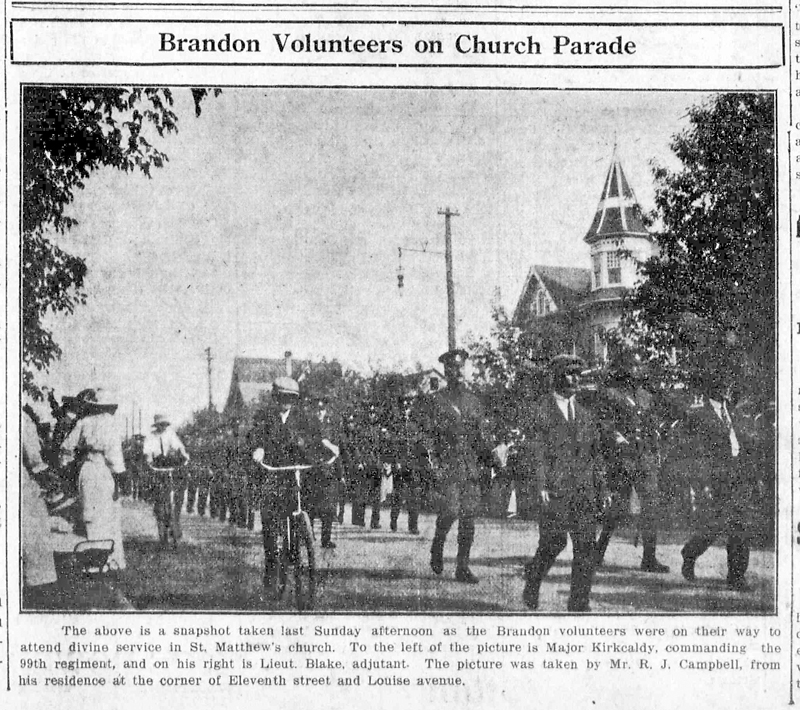
The surge of uniforms gave Brandon the appearance of a “garrison centre,” the Sun opined.
“At the Armoury the volunteers are kept busy and the streets with many citizens in uniform mingling with the crowd, gives the city quite a martial aspect.”
Armed guards were placed at buildings and bridges that were deemed vulnerable to sabotage, including the railway bridge east of Brandon.
It might not have been paranoia — the front pages saw regular reports of suspicious fires and explosions at grain elevators and train tracks across the country.
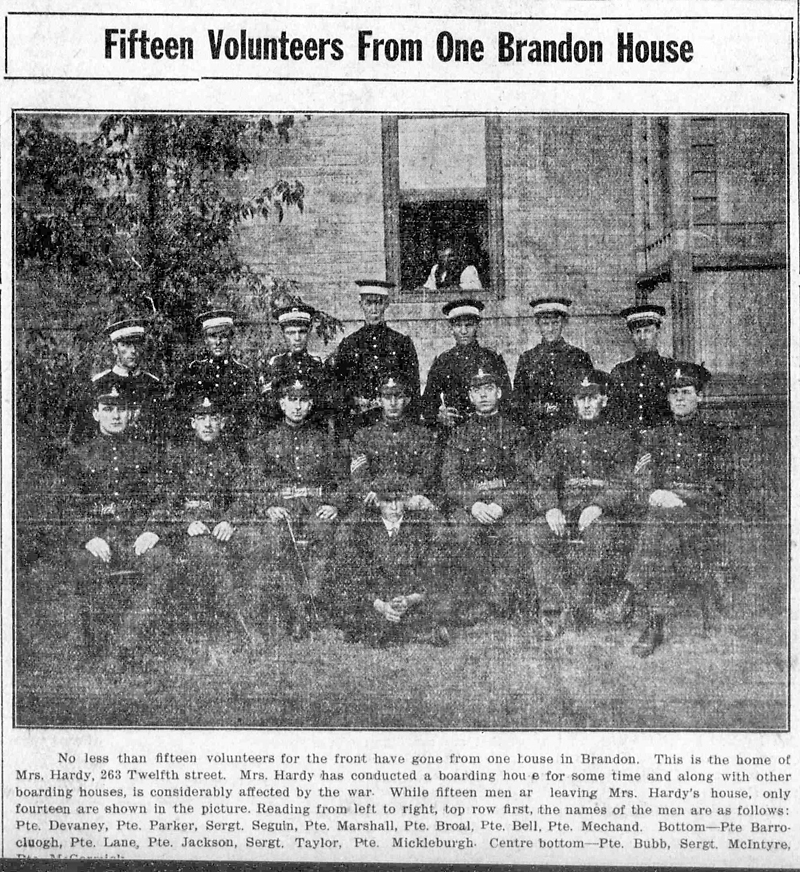
As official orders began to trickle in, turning the volunteers into fully paid soldiers, with meals included, many city employers were rushing to announce that they’d hold jobs for anyone who went to war.
Canadian Pacific Railway took the lead in offering to also pay six months’ salary to any employee who joined up; an offer exceeded by some other municipalities that promised salaries paid for the whole war — but not the City of Brandon, which had to be shamed into guaranteeing that returning veterans would have a job to come home to.
City council soon agreed to pay a month’s salary to at least some departing workers, and to take care of their dependants. They also ponied up for free streetcar rides to any man in uniform.
Troop trains began to run through the city, with reporters doing their best to glean war news from the soldiers passing through. Censorship from Europe meant that the official news from the front quickly became sparse.
Advertisers picked up on the mood in the city, too. In one large display ad, Christies announced, “War declared” on their old stocks of wallpaper. Some 25,000 rolls had to be “sacrificed,” at prices from four to 25 cents per roll.
But as departure dates got closer, the reality began to hit home that these boys were going off on a dangerous errand.
First, they’d head to the newly created Valcartier training base in Quebec; from there, to fight in Europe.
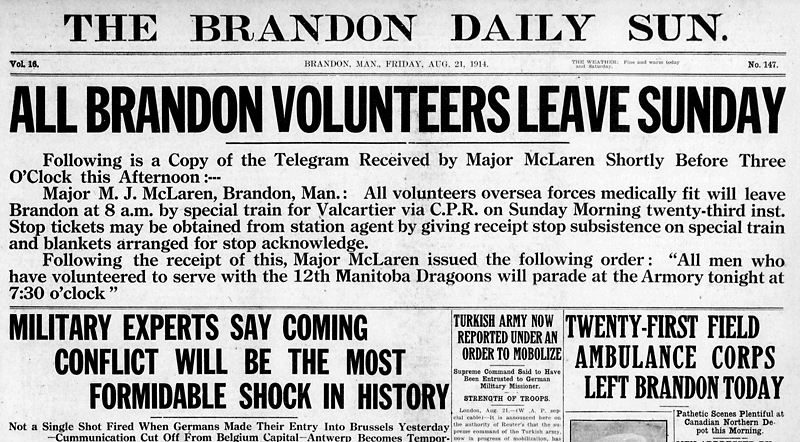
“There seems to be an air of sadness throughout the city as people begin to realize that their loved ones are going to what promises to be a war of long duration, and that many of them may never see Canada again,” the Sun wrote on the front page the day before the scheduled departure.
“Yet with this feeling there is the stronger one of duty, and very few try to dissuade the men from going to the front.”
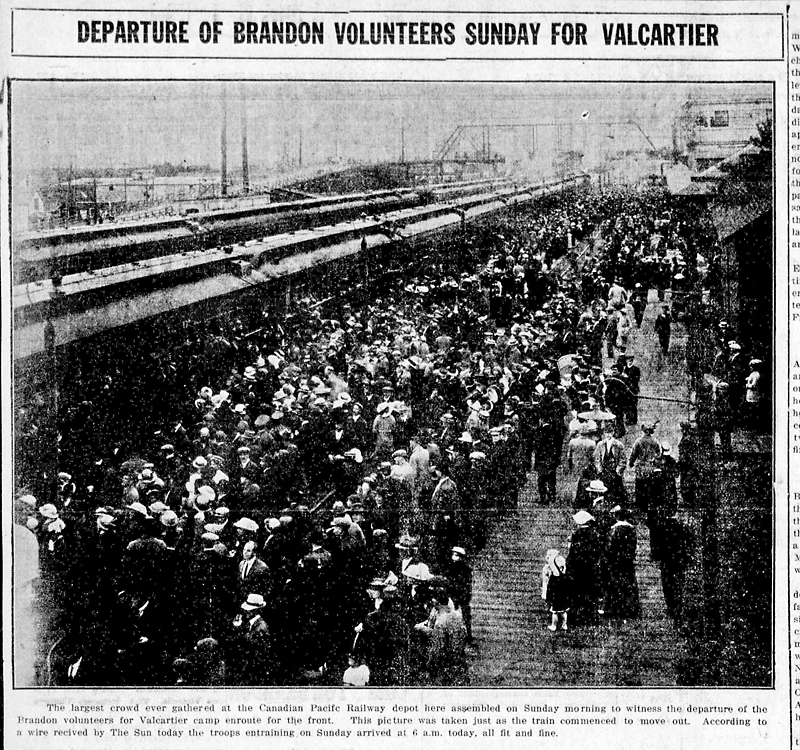
It was duty that poured through the strongest when troops marched to the train station the morning of their departure — with flags flying, bands playing and crowds of cheering people four deep.
The Great West Fireworks Company let off loud detonations to salute them.
They’d arrive safely in Quebec three days later.
» ghamilton@brandonsun.com
» Twitter: @Gramiq