
Travelin’ Westman — Out for Markosky Trout
Advertisement
Read this article for free:
or
Already have an account? Log in here »
We need your support!
Local journalism needs your support!
As we navigate through unprecedented times, our journalists are working harder than ever to bring you the latest local updates to keep you safe and informed.
Now, more than ever, we need your support.
Starting at $15.99 plus taxes every four weeks you can access your Brandon Sun online and full access to all content as it appears on our website.
Subscribe Nowor call circulation directly at (204) 727-0527.
Your pledge helps to ensure we provide the news that matters most to your community!
To continue reading, please subscribe:
Add Brandon Sun access to your Free Press subscription for only an additional
$1 for the first 4 weeks*
*Your next subscription payment will increase by $1.00 and you will be charged $20.00 plus GST for four weeks. After four weeks, your payment will increase to $24.00 plus GST every four weeks.
Read unlimited articles for free today:
or
Already have an account? Log in here »
Hey there, time traveller!
This article was published 26/09/2015 (3872 days ago), so information in it may no longer be current.
ROBLIN — Somewhere in one of the three lakes that make up Trout Triangle and Bench Lake near Roblin is a rainbow trout so big it will turn the first fisherman to land him into a living legend.
In truth, there is more than one.
And unlike other colossal creatures that roam murky waters around the world — ones of urban myth that are spoken of in local pubs over a pint — these fish are very real.
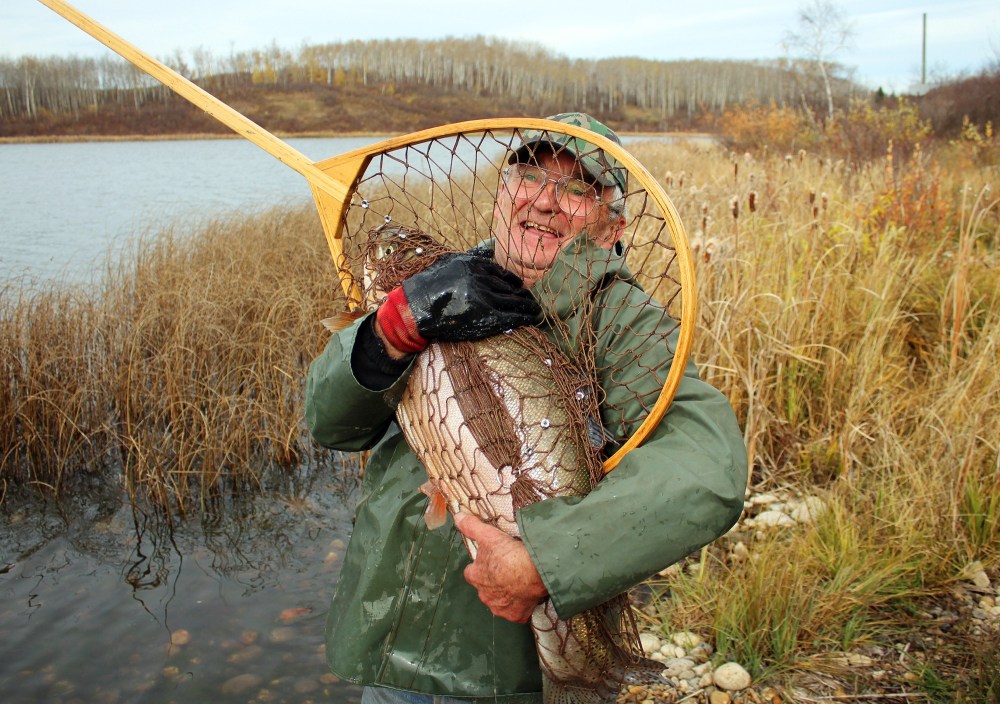
How can one be certain they exist? Because they’re the “babies” of Ken Markosky, who helped release the mammoth fish, aptly named the Markosky Trout, this year.
“Wouldn’t it be something to catch a 16-pounder with fly line,” Markosky said, about hooking one of the trout stocked in Tees, Persse, Bench and the Twin Lakes.
For more than four decades, Markosky has been growing and selling fingerlings from his farm near Roblin. Throughout the years the origin of the fish has changed, but for the most part the final destinations of the 10,000 rainbow trout remained relatively unchanged, going to a group of loyal customers who bought annually.
Markosky has an ideal setup for raising fish.
While many fish farmers spend thousands of dollars keeping tank water at the optimum temperature to keep fish healthy, Markosky has a natural stream that is gravity-fed through each one of his holding tanks exiting back into the stream on the other side. The consistent flow means temperatures stay low, resulting in a higher conversion rate, meaning the more his fish eat, the more they grow.
“They like the cooler water,” said Markosky, who can keep the water below 10 C even on the warmest Prairie summer day. “If you feed them a pound at those cooler temperatures, they’ll grow a pound.”
At the end of every season, however, when the last fish was sold, there were always a few stragglers left over. While it would have been easy to throw his babies out with the tank water, it’s not in Markosky’s nature. Instead, he built a retention pond on his property where he keeps his pets.
The pond serves two purposes — allowing Markosky to keep some of his pets, while also serving to distract customers on busy days when lineups can cause a backlog for staff packaging fish.
“I’d give people dixie cups and they would go up on the hill and feed the fish. They’ll eat right out of your hand,” Markosky said. “They’re up there for an hour and by the time they get back I’ve got caught up and I’ve got their order ready to go.”
For years these trout were allowed to grow unchecked. And one day, while Markosky was telling a fish story, a light bulb turned on for Roblin economic development officer Ben Brodeur.
Markosky told Brodeur that a few years back he wandered down to his pond to find one fish floating dead at the top of the water. After pulling him out — he knew it was a male based on its pronounced kype or hooked lower jaw —Markosky measured the fish before digging a grave and burying him in the countryside. It’s a testament to how much Markosky cares for his animals, but what also caught Brodeur’s attention was the fish measured 36 inches long.
“I don’t know how long he was in there — only God knows,” Markosky said, although the average life span in the wild is four to six years. “You can grow fish that are incredibly big —all depends how much you feed them.”
The giant trout got Brodeur thinking: What if they could release a few monster Markosky Trout into the lakes near Roblin?
After some planning, a group of volunteers transferred the fish to the nearby lakes, which are already renowned worldwide fishing destinations.
Markosky thought they might pull two or three fish from his pond, but was shocked when the fish kept coming.
“Suddenly one came down, two, three, four, five — holy mackerel,” Markosky said. “And these guys are struggling to carry them in the nets.”
When pressed repeatedly on the exact number of fish they released, Markosky was as elusive as a Master Angler trout.
“More than three,” he said laughing.
When pressed on which lakes got the fish, again the question was dodged, although Brodeur said the majority were dropped in Bench Lake due to its strict catch and release policy.
The pair are already planning to release approximately 20 more in two years, once they’ve been sufficiently fattened up.
Wade Schott swears he has already had one on his line.
“We were going along the west side of the lake and something grabbed my hook and it was big, whatever it was, because I couldn’t get it to move hardly,” Schott said.
It might have been a Markosky that he hooked, it might have been an anchor — we’ll never know.
If, or when, the first monster Markosky is fished from the lakes, no one will be surprised if it’s Phil Paczkowski who catches it.
Paczkowski is the second-ranked Master Angler in Manitoba.
The Roblin fisherman has caught 29 species of Master Angler fish, one behind Brian Lagimodiere.
Despite being second ranked, Paczkowski is quick to point out that he has caught more than 100 Master Angler fish more than Lagimodiere, but the ranking gives priority to the person with the most species caught.
The fish Paczkowski doesn’t have that Lagimodiere does is the muskellunge, a name derived from Ojibwa meaning “ugly pike.”
“And yes, I went twice, so you can’t say I didn’t try,” Paczkowski said about the fish that is typically found in large rivers in Michigan, Wisconsin and Minnesota, but is also found in rare places in Manitoba.
Fishing is a way of life for Paczkowski, who recently opened a live bait and tackle shop in Roblin.
Paczkowski guides fisherman who come from as far away as Europe — all of them in search of that trophy trout.
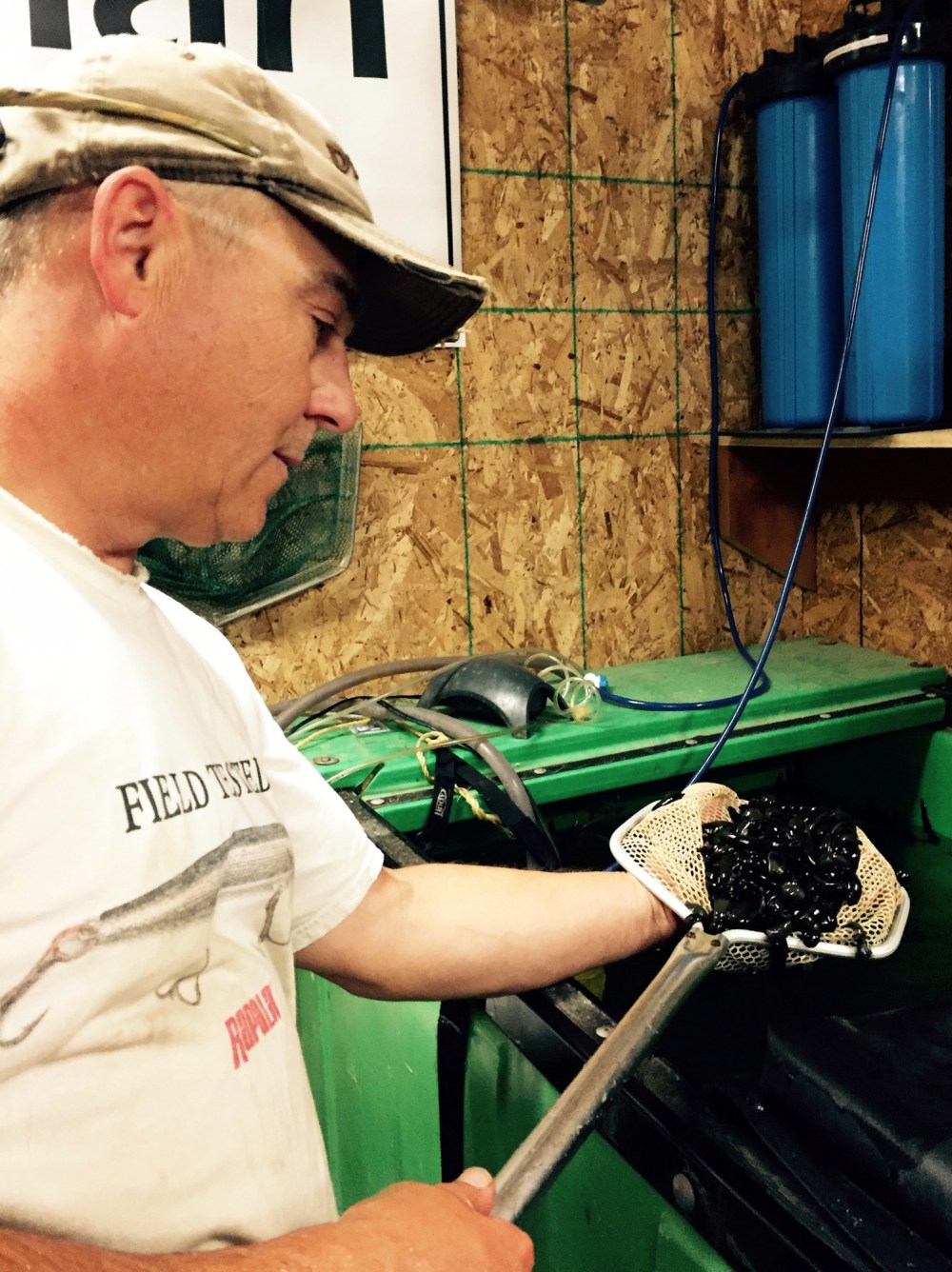
He said leeches were the most common bait used during the Bug Chucker Cup, one of the premier trout fishing tournaments in the world.
How he procures his leeches is a story in itself.
Paczkowski said it pays to be friends with the local butcher when it comes to leech hunting.
Often the organs of a cow don’t have much use at the grocery store, but for Paczkowski they are gold. He said a nice big liver and heart wrapped in a burlap bag is ideal for catching the blood suckers.
Throw it in the water in the morning and return the next day and Paczkowski said you’re left with a bag that is as black as the night, covered in leeches.
Unlike most fishermen, Paczkowski uses an 18-pound braid line with eight pound
test at the end so the fish can’t see it.
He uses the line so that he can get a fish to the surface quickly while it is still green before torpedoing it back into the water, a technique that helps fill the fish’s gills with oxygen.
As for the Markosky, he has never had one on the end of his line.
“But if I hook it, I’m going to get it to the net,” Paczkowski said.
» ctweed@brandonsun.com
» Twitter: @CharlesTweed