
Budget will not restore confidence
Advertisement
Read this article for free:
or
Already have an account? Log in here »
We need your support!
Local journalism needs your support!
As we navigate through unprecedented times, our journalists are working harder than ever to bring you the latest local updates to keep you safe and informed.
Now, more than ever, we need your support.
Starting at $15.99 plus taxes every four weeks you can access your Brandon Sun online and full access to all content as it appears on our website.
Subscribe Nowor call circulation directly at (204) 727-0527.
Your pledge helps to ensure we provide the news that matters most to your community!
To continue reading, please subscribe:
Add Brandon Sun access to your Free Press subscription for only an additional
$1 for the first 4 weeks*
- Enjoy unlimited reading on brandonsun.com
- Read the Brandon Sun E-Edition, our digital replica newspaper
*Your next Free Press subscription payment will increase by $1.00 and you will be charged $20.95 plus GST for four weeks. After four weeks, your payment will increase to $24.95 plus GST every four weeks.
Read unlimited articles for free today:
or
Already have an account? Log in here »
Hey there, time traveller!
This article was published 29/03/2023 (1275 days ago), so information in it may no longer be current.
The Trudeau government has a big problem. With recent polls showing the Liberals trailing the Conservatives in voter preference, yesterday’s budget speech was an ideal opportunity — and perhaps their final opportunity before the next federal election — to convince Canadians they are still the best party to manage the nation’s finances.
It won’t be easy. Indeed, the results of a large national poll conducted last week by Abacus Data reveals the immense challenge facing the Liberals. The poll found that almost half of respondents believed the economy will worsen over the next 12 months, with only 23 per cent believing it will improve. Even worse, more than two-thirds of respondents (including 40 per cent of past Liberal supporters) believed the government has done either a “poor” or “terrible” job in addressing the rising cost of living and in making housing more affordable and accessible.
Only 27 per cent of respondents agreed that “the federal government has a clear economic plan to grow the economy,” while 42 per cent disagreed.
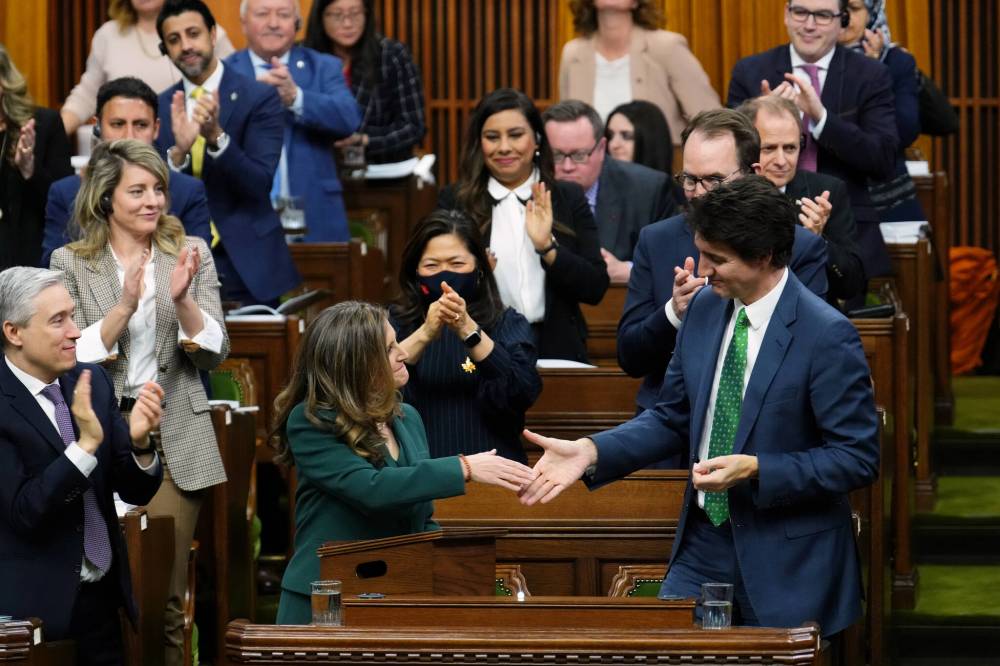
Finance Minister Chrystia Freeland shakes hands with Prime Minister Justin Trudeau after delivering the federal budget in the House of Commons on Parliament Hill in Ottawa in 2023. To paraphrase Freeland, the Liberals’ time in government will inevitably come to an end and, because of her resignation, perhaps sooner than expected, writes Brandon Sun columnist Deveryn Ross. (The Canadian Press)
Those are bad numbers, but the news is even worse for the Trudeau Liberals. According to Abacus CEO David Colletto, “On EVERY economic and pocketbook issue, the Conservatives have a clear advantage over the Liberals.” Indeed, Abacus found that Pierre Poilievre’s Tories lead the Liberals by 13 per cent on managing the economy, by 19 on keeping taxes low, by 15 on keeping interest rates as low as possible, by 11 on addressing the rising cost of living, by seven on creating good-paying jobs, and by six per cent on protecting pensions and retirement security.
According to Colletto, “the problem is one of empathy and clarity. The federal government and its senior leaders aren’t connecting with people and empathizing with their day-to-day struggles. And there hasn’t been a clear economic narrative that people recall. With only 23 per cent of Canadians believing the government has a clear economic plan, the budget presents an opportunity for the Liberal government to articulate its vision for economic growth and stability. Demonstrating a coherent strategy to address Canadians’ economic anxieties could help regain public trust.”
Colletto made those comments on Monday, before anybody knew the details contained in the budget. Now that we’ve heard the speech and read the related documents, does it demonstrate “a coherent strategy to address Canadians’ economic anxieties?”
I don’t think so. The budget tabled by Finance Minister Chrystia Freeland yesterday projects a deficit that is $10 billion higher than the $30.6-billion deficit the government forecast just last fall. They now predict it will rise to $40.1 billion, and that assumes the economy doesn’t worsen, requiring additional government spending. Unlike past years, no rainy day fund has been set aside.
There is no longer an estimate as to when we will return to a balanced budget. Even worse, our debt-to-GDP ratio will continue to climb for at least the next three years. That will no doubt shake the confidence of bond rating agencies, meaning that our borrowing costs are likely to rise.
Budget 2023 allocates $2.5 billion for a “grocery rebate” program that will help 11 million low-income Canadians, it delivers a new Canadian Dental Care Plan that will benefit up to nine million Canadians, and it allocates billions of dollars to reduce wait times and expand access to family health services. And there is almost $360 million over five years for a renewed Canadian Drugs and Substances Strategy.
That may satisfy the NDP MPs whose votes are keeping the government in power, but there is no new money for housing in this budget, and the one-time rent subsidy is gone. Given that access to affordable housing is a major concern of many Canadians, the Liberals’ failure to address the issue is a glaring absence.
That’s not the only absence, however. The Trudeau government is trying to convince Canadians they empathize with their day-to-day struggles, but where is the coherent and credible economic plan? Where is the vision for economic growth and stability? Where is the coherent strategy to address Canadians’ economic anxieties?
The simple answer is that there isn’t a persuasive plan, vision or strategy anywhere in Budget 2023. All that spending will probably buy the NDP’s support for a few more months, but it will not change Canadians’ opinions about the fiscal competence of this government.
For a government needing to regain the confidence of Canadians, this was a lost opportunity.