
Parental rights not the real issue
Advertisement
Read this article for free:
or
Already have an account? Log in here »
We need your support!
Local journalism needs your support!
As we navigate through unprecedented times, our journalists are working harder than ever to bring you the latest local updates to keep you safe and informed.
Now, more than ever, we need your support.
Starting at $15.99 plus taxes every four weeks you can access your Brandon Sun online and full access to all content as it appears on our website.
Subscribe Nowor call circulation directly at (204) 727-0527.
Your pledge helps to ensure we provide the news that matters most to your community!
To continue reading, please subscribe:
Add Brandon Sun access to your Free Press subscription for only an additional
$1 for the first 4 weeks*
- Enjoy unlimited reading on brandonsun.com
- Read the Brandon Sun E-Edition, our digital replica newspaper
*Your next Free Press subscription payment will increase by $1.00 and you will be charged $20.95 plus GST for four weeks. After four weeks, your payment will increase to $24.95 plus GST every four weeks.
Read unlimited articles for free today:
or
Already have an account? Log in here »
Hey there, time traveller!
This article was published 30/06/2023 (1224 days ago), so information in it may no longer be current.
I mean to revisit two critical educational questions: “what are the real goals of the growing parental rights movement?” and “to whom do our children belong?” These questions relate directly to school funding, teaching, curricula, attendance and the role of schools in their communities, all of which are being challenged.
At stake are the public purposes of education, or why we invented schools for all in the first place.
The rising parental rights movement has the potential to either undermine or enhance children’s education. On one hand, it is unfortunate that parental rights are being used as a political weapon to divide communities and entrench partisan ideologies. On the other, if it indicates a renewed and legitimate interest to improve schools, accept parental responsibilities, and support children, it would be a welcome move.
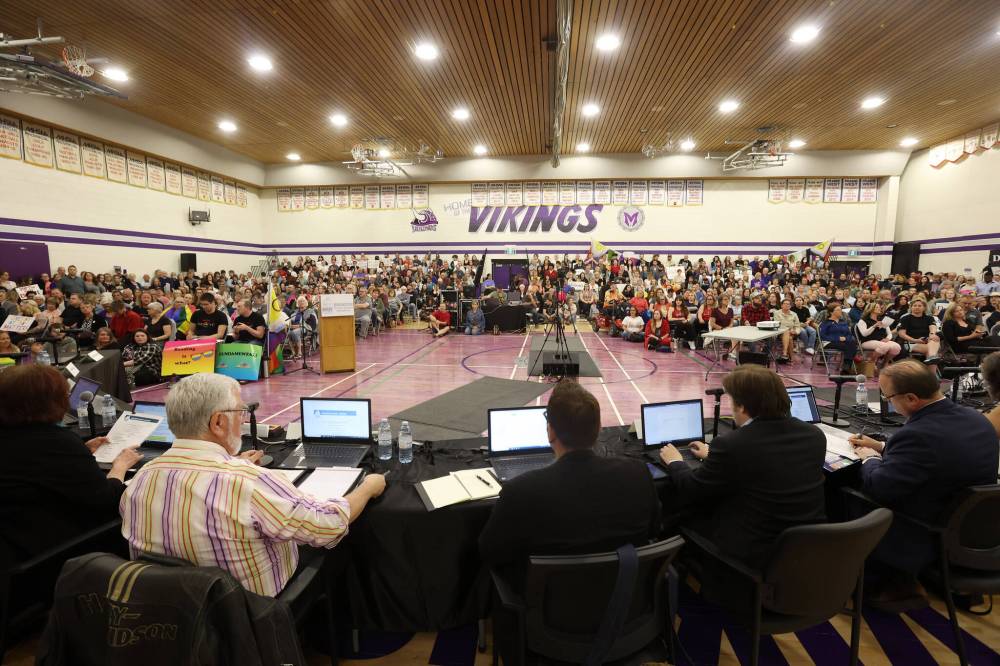
Brandon residents fill the Vincent Massey High School gymnasium on May 23 for a Brandon School Division board of trustees meeting. Dozens of people spoke in response to a previous proposal to establish a committee to review and possibly remove books from school libraries, including LGBTQ+ literature and sexual education resources. John R. Wiens writes that the rising parental rights movement has the potential to either undermine or enhance children's education. (Tim Smith/The Brandon Sun)
I fear the former has the upper hand.
Parental rights groups imply that children belong solely to their parents to do with them what they will, equivalent to absolute ownership. They also imply that there is an imminent threat to their authority, something which could not be further from today’s reality.
Aunts and uncles, grandparents and community members have basically yielded to parental edicts that their kids are “hands off,” no advice or comments are welcome. This is a far cry from what used to exist in most families and communities where “the village raised the child.”
Opting out of the village often means homeschooling, an exclusive religious or private experience that determines and limits their interaction with children unlike them or views unlike theirs. Gone are the original purposes of homeschooling as a preferable and reasonable option based upon the needs of a small number of children rather than the biases of their parents.
However, that is not enough for today’s parental rights claims — they’re also, usually justified by some supposed religious doctrine, after other people’s children. Some parents are seeking to have their libraries purged of sexually educational and inclusive materials. Others, often the same, want their religion to be taught in public schools.
Neither the censoring of their children’s reading material nor the teaching of their preferred religion is out of their reach. These are matters that they can already control. It makes one wonder what the real agendas are. Do they really want to live completely unfettered lives, free of any government directives or regulations?
The Manitoba government often publicly embraces parental rights rhetoric or remains silent on its implications. Some homeschooling has evolved into an unregulated free-for-all in direct violation of the conditions for regular monitoring, following provincial curricula, regular instruction, and regular reporting, all of which seem to have gone by the wayside for fear of backlash from hostile, anti-government parents and groups.
Similarly, the minister of education refuses to take a stance on banning books with LGBTTQ+ content or confront the contradictions of religious instruction in schools, deferring to local school trustees to deal with the issue. Ironically, this is the same government that under Bill 64 was ready to eliminate school boards as unnecessary and dysfunctional. All three are issues on which the public has a right to know where their governments stand.
What are the reasonable limits of parents’ rights regarding children?
A simple reality noted by most educational philosophers provides part of the answer. Parents choose to bring their children into a human world already inhabited by a staggering variety of people who, depending on your belief system, were also chosen by a Creator God to be here at the same time.
Parents might also be reminded that the very reason they enjoy any rights is that they happen to live in a democracy mostly sustained by benign governments.
According to the United Nations Declaration on Universal Rights of Children, children belong to all of us in terms of a responsibility we have to them to prepare them for the difficult task of being self-governing individuals who contribute to making the world better for everyone, a democratic world.
For children this means that to sustain such a system of government, enough must be committed to the goals of democracy as adults to be willing to accept the responsibilities of democratic citizenship. These are not attitudes, skills and knowledge that children are born with — they must be taught. That is why public schools must accept all comers, and why they are framed around values of respect for everyone, inclusion and equality. Exclusive parental rights are not an acceptable alternative.
» John R. Wiens is dean emeritus of the faculty of education at the University of Manitoba. His article first appeared in the Winnipeg Free Press.