
Numbers only part of story
Advertisement
Read this article for free:
or
Already have an account? Log in here »
We need your support!
Local journalism needs your support!
As we navigate through unprecedented times, our journalists are working harder than ever to bring you the latest local updates to keep you safe and informed.
Now, more than ever, we need your support.
Starting at $15.99 plus taxes every four weeks you can access your Brandon Sun online and full access to all content as it appears on our website.
Subscribe Nowor call circulation directly at (204) 727-0527.
Your pledge helps to ensure we provide the news that matters most to your community!
To continue reading, please subscribe:
Add Brandon Sun access to your Free Press subscription for only an additional
$1 for the first 4 weeks*
- Enjoy unlimited reading on brandonsun.com
- Read the Brandon Sun E-Edition, our digital replica newspaper
*Your next Free Press subscription payment will increase by $1.00 and you will be charged $20.95 plus GST for four weeks. After four weeks, your payment will increase to $24.95 plus GST every four weeks.
Read unlimited articles for free today:
or
Already have an account? Log in here »
Hey there, time traveller!
This article was published 14/07/2023 (1167 days ago), so information in it may no longer be current.
Last week, the Ipsos polling company released the results of its latest poll of Canadians regarding their voting intentions. The poll found that if a federal election were held then, Conservative candidates would receive 37 per cent of votes cast, while Liberal candidates would receive 32 per cent. The NDP were trailing at 16 per cent, with the Bloc Québécois at eight per cent, the Green Party at three per cent and the Peoples’ Party at just two per cent.
The new Ipsos numbers are consistent with the results of polls conducted by three other national polling companies over the past month. They found that the Tory lead over the Liberals ranges from six to eight points.
In addition, a recent Abacus Data poll found that 81 per cent of Canadians believe it is time for a change in government, and just 20 per cent believe the Trudeau Liberal government deserves to be re-elected.
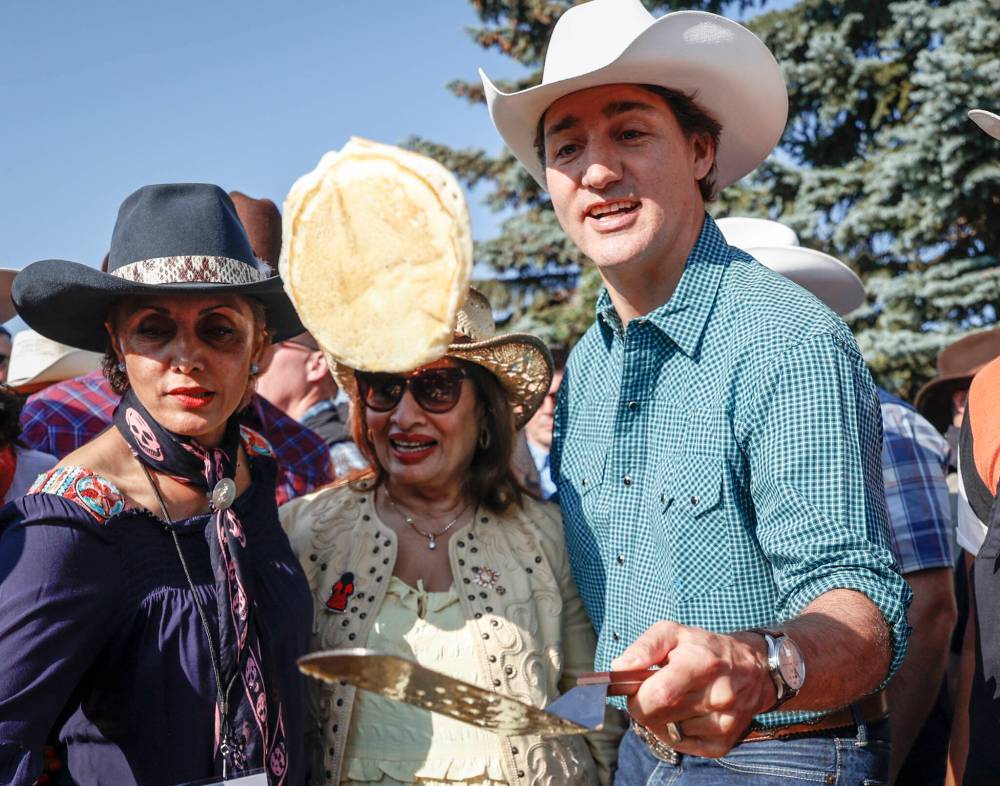
A consistent lead in the polls doesn’t mean the Tories can expect to topple Prime Minister Justin Trudeau, shown cooking pancakes at the Calgary Stampede on July 8. (The Canadian Press)
A consistent lead in the polls doesn’t mean the Tories can expect to topple Prime Minister Justin Trudeau, shown cooking pancakes at the Calgary Stampede on July 8. (The Canadian Press)
Based on all those poll numbers, it’s easy to assume the Conservatives would be headed toward a stable majority if an election were held this summer. That assumption would be wrong, however.
Despite the big Conservative lead, the respected political website 338canada.com projected last week that an election held now would actually result in a Liberal victory. It estimated the Liberals would win 144 seats, with the Tories winning just 134 seats.
How the Liberals could win the most seats despite such a strong appetite for change? It’s because seats in the House of Commons are not allocated based on the percentage of votes received by each party nationally. They are based on which party’s candidates receive the most votes in each of the 338 ridings.
The Liberals would likely win the most seats under our “first past the post” electoral system because their support is more evenly distributed over a greater number of ridings than the support the Tories receive from voters.
The Conservatives’ nationwide popular vote numbers are distorted by the massive support they receive in Western Canada. All of those Tory votes on the Prairies guarantee wins in that region by huge margins, but have zero impact on seats in Ontario, Quebec and Atlantic Canada, where support for Conservatives is far less enthusiastic.
This is not new information. Conservatives have had a “vote inefficiency” problem in the majority of federal elections held over the past several decades. That’s because the messaging and policies that attract western Canadian voters to support the party often fail to resonate in other areas of the country.
What can today’s Tories do to change this reality? What must they do in order to win more votes in Ontario, Quebec and the Atlantic provinces?
The answer appears so obvious: create policies and messaging that is more attractive to a greater number of Canadians living in central and eastern Canada. That sounds easy, but the Conservatives’ problem is that they appear consistently unwilling to do so. They seem more committed to adhering to what they regard as “core conservative values” than winning elections.
Former Conservative leader Erin O’Toole tried to make his party more moderate, and it appeared headed toward victory in the 2021 election before its unpopular positions on abortion and gun control became the focus of that campaign. After the election, he was accused by senior party members of compromising party values and was ultimately forced to resign as leader.
Under current leader Pierre Poilievre, the Tories are attempting a different strategy. By adopting tougher messaging and pandering to Trumpist Canadians, he is attempting to eliminate the right-wing vote-splitting that occurred between the Conservatives and Peoples’ Party. That strategy was on full display in the recent Portage-Lisgar byelection.
Beyond that, Poilievre is attempting to soften moderate Canadians’ perceptions of him. Over the past few weeks, he has been supportive of LGBTTQ+ rights. He is also undergoing a makeover that includes contact lenses, a new hair style, a more hip wardrobe and a softer, more controlled vocal style.
It’s a transparently shallow strategy, but it doesn’t have to be wildly successful in order to push the Tories toward victory. Indeed, with just a couple more points in the polls, Canadians could have yet another prime minister the majority don’t want: Pierre Poilievre.