
Votes, wedges and political tricks
Advertisement
Read this article for free:
or
Already have an account? Log in here »
We need your support!
Local journalism needs your support!
As we navigate through unprecedented times, our journalists are working harder than ever to bring you the latest local updates to keep you safe and informed.
Now, more than ever, we need your support.
Starting at $15.99 plus taxes every four weeks you can access your Brandon Sun online and full access to all content as it appears on our website.
Subscribe Nowor call circulation directly at (204) 727-0527.
Your pledge helps to ensure we provide the news that matters most to your community!
To continue reading, please subscribe:
Add Brandon Sun access to your Free Press subscription for only an additional
$1 for the first 4 weeks*
- Enjoy unlimited reading on brandonsun.com
- Read the Brandon Sun E-Edition, our digital replica newspaper
*Your next Free Press subscription payment will increase by $1.00 and you will be charged $20.95 plus GST for four weeks. After four weeks, your payment will increase to $24.95 plus GST every four weeks.
Read unlimited articles for free today:
or
Already have an account? Log in here »
Hey there, time traveller!
This article was published 29/07/2023 (1170 days ago), so information in it may no longer be current.
Well, we’re not talking about health care anymore, are we?
Just like that, the Manitoba Progressive Conservatives may have found something to push the front-page focus off of health care and onto the wedge issue of searching the landfills, ahead of an election on Oct. 3.
What’s a wedge issue?
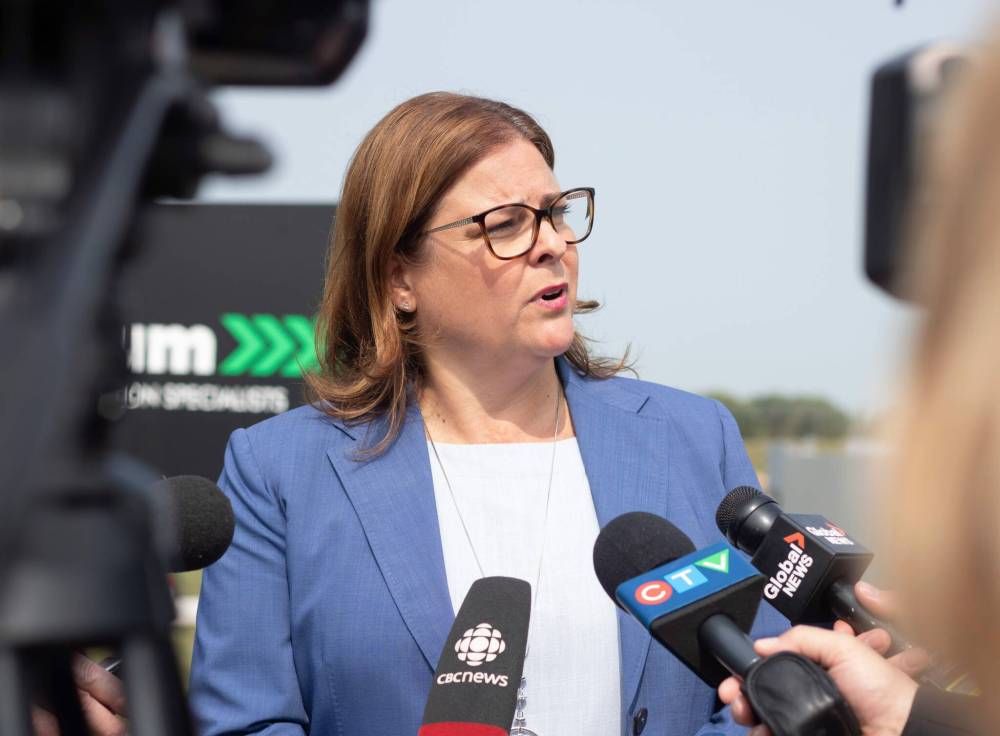
Shannon Sampert believes Premier Heather Stefanson and the Progressive Conservatives may gain some traction ahead of this fall's provincial election through the wedge issue of searching the landfills. (File)
It’s a device in politics introduced in the Reagan era by Lee Atwater, one designed to make the rhetoric much more divisive, and it has become commonplace in both Canadian and American landscapes.
Wedge issues are often controversial — think abortion or medically assisted dying — and are a way to divide the support for the opposition and also create consensus for those who support the governing party.
There are many who would argue that the Manitoba government has a moral obligation to search Prairie Green landfill for Morgan Harris, 39, and Marcedes Myran, 26. But both Premier Heather Stefanson and Justice Minister Kelvin Goertzen have said no to the search on the grounds that it would be too dangerous.
Meanwhile, the former head of the RCMP agrees with that assessment. Brenda Lucki has said that police cannot handle the complexities of searching the landfill for the remains. In a report provided to the Canadian Press through a request under the Access to Information Act, Lucki warned that the site contained asbestos and other toxic gases, including ammonia.
Obviously, this is not as clear cut as it would seem on the surface and as a wedge issue, the landfill search serves as a metaphor. It has undercurrents of race politics and resentment over the costs of reconciliation (or as political scientist David McIvor calls it, the mendacity of reconciliation). These provide Stefanson an opportunity to swing votes toward the Tories just weeks before the official race begins in what is shaping up to be a potentially close contest.
A Winnipeg Free Press-commissioned poll with Probe Research of 1,000 Manitoba adults, done from May 31 to June 13, suggests Stefanson’s Progressive Conservatives and the NDP under leader Wab Kinew each enjoy the support of 41 per cent of decided voters across Manitoba. That means the Conservatives are starting to make inroads after months of trailing the NDP in the polls. However, it’s Winnipeg where the election is won. In the latest poll, the NDP held 48 per cent support compared to the Conservatives with 32 per cent.
According to Probe, three-quarters of those who voted for the Progressive Conservatives in 2019 intend to vote again for the Progressive Conservatives on Oct. 3. However, more than one in 10 are currently undecided in terms of which party they will support. By comparison, the NDP is retaining 83 per cent of their 2019 supporters.
Overall, the Manitoba election comes down to Winnipeg ridings — and mostly ridings in south Winnipeg — and it comes down to 20,000 votes at the very most. That’s not a lot of wiggle room. This is what Stefanson has to work with.
And the Tories would be wise to focus on white, suburban women for votes. The last poll suggests there is a gender gap with only a quarter of Winnipeg women saying they would vote for the PCs. This wedge issue could be the opportunity to turn this around.
Stefanson could play up a dichotomy of searching the landfill and putting police officers at risk or putting money, in a post-COVID economy, toward health care, education and family doctors. Certainly, the upswing in polling support suggests that the latest round of spending on things like child care, family doctors and schools has resonated with some voters. Partner that with a campaign that plays up a woman leader against a leader who can come across as a bully, and the Tories may be back on track.
Voter turnout in Manitoba elections is not particularly high. In 2019, it was only at 55 per cent, down from 57 per cent in 2016. Those who do vote tend to be retired, long-term residents and in a higher income bracket. The landfill search and its undercurrents of race and privilege can be easily played up in the Tories’ favour.
But elections and election campaigns are fickle. The undecided voter won’t pay a lot of attention to the campaign until largely two weeks before Oct. 3 — election day — and certainly not until after Labour Day. And anything can happen between then and now.
But at least the Tories and Stefanson have found an issue that will get the electorate talking about something other than health care.
» Shannon Sampert is a communications consultant, freelance editor for Policy Options and former politics and perspectives editor at the Winnipeg Free Press. She teaches part-time at the University of Manitoba. This column was previously published in the Free Press.