
Authenticity problem looms large
Advertisement
Read this article for free:
or
Already have an account? Log in here »
We need your support!
Local journalism needs your support!
As we navigate through unprecedented times, our journalists are working harder than ever to bring you the latest local updates to keep you safe and informed.
Now, more than ever, we need your support.
Starting at $15.99 plus taxes every four weeks you can access your Brandon Sun online and full access to all content as it appears on our website.
Subscribe Nowor call circulation directly at (204) 727-0527.
Your pledge helps to ensure we provide the news that matters most to your community!
To continue reading, please subscribe:
Add Brandon Sun access to your Free Press subscription for only an additional
$1 for the first 4 weeks*
- Enjoy unlimited reading on brandonsun.com
- Read the Brandon Sun E-Edition, our digital replica newspaper
*Your next Free Press subscription payment will increase by $1.00 and you will be charged $20.95 plus GST for four weeks. After four weeks, your payment will increase to $24.95 plus GST every four weeks.
Read unlimited articles for free today:
or
Already have an account? Log in here »
Hey there, time traveller!
This article was published 26/08/2023 (1142 days ago), so information in it may no longer be current.
In an article published on the Politico website in 2019, Mary Newman wrote that “The term ‘authentic’ is defined as being true to one’s own character, spirit or personality.” She added that “The idea of ‘authenticity’ always pops up during election cycles, and in the age of social media, when voters want to get to know politicians on a more personal level, being seen as authentic has become even more important.”
In an opinion piece published on the Policy Magazine website a few months ago, Dalhousie University professor Lori Turnbull wrote that “In a world of sound bites, pre-approved speeches, and staged press conferences, we are all starved for something ‘real’ — however imperfect or unrehearsed.”
“With declining levels of public trust and voter engagement, we are in dire need of an injection of authenticity into our political blood supply,” she adds. “We need real people to say what they mean and do what they say, even if it costs them votes. Without this, voter apathy will get worse and political competition will lose its meaning, purpose, and legitimacy.”
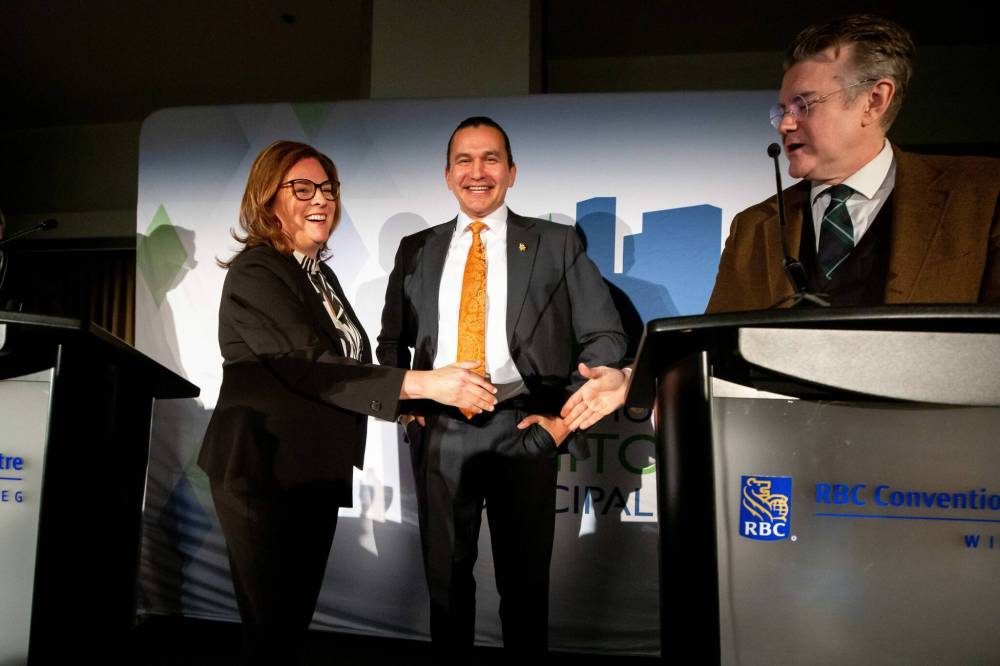
(From left) Premier Heather Stefanson, NDP Leader Wab Kinew and Liberal Leader Dugald Lamont shake hands after the Association of Manitoba Municipalities leaders forum in Winnipeg earlier this year. Deveryn Ross writes that over the last several weeks, Manitobans have heard Stefanson and Kinew each say things and make commitments that appear to be dramatically inconsistent with positions they have previously taken. Meanwhile, Ross points out that Lamont has remained true to his previous positions, offering moderate, reasonable campaign commitments that are consistent with his past policy positions but also notes that the Liberals have a slim chance of winning this fall's provincial election. (Winnipeg Free Press)
Finally, an article published in May on the National Institutes of Health website defines perceived political authenticity as “whether politicians appear as true to themselves,” and adds that “Politicians appear true to themselves when their actions are consistent with their true views (consistency), when they reveal intimate insights about their lives (intimacy), appear down-to-earth (ordinariness) and seem not to be influenced by others but do and say what they think (immediacy).”
I set out all of that in order to make an obvious point: authenticity is a critical factor in today’s politics. Voters are tired of pre-packaged flim-flam from candidates. They want candidates who they perceive as genuine, consistent and true to themselves, warts and all.
With that reality in mind, what are we to make of what is happening in the current Manitoba election campaign?
In the past several weeks, we have seen Progressive Conservative Party Leader Heather Stefanson and Manitoba New Democratic Party Leader Wab Kinew each say things and make commitments that appear to be dramatically inconsistent with positions they have previously taken.
Indeed, Stefanson appears to have suddenly abandoned the fiscal conservatism that she has openly supported for her entire political life, including five years as a senior member of the Pallister government. As deputy premier and member of a number of powerful government committees, she played a direct role in the creation and implementation of austerity measures that included spending cuts, job cuts and hard-nosed collective bargaining tactics.
In March, however, she morphed into Big-Spender Heather. Since then, she and her ministers have sprayed the province with upwards of $2 billion in spending commitments.
Finance Minister Cliff Cullen signalled Stefanson’s transformation in his 2023 provincial budget speech, when he said that “Unlike the budgets of my predecessors where fiscal responsibility ruled the day, Budget 2023 fully reflects the progressive conservative roots of our premier — where helping Manitobans make ends meet and historic new funding will lead to safer streets, stronger communities and the healing of our health care system.”
The problem is that few Manitobans — indeed, few members of her own party — bought what Cullen was selling. It is matter of public record that Stefanson is conservative party royalty, and a multi-millionaire. Her roots are third-generation Tuxedo Tory, not the “progressive conservative roots” Cullen claims she possesses. It’s just not authentic; it’s not real.
The problem is just as bad for Kinew. He’s “on record” as supporting the decriminalization of hard drugs, yet now says he will “drop the hammer” on drug dealers if the NDP win the election. Since becoming NDP leader, he has complained that too many people are incarcerated in our province, yet he is now promising to build a new provincial jail in Dauphin.
For seven years, Kinew attacked and voted against Tory tax cuts, but now he promises to continue the education property tax rebates he repeatedly criticized. He’s promising to cut the gas tax so that it will be cheaper to fuel our cars, but many have pointed out that the promise contradicts his position on greenhouse gas emissions.
Of the three major party leaders, only Liberal Leader Dougald Lamont has remained true to his previous positions, offering moderate, reasonable campaign commitments that are consistent with his past policy positions. That’s laudable, but the Liberals’ chances of winning the election and forming government are rather slim.
And that’s the point: Stefanson and Kinew aren’t adopting these new positions because they sincerely believe in them. They are doing so because polling data suggests that making those commitments could increase their respective parties’ odds of winning the election.
What the polling data doesn’t tell them, however, is that there’s a penalty to be paid by politicians who are perceived as willing to say anything to get elected. They lose credibility, and that costs elections.
Manitoba voters aren’t stupid. They aren’t buying the Big-Spender Heather and Crime-Fighter Kinew characters because neither can possibly be viewed as authentic.
With just five weeks until election day, now would be a good time for Stefanson and Kinew to stop pretending to be people they aren’t, stop making promises that undermine their credibility and start focusing on the critical issues that Manitobans care about.