
Chronic underfunding puts BU in precarious position
Advertisement
Read this article for free:
or
Already have an account? Log in here »
We need your support!
Local journalism needs your support!
As we navigate through unprecedented times, our journalists are working harder than ever to bring you the latest local updates to keep you safe and informed.
Now, more than ever, we need your support.
Starting at $15.99 plus taxes every four weeks you can access your Brandon Sun online and full access to all content as it appears on our website.
Subscribe Nowor call circulation directly at (204) 727-0527.
Your pledge helps to ensure we provide the news that matters most to your community!
To continue reading, please subscribe:
Add Brandon Sun access to your Free Press subscription for only an additional
$1 for the first 4 weeks*
- Enjoy unlimited reading on brandonsun.com
- Read the Brandon Sun E-Edition, our digital replica newspaper
*Your next Free Press subscription payment will increase by $1.00 and you will be charged $20.95 plus GST for four weeks. After four weeks, your payment will increase to $24.95 plus GST every four weeks.
Read unlimited articles for free today:
or
Already have an account? Log in here »
Hey there, time traveller!
This article was published 14/10/2023 (1064 days ago), so information in it may no longer be current.
We saw the crisis coming, we wrote about the danger it posed and measures that were required to avoid it, but now the crisis is here.
Last March, the Stefanson government released its budget for the current fiscal year, including the funding Manitoba’s universities would receive. Under that budget, which was passed in June, the University of Winnipeg received a 20.2 per cent funding increase, the University of Manitoba received a 10.8 per cent increase, and the Université de St. Boniface received a 10 per cent increase. Funding for Brandon University was increased by just 3.5 per cent.
The paltry increase for BU meant that, for the fifth consecutive year, provincial funding for the university rose by a level below the rate of inflation. In the 2019-20 and 2020-21 fiscal years, funding increased by just one per cent per year. It rose by just 0.48 per cent in 2021-22, and by just 0.6 per cent in 2022-23.
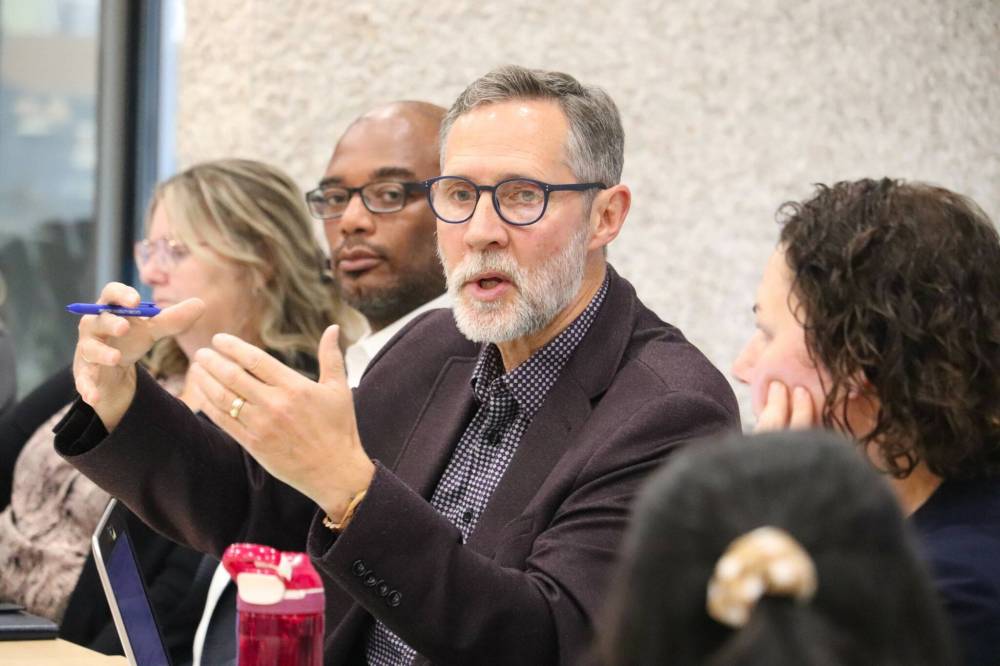
Scott Lamont, Brandon University vice-president of administration and finance, forecasts the school's 2024-25 operating budget expectations during an Oct. 3 Board of Governors meeting. Deveryn Ross asks who will stick up for BU after years of underfunding by the province. (File)
After accounting for inflation, BU is now receiving less funding support now than it received five years ago. It’s funding has basically been cut, year after year, after year.
In response to BU being short-changed yet again, Profs. Scott Forbes and Allison McCulloch (the president and vice-President, respectively, of the Manitoba Organization of Faculty Associations at the time) said this in an op-ed published in the Winnipeg Free Pres on March 22 of this year: “That meagre increase makes no sense, given its precarious financial position, most notably running an operating deficit in 2019/20. The pandemic has adversely affected enrolment, shrinking the tuition-fee base. The lower cap on tuition-fee increases shrinks it even further.”
They said that “there must be an immediate correction to the 2023/24 funding baseline for Brandon University, at least in line with the average increase for the Winnipeg universities,” and warned that continued underfunding of BU by the province could eventually cause a crisis similar to that which recently occurred at Laurentian University. In 2021, that university sought creditor protection, fired more than 100 tenured faculty members and cancelled more than one-third of its programs.
Three days later, I wrote a column in this newspaper that also discussed the issue (Underfunding hurts Brandon University – March 25). I asked whether, after five consecutive years of funding increases below the rate of inflation, anybody really believed BU could withstand another five years of underfunding without dire consequences for the university, our city and region.
I argued that it was time for BU administration, faculty, staff and alumni, to join with residents of our city and region, to join together to tell the Stefanson government that the underfunding of BU must stop.
Forbes, McCullough and I made clear that we were disappointed by way Brandon University was being treated, and that we were concerned about the future of the institution if the underfunding continued. To our surprise, we were basically accused of being Chicken Little alarmists.
Instead of using that moment to launch a unified campaign for stable, adequate funding for the institution, barely a peep was heard from BU administration and its board of governors about the seriousness of the situation. Not one of the government-appointed members of the board stepped forward to tell the Stefanson government that BU deserved better.
To the contrary, BU President David Docherty responded that “Some may say that our resources are stretched, but it is a stretch to say we are facing ‘financial crisis.’”
BU administration may not have regarded the situation as a crisis then, but it sure is now. On Sept. 23, it was revealed that Brandon University administration is projecting a $3 million deficit for the upcoming 2024-25 fiscal year, based on an expected $4.5 million increase in expenses, but just a $1.5 million increase in revenues.
In explaining the projected shortfall, Scott Lamont (BU’s VP of administration and finance) told the university’s board of directors that there are several factors but the primary cause of the projected shortfall is BU’s stagnant provincial operating grant, which is the university’s largest source of revenue.
“Our operating grants decreased over the last four, five years by 2.5 per cent while inflation went up 8.5 per cent,” he said. “At a certain point, you run out of options to find the ways to balance the budget … while you’re trying to offer additional services.”
In response to last spring’s funding announcement, the BU board of governors made cuts in a number of areas, including a $225,000 subsidy for the Program for the Education of Native Teachers (PENT). We can only imagine the cuts that will be necessary in order to address the $3 million deficit projected for next year.
Those cuts could be a devastating blow for BU, our city, region and economy, but that outcome can be avoided if the newly-elected Kinew government chooses to fund our university at the same level as Winnipeg universities. The next provincial budget is still six months away, but the time to make that point is now.
The clock is ticking and the stakes are high, but the silence is deafening. Who is speaking for BU? Who in our community is fighting for more funding — for funding fairness — for our university?