
Creating Co-op success stories
Advertisement
Read this article for free:
or
Already have an account? Log in here »
We need your support!
Local journalism needs your support!
As we navigate through unprecedented times, our journalists are working harder than ever to bring you the latest local updates to keep you safe and informed.
Now, more than ever, we need your support.
Starting at $15.99 plus taxes every four weeks you can access your Brandon Sun online and full access to all content as it appears on our website.
Subscribe Nowor call circulation directly at (204) 727-0527.
Your pledge helps to ensure we provide the news that matters most to your community!
To continue reading, please subscribe:
Add Brandon Sun access to your Free Press subscription for only an additional
$1 for the first 4 weeks*
- Enjoy unlimited reading on brandonsun.com
- Read the Brandon Sun E-Edition, our digital replica newspaper
*Your next Free Press subscription payment will increase by $1.00 and you will be charged $20.95 plus GST for four weeks. After four weeks, your payment will increase to $24.95 plus GST every four weeks.
Read unlimited articles for free today:
or
Already have an account? Log in here »
Hey there, time traveller!
This article was published 06/01/2024 (984 days ago), so information in it may no longer be current.
I admit that I will be showing my bias in writing this month’s column. Of course, I am always biased in favour of Brandon University, but this one is more personally based. In an era where governments, businesses and not-for-profit organizations are calling for “work-ready graduates,” I am eager to talk about one of BU’s greatest assets, our Co-op program.
I say my bias is personal, as our middle son, Quinn, is a co-op education success story from the Sobeys School of Business at Saint Mary’s University in Nova Scotia. He did three work terms, with three different organizations, in two different provinces, and that exposure created a foundation for him to launch his professional career. He is now working full-time with RBC in Victoria, B.C. (Thank you Terry Burgess for your personal support of our son; ACC’s gain is certainly RBC’s loss).
Mamaawii-atooshke aakihkiwiin, Brandon University’s Strategic Plan, focuses on our students, our people and our community. The connection between these three is critical. Preparing our students to tackle economic, social and political challenges is at the heart of what we do, and we do it across the university. Our health studies students have practicums that make them better nurses. Our education students spend a lot of time in classrooms before they get their degrees. Our music students perform on stage throughout their time at BU. And our Co-op program does much the same thing for students in the faculties of arts and science.
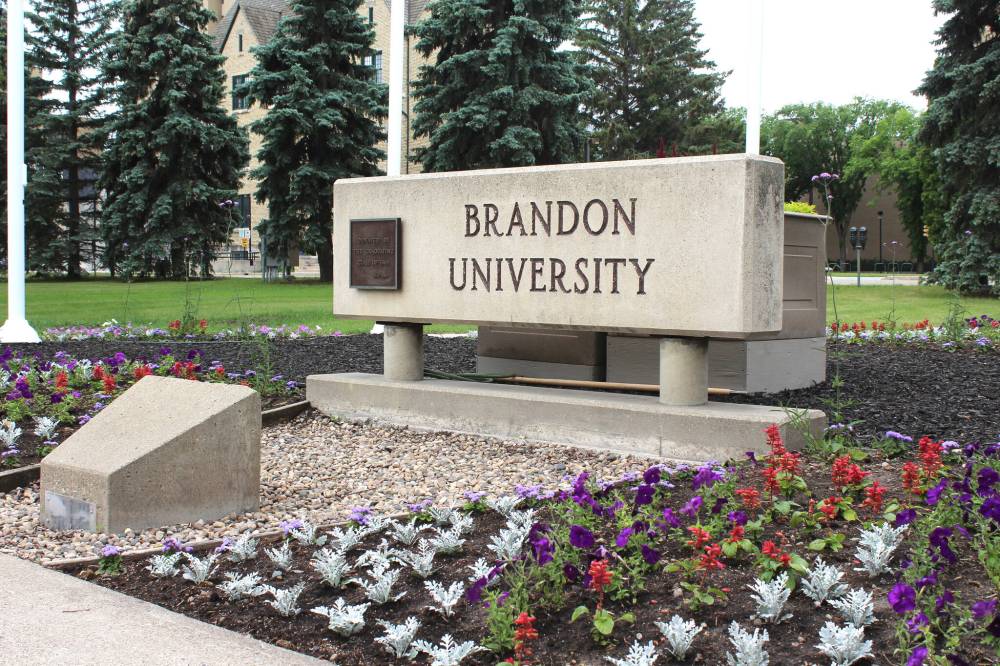
Brandon University president David Docherty writes that in its first five years, the university's Co-op program has connected more than 100 students to meaningful and relevant work opportunities that have generated approximately $1.1 million in student salaries alone. (File)
So what is BU Co-op? Essentially, it connects students to organizations through paid, full-time employment in the summer months. Research shows that students with co-op experience are more likely to secure employment upon graduation, work in jobs related to their degree, and earn higher salaries compared to non-co-op peers. Through career exploration, goal setting, skill development and industry exposure, Co-op students leave university with enhanced resumes, feeling confident and prepared for their first job after graduation. Additionally, as their work-term opportunities are paid employment, Co-op students are learning and earning. Our BU Co-op program, in its first five years, has connected more than 100 students to meaningful and relevant work opportunities that have generated approximately $1.1 million in student salaries alone. That is a significant economic impact for our region.
You may be thinking that these students come predominantly from our business department. While business students are sought after by local firms, I am delighted to share that the majority of Co-op students come from other disciplines like computer science, psychology, history, English, environmental science, biology and applied disaster and emergency studies. Every major in the Faculty of Science, and most majors in arts, allow students to add Co-op to their degree. In fact, Brandon University is the only university in the province to offer Co-op to students majoring in philosophy, religion, gender and women’s studies, fine arts, native studies, French, rural and community studies and sociology. By investing in the transformative power of work-integrated learning programs like Co-op, practicum and placements, we find ways to make quality experiential education accessible to students, which is vital to our vision of being Canada’s finest regional university.
Speaking of accessibility, thanks to the RBC Future Launch Fund, we have been making our Co-op program more accessible to more students. RBC’s generous support, which started in 2021, has allowed us to welcome more Indigenous and international students as well as 2SLGBTQIA+ students, students with disabilities and students from rural or remote communities to join BU Co-op. When I witness the impact Co-op has on students, I can’t help but think that we’re changing the trajectory of students’ lives and their families, especially for students from equity-deserving groups.
Here on campus, we have found that Co-op students make significant contributions. A couple of years ago, we had a Co-op student in our office. Madalyn did several jobs for us, including working with alumni affairs, our communications group and doing some research for me in my role as a political scientist. When her term was over, Madalyn continued to work for us part-time. For students who work for local employers, this is quite common. Co-op students appreciate the opportunity to stay connected to their employer part-time during the school year, and most Co-op students return to the same employer year upon year, which is a great way for organizations to build their talent pipeline.
Beyond a streamlined recruitment strategy, there are many more benefits for employers. Our Co-op students are high-potential, eager to learn and bring an energy and fresh perspective to your workplace. There are also federal wage subsidies and provincial tax incentives that can help reduce the cost of creating a job for a Co-op student. At a time when we’re all trying make the most of our resources, these dollars can make all the difference and allow you to grow your team for a fraction of the cost.
I would like to thank the 70-plus businesses and non-profits in our community who have created a space for our Co-op students over the last five years. Many of you are business leaders, industry experts, and proud BU Alumni who are actively helping us to provide our Co-op student opportunities to hone future-ready skills like communication, collaboration, critical thinking, intercultural effectiveness and digital and technological agility. Thank you.
If you are a business leader, hiring manager or executive director who is looking to add new energy to your team, I invite you to reach out to our Co-op manager, Cora Dupuis. She is the most passionate and dedicated Co-op ambassador I know. She will walk you through the process and help you find the talent you’re looking for. Just like that first RBC manager who hired my son as a co-op student years ago, you too can help create a Co-op success story.
A quick postscript. Over the break, I happened to do a little local Boxing Week shopping (the anticipated annual sweaters where shockingly absent from our tree). I was trying on a sweater and asked the sales person if it seem a little tight. He quietly said, “I am afraid you should probably try the extra large one, president Docherty!” I loved the reminder that we are a small, close-knit community. I thank all employers who hire out students, Co-op or not. It was also the kind of personal attention you get when you shop local.