
Why crackdowns on student protesters are so dangerous
Advertisement
Read this article for free:
or
Already have an account? Log in here »
We need your support!
Local journalism needs your support!
As we navigate through unprecedented times, our journalists are working harder than ever to bring you the latest local updates to keep you safe and informed.
Now, more than ever, we need your support.
Starting at $15.99 plus taxes every four weeks you can access your Brandon Sun online and full access to all content as it appears on our website.
Subscribe Nowor call circulation directly at (204) 727-0527.
Your pledge helps to ensure we provide the news that matters most to your community!
To continue reading, please subscribe:
Add Brandon Sun access to your Free Press subscription for only an additional
$1 for the first 4 weeks*
- Enjoy unlimited reading on brandonsun.com
- Read the Brandon Sun E-Edition, our digital replica newspaper
*Your next Free Press subscription payment will increase by $1.00 and you will be charged $20.95 plus GST for four weeks. After four weeks, your payment will increase to $24.95 plus GST every four weeks.
Read unlimited articles for free today:
or
Already have an account? Log in here »
Hey there, time traveller!
This article was published 30/04/2024 (863 days ago), so information in it may no longer be current.
The recent violent crackdowns on pro-Palestinian encampments on campuses across the United States have reignited a long debate about the role of law enforcement on university grounds.
For those north of the border — despite similar encampments cropping up in recent days at McGill University in Montréal — they may have also reinforced a familiar sense of superiority about our supposedly peaceful nation.
But make no mistake — since at least the 1960s, authorities across Canada have used police to silence peaceful student protests.
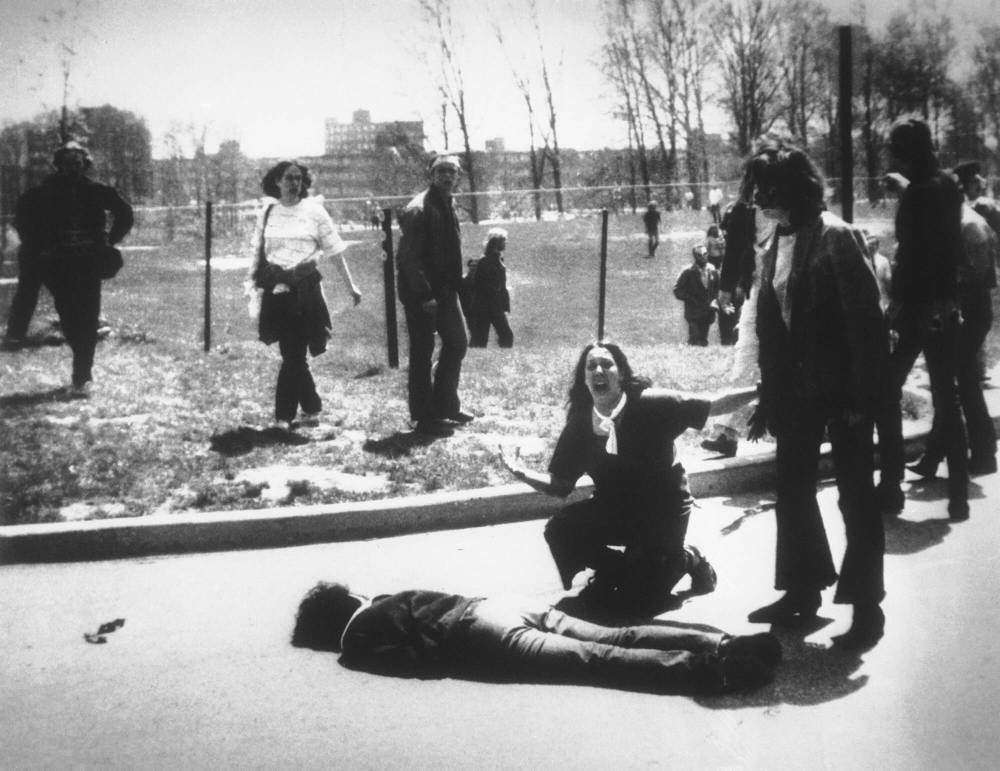
Mary Ann Vecchio gestures and screams as she kneels by the body of a student lying face down on the campus of Kent State University in Kent, Ohio, on May 4, 1970. National Guardsmen had fired into a crowd of demonstrators, killing four. Roberta Lexier writes that no campus protests in Canada have fuelled the type of state violence playing out on American campuses now, not to mention the Kent State incident. (File)
Take Simon Fraser University, for example.
By 1968, the so-called radical campus was accustomed to upheaval. But when approximately 200 students occupied the university’s administration building that year — purportedly to demand equitable admissions processes, though some activists hoped to spark a direct confrontation with campus officials — university president Ken Strand called the RCMP.
In the middle of a November night, 114 students were handcuffed, arrested and escorted down Burnaby Mountain.
Hugh Johnston, a historian at Simon Fraser, described the scene in his book “Radical Campus: Making Simon Fraser University”:
“Over 100 unarmed police officers were on the scene; and they achieved surprise by blocking the road to the university while Vice-President [George] Suart cut off both pay phones and regular phones in the occupied building.
The students inside did not resist and were taken out the back door one at a time — with a police officer on either arm — and through a 50-man police corridor to a succession of [police vehicles] pulling up one behind the other … A crowd from a dance in the cafeteria had formed behind the library where the [vehicles] were lining up, and linking arms, they began singing ‘We Shall Overcome.’”
Police escalation
This was not the first time police helped suppress non-violent demonstrations in Canada.
The 1919 Winnipeg General Strike ended when police officers attacked a crowd that had overturned a streetcar.
On so-called Bloody Saturday, two protesters were killed, 34 wounded and 94 arrested.
It was a similar scene during the Regina Riot in 1935 that left one dead, 45 wounded and 130 arrested.
Even after the Canadian Charter of Rights and Freedoms was enshrined in 1982, guaranteeing the rights to peaceful assembly and free expression for all citizens, protesters risk detention or worse.
Some examples include Indigenous land defenders and those protesting the G20 summit in Toronto in 2010.
For generations, however, universities remained separate from the broader community. Drawing on the principle of in loco parentis — in which colleges act as guardians to their students — institutions had their own rules, disciplinary structures and punishments.
Local law enforcement largely had no jurisdiction and no authority on campuses. Their presence historically caused tension, even riots.
In 1964, for instance, students at the University of California, Berkeley, launched a nationwide movement opposing police interference at the university.
This period of unrest marked a change in the relationship between universities and off-campus authorities after the Second World War.
Charges, prison sentences
Dealing with an influx of anti-authoritarian baby boomers, university administrators lost interest in maintaining their parental responsibilities. Students were to be treated as mature, responsible adults.
After occupying the administrative building in 1968, more than 100 Simon Fraser students faced charges of “mischief against private property” and the possibility of two to 14 years in prison.
Ultimately, 104 pleaded guilty to “disturbance,” receiving $250 fines, and one was sentenced to three months in prison.
At Montréal’s Sir George Williams University — now Concordia — 97 students were arrested for their role in a 1969 occupation protesting racist policies and practices.
As participant Rodney John recalled: “Some were given prison sentences of two weeks to three years. Bail set ranged from $1,500 to $15,000.”
For marginalized students from the Caribbean, such penalties proved catastrophic.
John explained 50 years later: “The cost to the students — not only the ones arrested — is never mentioned, much less calculated.”
Penalties were similarly severe for the 49 students arrested during protests against the Asia-Pacific Economic Cooperation (APEC) meetings at UBC in 1997; the Trent Eight, who were detained in 2001 after occupying a college about to be closed; and the 2,000-plus students arrested during the 2012 tuition protests in Québec.
No campus protests in Canada have fuelled the type of state violence playing out on American campuses now as students protest Israel’s bombardment of Gaza or in May 1970, when the Ohio National Guard shot and killed four student anti-Vietnam War protesters at Kent State University.
Nonetheless, the consequences of police interventions can be severe. Fines, lost employment opportunities, criminal charges and other repercussions can trail students for the rest of their lives.
The increased militarization of police since 9/11 also dramatically raises the risk of violence and injury, as demonstrated in 2011 at the Occupy Wall Street protests and currently during the student encampment protests in the U.S.
At McGill, for now, there has been no police involvement. The university says it’s contemplating its next steps.
Distracting from bigger issues
Police crackdowns can spark additional demonstrations, as they did in the weeks following the Kent State shooting.
What’s more, while violating the fundamental human rights and academic freedom of students, they can also distract from the issues at hand: in the case of the ongoing crackdowns in the U.S., that’s the horrific plight of the Palestinian people.
Even if you disagree with their concerns or their tactics, students should not be penalized for thinking critically about world events and trying to bring about positive social change.
This is exactly what they are supposed to do, and why there has been a push over the past 50 years to devalue and defund humanities and social sciences programs.
If we are serious about solving global problems and creating a more equitable world, then university administrators, politicians and other stakeholders must stop using law enforcement to prevent students from asking inconvenient questions. The costs are simply too high.
» Roberta Lexier is an associate professor in the departments of General Education and Humanities at Mount Royal University.
» This column previously ran at The Conversation Canada: theconversation.com/ca