
Meta’s news ban could leave people at risk in emergencies
Advertisement
Read this article for free:
or
Already have an account? Log in here »
We need your support!
Local journalism needs your support!
As we navigate through unprecedented times, our journalists are working harder than ever to bring you the latest local updates to keep you safe and informed.
Now, more than ever, we need your support.
Starting at $15.99 plus taxes every four weeks you can access your Brandon Sun online and full access to all content as it appears on our website.
Subscribe Nowor call circulation directly at (204) 727-0527.
Your pledge helps to ensure we provide the news that matters most to your community!
To continue reading, please subscribe:
Add Brandon Sun access to your Free Press subscription for only an additional
$1 for the first 4 weeks*
- Enjoy unlimited reading on brandonsun.com
- Read the Brandon Sun E-Edition, our digital replica newspaper
*Your next Free Press subscription payment will increase by $1.00 and you will be charged $20.95 plus GST for four weeks. After four weeks, your payment will increase to $24.95 plus GST every four weeks.
Read unlimited articles for free today:
or
Already have an account? Log in here »
Hey there, time traveller!
This article was published 01/05/2024 (861 days ago), so information in it may no longer be current.
The B.C. government recently announced plans to work with American tech company Meta this wildfire season to deliver important public safety information. Premier David Eby called it a “major step,” and said he was appreciative that a deal could be reached.
While this is a welcome development, Meta is still blocking news outlets from publishing to Facebook and Instagram, including during public safety emergencies when information is needed most. The company took this action in response to Parliament passing the Online News Act in June 2023.
Last summer, the ban made it difficult for news outlets and emergency officials to deliver timely information to the public. This was made more challenging because people are often dispersed geographically and clinging to their phones and social media for reliable guidance. One Yellowknife news editor, in the midst of an evacuation, called the ban “stupid and dangerous.”
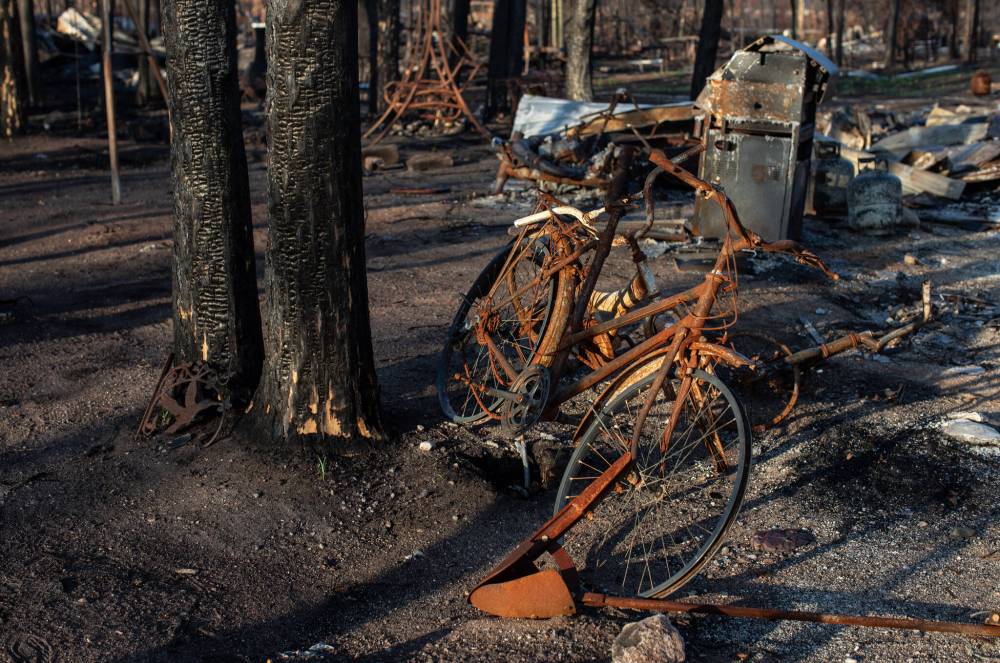
A residential area destroyed by the wildfires is shown in Enterprise, N.W.T., in October 2023. (File)
With wildfire season underway, Meta’s ban continues to display a disappointing lack of corporate responsibility and disdain for Canadian users. If they don’t reverse the news ban during emergencies, the government should look at ways to force them to open their platforms under some circumstances. Longer term, the federal government must revise the ill-considered law that provoked this fight.
In emergencies, information is key
There are already more than 100 fires burning in British Columbia alone. Officials have warned that drought conditions across the country may lead to an even worse fire season than last year.
In these types of emergencies, accurate and current information is vital for health, safety and survival. Crisis communicators and emergency management agencies work with public officials, media organizations and other infrastructure crews to get vital updates and messages to the public through as many commonly co-ordinated channels as possible.
Facebook remains the most popular social media platform in Canada and public communicators understand its importance. For example, Drexel University’s School of Public Health houses an online Social Media Message Library that provides examples of social media messaging best practices during crises and emergencies, including successful instances from Facebook.
Thankfully, government Facebook and Instagram pages have been able to post critical emergency information during the ban. But for public safety information to reach as many people as possible, overworked communications teams need news outlets to amplify their messages.
Filling the vacuum
A recent study from the Media Ecosystem Observatory, an interdisciplinary collaboration between McGill University and the University of Toronto, suggests that six months after the ban, roughly a third of Canadians still use Facebook or Instagram for news and current affairs information. In northern, rural and Indigenous communities, where there is often poor communications infrastructure and long distances between population centres, this is likely much higher.
With news unavailable on the platform, we have seen some small shifts in user behaviour. According to the study, users’ political engagement appears to have stayed the same and some sites, such as the conservative Canada Proud network, have seen an increase in engagement. News outlets, meanwhile, have seen their own engagement plummet. Screenshots of news articles have become the preferred way to get around the ban, especially during emergencies like the Yellowknife evacuation.
We have also seen the rise of social media influencers wielding disproportionate sway during emergencies. For example, during the August 2023 wildfires in the Shuswap Lake region in B.C., conspiracy theories and misinformation spread faster than the mainstream media’s messages in small communities.
How to solve this mess
It didn’t have to be this way. The Liberal government’s Online News Act — which forces large social media companies to negotiate with news outlets for compensation — was flawed from the start. The government ignored warnings about the law’s potentially disastrous consequences for small, independent media outlets that rely on social media to distribute their content and communicate with audiences.
In forging ahead, the government has provoked what law professor Michael Geist called a “lose-lose-lose-lose scenario.” It’s bad for news organizations, bad for the platforms and even worse for the public. And while Meta’s actions are over the top, they telegraphed their intentions, which the Trudeau government decided to ignore.
Google made similar threats, but eventually reached a $100-million agreement with the Canadian government in November 2023.
Meta, on the other hand, has chosen profit over tackling misinformation. Its own corporate principles commit to public safety and building community. If Meta was acting on these principles, it would be supplying emergency responders and Canadians with its communication tools during times of crisis, regardless of its battles with the government.
So far, Meta has shown no appetite to change its policy. It is fighting similar battles in Australia and elsewhere and appear willing to make an example out of Canada.
If Meta does not reconsider its position, the Liberal government must explore legal or regulatory options to force the company to open its platforms to news outlets during public emergencies. Further, the government needs to scrap or revise the Online News Act to require and incentivize social platforms like Facebook to be available for media amplification during public emergencies.
Last summer, premiers, Indigenous groups and other members of the public requested the Meta media ban stop during emergencies. As wildfire season begins again, the company and federal government should make sure the public has access to potentially life-saving information.
» Archie McLean is an associate professor of journalism and digital media at Mount Royal University. Peter Malachy Ryan is an associate professor of public relations at Mount Royal University.
» This column was originally published at The Conversation Canada: theconversation.com/ca