
Fixing the notwithstanding clause
Advertisement
Read this article for free:
or
Already have an account? Log in here »
We need your support!
Local journalism needs your support!
As we navigate through unprecedented times, our journalists are working harder than ever to bring you the latest local updates to keep you safe and informed.
Now, more than ever, we need your support.
Starting at $15.99 plus taxes every four weeks you can access your Brandon Sun online and full access to all content as it appears on our website.
Subscribe Nowor call circulation directly at (204) 727-0527.
Your pledge helps to ensure we provide the news that matters most to your community!
To continue reading, please subscribe:
Add Brandon Sun access to your Free Press subscription for only an additional
$1 for the first 4 weeks*
- Enjoy unlimited reading on brandonsun.com
- Read the Brandon Sun E-Edition, our digital replica newspaper
*Your next Free Press subscription payment will increase by $1.00 and you will be charged $20.95 plus GST for four weeks. After four weeks, your payment will increase to $24.95 plus GST every four weeks.
Read unlimited articles for free today:
or
Already have an account? Log in here »
Hey there, time traveller!
This article was published 30/05/2024 (908 days ago), so information in it may no longer be current.
These are hard days for defenders of the Charter of Rights and Freedoms.
The Governments of Quebec, Ontario, and Saskatchewan have recently passed legislation invoking Section 33 of the Constitution, which gives legislatures the power to pass legislation that derogates from the sections of the Charter that protect fundamental freedoms, legal rights, and equality rights. The willingness, even enthusiasm, of certain provinces to diminish individual rights has tempted Pierre Poilievre, leader of the Conservative Party, to muse that if elected prime minister, he might go down that road too, thereby breaking the taboo that no federal government has ever used Section 33.
The debate over Section 33 goes back to the adoption of the Charter in the first place as the culmination of the great constitutional compromise of November 1981 between the provinces and the federal government.
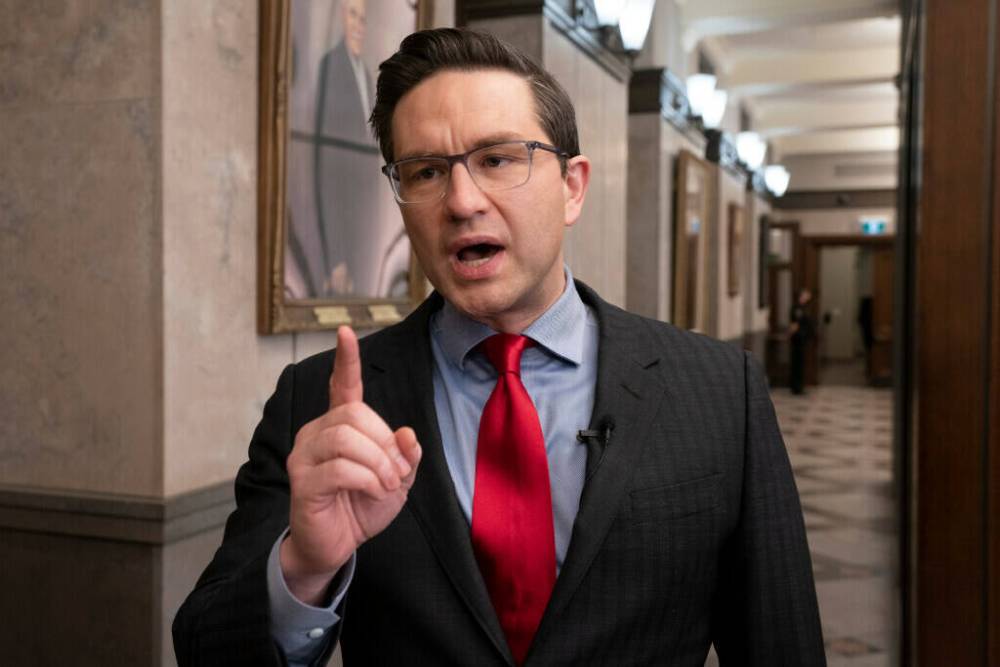
There is a trend among certain provincial governments to invoke the notwithstanding clause to skirt the courts and the Charter of Rights and Freedoms. Federal Opposition Leader Pierre Poilievre (shown here) has even pondered whether he would use it if elected prime minister, which the federal government has never done before. Manitoba should lead the way in reversing this populist strategy, Thomas S. Axworthy writes. (File)
In 1954, Pierre Trudeau, then a young lawyer serving as counsel to a Quebec trade union, wrote a brief submitted to the Tremblay Royal Commission that called on Quebec to “declare its willingness to accept the incorporation of a declaration of human rights into the Constitution … It could also propose a specific plan to repatriate the Canadian Constitution, including an amending formula.” A generation later, these three goals continued to form the core of Prime Minister Trudeau’s constitutional mission.
In 1981, in a final burst of negotiation after years of fruitless meetings, the provinces and the Government of Canada agreed to a package of amendments to the Constitution that achieved the three goals. The deal was, in essence, a swap — the federal government accepted the provincially inspired Alberta amendment formula in exchange for the provinces agreeing to the federally drafted Charter of Rights and Freedoms.
But it was a Charter with an escape hatch: at provincial insistence, Section 33 was added. It states that Parliament or legislatures in passing legislation may declare that an Act shall operate “notwithstanding” the protections of sections 2 (fundamental freedoms) or sections 7-15 (legal and equality rights).
How best to protect rights was a constant in the decades-long federal-provincial negotiations over the Constitution.
Proponents of the Charter could point to relatively recent abuses of rights, as when the Mackenzie King government, to its eternal shame, gave in to wartime hysteria and took away the liberties and property of thousands of Japanese Canadians who had done no wrong.
Such actions, Trudeau argued, should be subject to judicial review with the courts serving as a countervail to the power of parliamentary majorities. Defenders of parliamentary supremacy, like Premiers Sterling Lyon of Manitoba or Allan Blakeney of Saskatchewan, worried about judicial activism thwarting the prerogatives of elected politicians.
Section 33, which Trudeau very reluctantly accepted, was the compromise that bridged these two positions. Defenders of Section 33 believed it would be used only as a last resort to defend parliamentary supremacy, while optimists wrote that rights might even be enhanced because there could be a public dialogue between the courts and legislatures.
Today, the dialogue theory is in shreds.
Led by Quebec, provinces have resorted to the notwithstanding clause 26 times in legislation, and most worryingly they have been using Section 33 pre-emptively, putting it into legislation before the courts even have a chance to review whether rights have been infringed. Such pre-emption leaves individuals, especially minorities, vulnerable to the outbursts of populist distemper that majorities sometimes display.
Canadians understand these dangers. A 2023 survey by the Angus Reid Institute reported that 58 per cent of Canadians were concerned about the increased use of the notwithstanding clause in provincial politics with 55 per cent favouring its abolition (62 per cent in Manitoba).
It is time to rein in the excesses of the current use of the notwithstanding clause. The Government of Manitoba can lead the way. Premier Wab Kinew should bring in a bill to establish guardrails on the use of Section 33: the bill should prohibit the use of pre-emption and stipulate that at least 60 per cent of the members of the Manitoba legislature must approve any potential application of the clause.
Manitoba was a democratic innovator in being the first province to give women the vote in 1916 and in establishing an independent electoral boundary commission to eliminate gerrymandering in 1957. We need our province to be a first mover again — this time to protect the Charter of Rights and Freedoms from populist politicians who want to remove any judicial restraint on their executive power.
» Thomas S. Axworthy was principal secretary to former Prime Minister Pierre Trudeau.