
Manitoba at risk of losing its housing affordability advantage
Advertisement
Read this article for free:
or
Already have an account? Log in here »
We need your support!
Local journalism needs your support!
As we navigate through unprecedented times, our journalists are working harder than ever to bring you the latest local updates to keep you safe and informed.
Now, more than ever, we need your support.
Starting at $15.99 plus taxes every four weeks you can access your Brandon Sun online and full access to all content as it appears on our website.
Subscribe Nowor call circulation directly at (204) 727-0527.
Your pledge helps to ensure we provide the news that matters most to your community!
To continue reading, please subscribe:
Add Brandon Sun access to your Free Press subscription for only an additional
$1 for the first 4 weeks*
- Enjoy unlimited reading on brandonsun.com
- Read the Brandon Sun E-Edition, our digital replica newspaper
*Your next Free Press subscription payment will increase by $1.00 and you will be charged $20.95 plus GST for four weeks. After four weeks, your payment will increase to $24.95 plus GST every four weeks.
Read unlimited articles for free today:
or
Already have an account? Log in here »
Hey there, time traveller!
This article was published 31/05/2024 (838 days ago), so information in it may no longer be current.
Premier Wab Kinew said Tuesday at the Manitoba Chambers of Commerce breakfast event that one of this province’s advantages is its affordable housing.
Unfortunately, that used to be true. It’s not any longer. But it’s a great line Manitoba business owners and government have used to recruit out-of-province employees or to try to retain current staff leaving for other provinces.
Kinew was addressing the issue of reducing the migration of people out of the province to other cities. He is wise to be concerned. Both Edmonton and Calgary saw the largest year-over-year population increase since Statistics Canada began keeping records in 2001. Calgary’s population grew by six per cent, while Edmonton’s grew by 4.2 per cent. Winnipeg is stagnant, yet again.
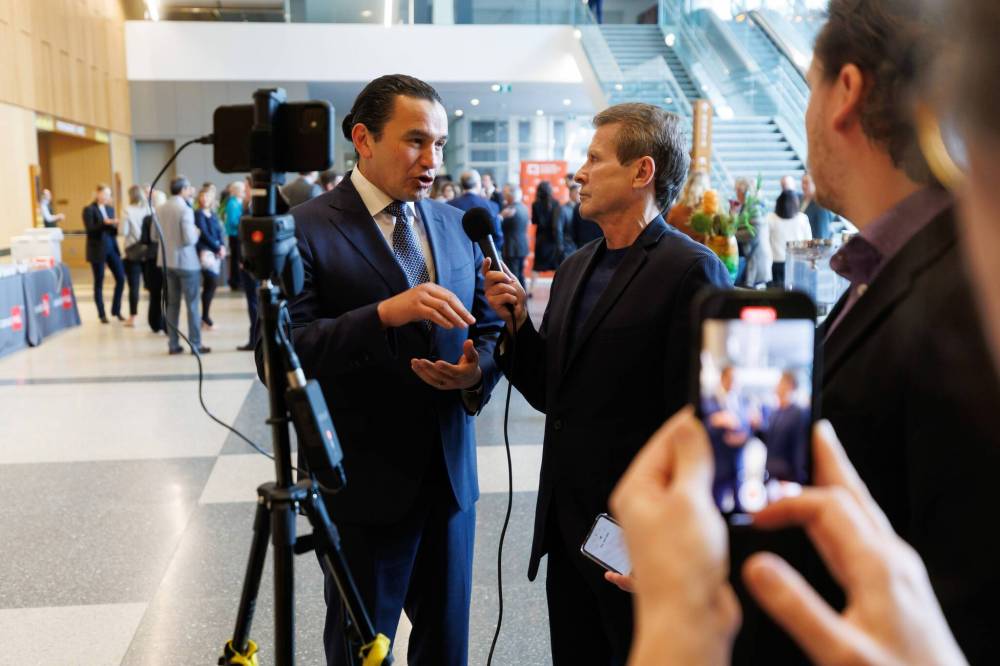
Premier Wab Kinew chats with media before Tuesday’s Manitoba Chambers of Commerce breakfast, where he addressed reducing the migration of people out of the province. (Mike Deal/Winnipeg Free Press)
Yet, despite its surge in growth, Edmonton’s average housing cost is about the same as Winnipeg’s. According to the Realtor’s Association of Edmonton, the average house in Alberta’s capital is $407,458. In Manitoba’s capital, the average cost of a home is $406,533. That’s pretty close.
Calgary is a different story, of course. Calgary’s average home goes for about $688,500. So compared to Calgary, sure, Winnipeg may be affordable. But let’s compare average wages. According to the Government of Canada, a receptionist in Calgary can expect to be paid on average around $20 an hour, while a software engineer or designer would get on average around $52.88 per hour.
In Edmonton, where the housing costs are relatively the same as Winnipeg, that receptionist gets paid on average $18.50 an hour. The software engineer or designer takes home on average $45.67 an hour.
In Winnipeg, those wages are significantly lower by comparison. A receptionist is paid on average $17.96 per hour while a software engineer or designer gets just $36.06.
Some Manitoba advantage.
With an unemployment rate of 3.8 per cent in Alberta, it’s likely that those hourly rates will start to rise, while Manitoba’s unemployment rate is standing at slightly higher than five per cent. Wages appear to be stagnant.
At the same time, Albertans don’t pay a provincial sales tax. Every time they purchase clothing, cars, housing or services, they only need to pay the GST and that’s it. That’s another significant saving.
Property taxes in Winnipeg are also expensive, although the NDP has announced an “affordability tax credit” that ostensibly wipes out education property taxes on homes valued at less than $285,000. Still, according to an online article published by Forbes Advisor, Winnipeg’s municipal tax rate is the highest in Canada. Both Edmonton and Calgary are significantly lower.
According to a 2022 report from the Canada West Foundation, Manitoba, along with Saskatchewan, has been experiencing net out-migration for most of the last 50 years. Any growth in population has had to come from relying on immigration. Manitoba’s compound annual growth rate is just under one per cent, according to Economic Development Winnipeg. This province must rely on immigration to ensure that the population doesn’t dwindle, particularly as it ages.
Research shows that young people leave Manitoba to pursue opportunities both education- and career-wise, but the belief is that they will eventually return to their roots once they have a family. The affordability of homes in Winnipeg used to be the beacon needed to guide them back home.
But it makes no sense now, when the housing market is on par with cities like Edmonton that offer better wages, no sales tax and lower municipal taxes. Grandma and grandpa can always retire in Alberta, with a lower overall personal income tax rate and health premiums.
The Manitoba Chambers of Commerce is in the process of building on the research from that Canada West report to determine how to address the net out-migration problem.
Here’s my suggestion: start paying people more. And stop repeating the lie that this province offers affordable housing.
It’s just not true anymore.
» Shannon Sampert is a lecturer at RRC Polytech. She was the politics and perspectives editor at the Winnipeg Free Press from 2014-17. This column previously appeared in the Free Press.