
How forest fires also have impact on lakes
Advertisement
Read this article for free:
or
Already have an account? Log in here »
We need your support!
Local journalism needs your support!
As we navigate through unprecedented times, our journalists are working harder than ever to bring you the latest local updates to keep you safe and informed.
Now, more than ever, we need your support.
Starting at $15.99 plus taxes every four weeks you can access your Brandon Sun online and full access to all content as it appears on our website.
Subscribe Nowor call circulation directly at (204) 727-0527.
Your pledge helps to ensure we provide the news that matters most to your community!
To continue reading, please subscribe:
Add Brandon Sun access to your Free Press subscription for only an additional
$1 for the first 4 weeks*
- Enjoy unlimited reading on brandonsun.com
- Read the Brandon Sun E-Edition, our digital replica newspaper
*Your next Free Press subscription payment will increase by $1.00 and you will be charged $20.95 plus GST for four weeks. After four weeks, your payment will increase to $24.95 plus GST every four weeks.
Read unlimited articles for free today:
or
Already have an account? Log in here »
Hey there, time traveller!
This article was published 27/06/2024 (814 days ago), so information in it may no longer be current.
The forest fires in Canada during the summer of 2023 were particularly devastating. With the destructive impact on human infrastructure, plumes of smoke covering thousands of square kilometres and millions of tonnes of CO2 being emitted, 2023 is being called a record year for forest fires.
The different impacts the fires had obviously raise concerns about air quality and climate change. Studies also point to a potential feedback effect. In other words, climate change exacerbates fires, which in turn exacerbate climate change.
But there is another issue of growing concern to experts: what are the effects of forest fires on lakes?
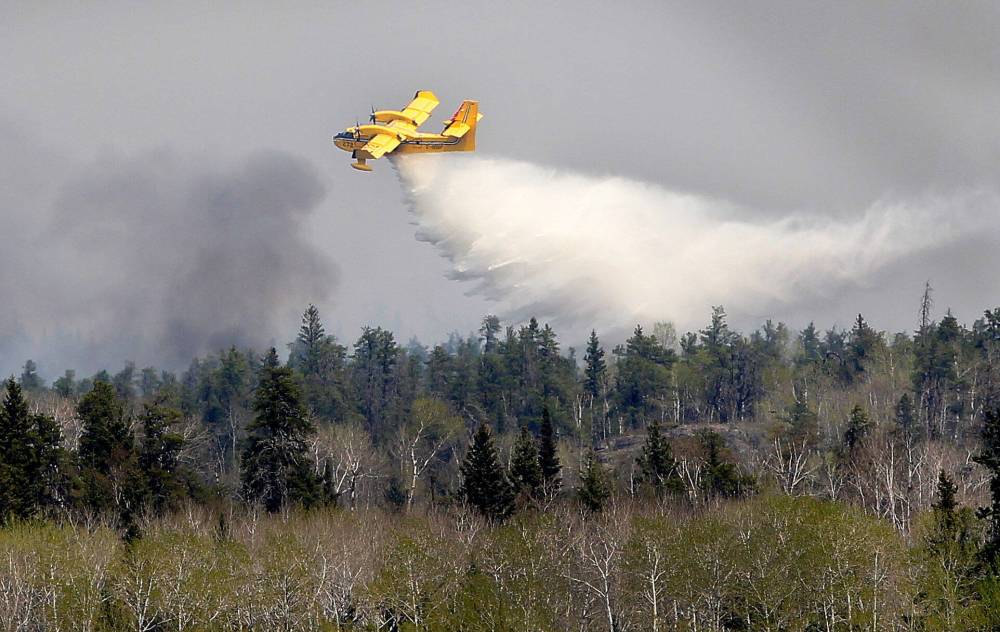
Water bombers from Ontario dump water on the forest fire on the east end of Caddy Lake in the Whiteshell in May 2016. Jean-François Lapierre and Mathilde Bélair write that while drawing water from lakes to fight fires is effective, it can disrupt the physical structure of the lakes. (Winnipeg Free Press)
As researchers in freshwater ecology, we aim to shed light on this question by looking at the three main factors that are believed to affect aquatic ecosystems in burned catchment areas.
PUTTING OUT FIRES WITH LAKE WATER
One way of fighting fires is to use large quantities of water, often drawn from lakes and transported by air tankers. Although effective, this method can disrupt the physical structure of the lakes (water level, disturbance of deep-seated sediments).
Products containing nutrients (nitrogen, phosphorus) or potentially toxic substances for aquatic life can also be added to the water to prevent it from evaporating too quickly before reaching the ground. Yet few, if any, scientific studies have documented the effect of this phenomenon on lakes themselves.
DON’T UNDERESTIMATE SMOKE PLUMES
Smoke plumes (and the ash they contain) bring large quantities of nutrients, metals and minerals that can be deposited on the surface of lakes. In extreme cases, up to 20 centimetres of ash has been deposited on lakes near high-intensity fires.
Studies suggest that the effects of these ash deposits on lakes are relatively short term. They can last from a few days to a few months, depending on how long it takes for the lake water to renew itself.
These effects are more significant in hot, dry regions (such as California and the Mediterranean), where lakes typically drain small catchment areas with soils that are poor in organic matter and nutrients. In these regions, the input of nutrients or pollutants from the atmosphere can be proportionally greater than the input via rainwater leaching.
A persistent plume of smoke can also capture a large proportion of the sun’s rays, which disturbs aquatic organisms that photosynthesize (and therefore need light).
MORE WATER TRANSPORTED FROM SOILS TO LAKES
The transport of matter from the terrestrial environment to lakes through leaching seems to be the main driver of the effects of fires on the majority of Canadian lakes.
Combustion itself greatly alters the physical and chemical structure of soils. In addition, tree mortality reduces evaporation and accentuates erosion, causing more water to be transported from the soil to the lakes. What’s more, following a fire, the transport of water from the soil to the lakes tends to take place in the surface soils, which are richer in various materials (organic carbon and nutrients naturally present, in addition to combustion residues).
Chemical changes in soils caused by fires increase the mobility of matter during rainfall. As a result, lakes draining burned land receive a greater volume of water (runoff), which contains more nutrients and combustion residues, than lakes draining unburned land.
These effects can persist for several years, depending on how quickly catchment areas recover after a fire. Indeed, studies have shown increases in concentrations of nutrients (nitrogen, phosphorus), organic carbon and suspended solids in lake water for up to four years after fires. But the effects on aquatic life (abundance, potential contamination) remain unclear.
These effects on water quality and aquatic life would in fact be comparable to those observed during forest cutting. The impact of fires seems to be proportional to the severity (the area covered) and intensity (the heat) of the fire, up to a certain point. Fires that are too hot (where the temperature exceeds 450 C) can actually lead to the material in the soil literally going up in smoke rather than being transported to the lakes.
AN ENORMOUS AMOUNT OF CARBON
In Canada alone, in 2023, around 480 million tonnes (mt) of carbon (i.e. 1,760 mt of CO2) were emitted into the atmosphere as a direct result of the burning of trees (and soils) by forest fires. This quantity far exceeds the 708 mt of CO2 emitted by all human activities in the country.
Every square metre of burned land will be drained by an aquatic ecosystem, often a lake. And fires increase the carbon load toward lakes. It is therefore likely that an additional — but as yet not quantified — return of terrestrial carbon will be re-emitted via the surface of lakes into the atmosphere following the conversion of organic carbon into CO2 via biological and physical processes in the water. Another portion of the carbon deposited in lakes may sediment and be stored deep in the sediments over the long term.
Quantifying the fate of terrestrial carbon in lakes following forest fires will provide a better understanding of the extent to which lakes amplify or mitigate a possible feedback loop between forest fires and climate change.
» Jean-François Lapierre is a limnology professor at the Université de Montréal. Mathilde Bélair is a limnologist and aquatic biogeochemist (carbon cycle) at the Université de Montréal.
» This column was originally published at The Conversation Canada: theconversation.com/ca