
How overcrowding impacts the world’s tourism hot spots
Advertisement
Read this article for free:
or
Already have an account? Log in here »
We need your support!
Local journalism needs your support!
As we navigate through unprecedented times, our journalists are working harder than ever to bring you the latest local updates to keep you safe and informed.
Now, more than ever, we need your support.
Starting at $15.99 plus taxes every four weeks you can access your Brandon Sun online and full access to all content as it appears on our website.
Subscribe Nowor call circulation directly at (204) 727-0527.
Your pledge helps to ensure we provide the news that matters most to your community!
To continue reading, please subscribe:
Add Brandon Sun access to your Free Press subscription for only an additional
$1 for the first 4 weeks*
*Your next subscription payment will increase by $1.00 and you will be charged $20.00 plus GST for four weeks. After four weeks, your payment will increase to $24.00 plus GST every four weeks.
Read unlimited articles for free today:
or
Already have an account? Log in here »
Hey there, time traveller!
This article was published 03/08/2024 (607 days ago), so information in it may no longer be current.
Every summer, millions of people jet off on vacations around the world. The United Nations World Tourism Organization estimates that international arrivals, the measure of global travel, will be two per cent higher than the pre-pandemic total was in 2019.
However, as more of us are taking vacations, some of the world’s tourism hot spots are feeling more crowded than ever. And that has even led to protests in some popular destinations. Residents in some European cities have marched through popular areas, calling on tourists to “go home.”
Some destinations, like Amsterdam, are doing what was previously thought unthinkable and actively discouraging visitors. Tourism crowding has become an indelible feature of travel and it warrants some understanding.
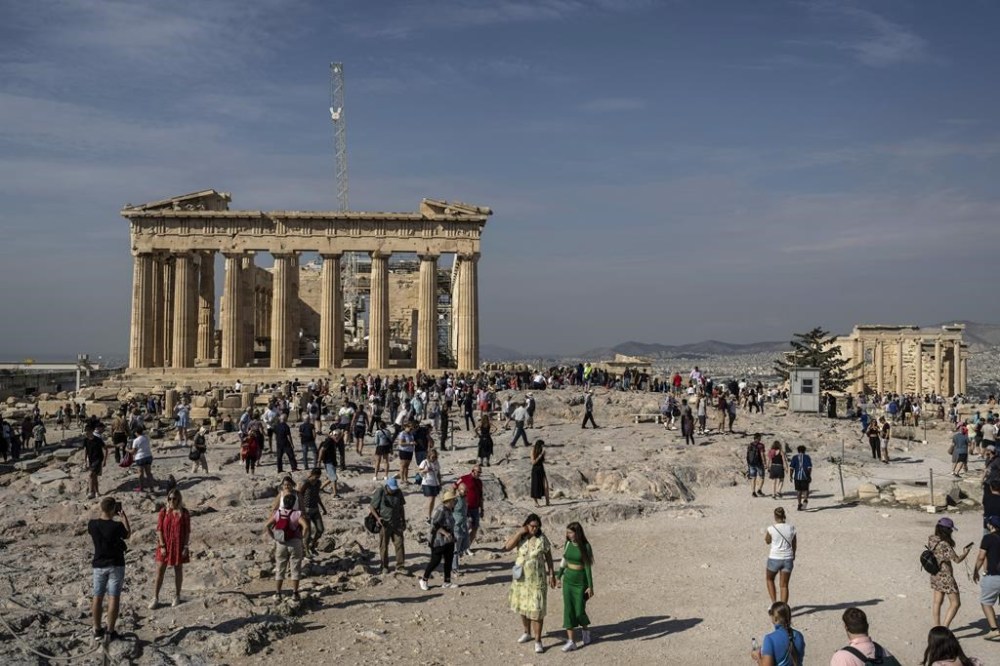
So, what is overcrowding in tourism? How do we respond to it? And why does it appear to be increasing?
Tourism overcrowding
At its most basic level, overcrowding occurs because a lot of people decide to go to the same place at the same time.
There are three basic principles of tourism overcrowding. Firstly, overcrowding is real and it creates stress and compromises our experience.
Secondly, we feel more crowded in the presence of incompatible behaviours. For instance, we are more likely to feel overcrowded on a sidewalk if we have to avoid a skateboarder, a cyclist and a couple of aggressive vendors than we might at a packed music festival where everyone is acting similarly.
Thirdly, a place is overcrowded when we think it is. There is no standard measure of overcrowding for the visitor. It is an individually experienced phenomena.
We cannot understand tourism crowding without taking into account the context of local residents. We recently learned of locals spraying tourists in Barcelona with water guns as part of a demonstration. Locals do not do that unless they are truly fed up.
This brings us to what I call the host-guest covenant, which is the idea that visitors should keep to touristic areas so residents can maintain the sanctity of their neighbourhoods.
With the rise of short-term rentals, many visitors are able to go beyond the touristic parts of town. Some visitors might believe that, by sticking to touristic areas, their trip remains superficial and undeserving of the time and money it costs.
Short-term rentals can allow them to avoid other tourists and gain a more “authentic” experience. However, it can make things worse for residents, who must contend with more tourists encroaching on their neighbourhoods.
How people cope with overcrowding
Some people detest crowds, while others are drawn to them. There are four basic ways people cope with the stress of overcrowding.
The first way is to alter travel plans to avoid crowds. It’s the most common coping method and involves avoiding certain places when we know they’re going to be busy.
Another method is rationalization. When people find themselves in tourist crowds, they often rationalize the situation to avoid cognitive dissonance. For instance, visitors to the Louvre Museum might be more willing to tolerate crowds because they expect everyone wants to see the Mona Lisa.
It implies people knowingly enter overcrowded tourist spaces. And they do, for several reasons: the attraction, fear of missing out, because crowds offer a sense of safety, and the validation that they’re somewhere important. Rationalization explains why we see thousands of people in the same place at the same time.
A third coping method is product shift. It suggests we will intentionally downgrade a product to avoid cognitive dissonance. When someone tells you that Tofino used to be a quaint little surf town and now it’s touristy, they are engaging in product shift.
The fourth is direct action, which involves contacting the authorities to rectify a situation. It can be as simple as asking a museum official to quiet down a noisy group or posting a review of Niagara Falls suggesting more information on how to avoid crowds.
Coping methods are similar for visitors and the residents of the places they visit, but the latter places more emphasis on displacement. They have a deeper knowledge of the place and ability to navigate crowds effectively.
Social media’s impact
Some argue tourism took a sharp turn for the worse with the advent of social media. Maybe, but the real impact of social media is that it made travel into a more visible status symbol.
Prior to social media, returning travellers would print out their photos and share them with family and friends. Today we can share our photos instantly online.
In addition, a desire to have the most “Instagrammable” experiences encourages risk avoidance. In essence, it encourages us to stick to the tried-and-true tours, destinations and attractions, rather than off-the-beaten-path places. This reinforces the basic principle of overcrowding: a lot people deciding to go the same place at the same time.
Given all these trends, it is expected that most post-pandemic travel will continue to be trips to “safer” destinations where tourists believe they are more likely to get their money’s worth. In other words, the Global North travellers going to places in the Global North they believe will be worthwhile experiences.
All tourists want to have a good time when on holiday. That often means the wisdom of crowds still holds sway, and no matter how uncomfortable overcrowding might be, thousands of people going the same place at the same time feels less risky than being on your own.
» Joe Pavelka is a professor in the Department of Health and Physical Education at Mount Royal University.
» This column was originally published at The Conversation Canada: theconversation.com/ca