
Do campaign ethics still matter in the age of Trump?
Advertisement
Read this article for free:
or
Already have an account? Log in here »
We need your support!
Local journalism needs your support!
As we navigate through unprecedented times, our journalists are working harder than ever to bring you the latest local updates to keep you safe and informed.
Now, more than ever, we need your support.
Starting at $15.99 plus taxes every four weeks you can access your Brandon Sun online and full access to all content as it appears on our website.
Subscribe Nowor call circulation directly at (204) 727-0527.
Your pledge helps to ensure we provide the news that matters most to your community!
To continue reading, please subscribe:
Add Brandon Sun access to your Free Press subscription for only an additional
$1 for the first 4 weeks*
*Your next subscription payment will increase by $1.00 and you will be charged $20.00 plus GST for four weeks. After four weeks, your payment will increase to $24.00 plus GST every four weeks.
Read unlimited articles for free today:
or
Already have an account? Log in here »
Hey there, time traveller!
This article was published 31/08/2024 (580 days ago), so information in it may no longer be current.
Donald Trump is under fire for sharing a social media post featuring a misogynist and offensive slur against U.S. Vice-President Kamala Harris.
Prior to Trump’s arrival on the American political stage, such unethical behaviour would have probably immediately disqualified presidential candidates.
That’s seemingly no longer the case as the Republican party once again places its hopes in Trump to win the White House in November.
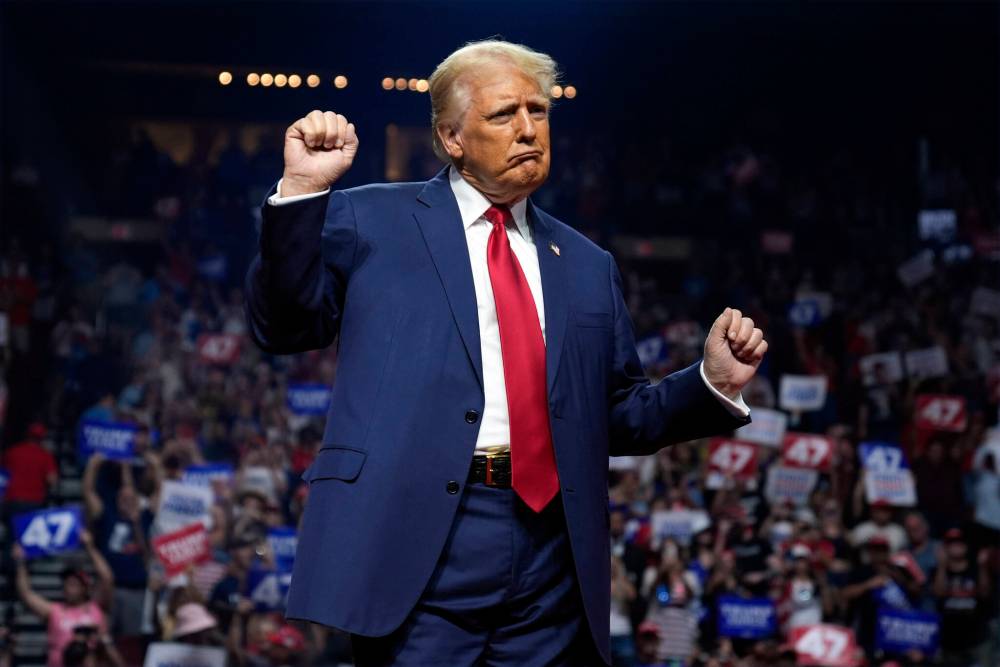
Republican presidential nominee Donald Trump dances during a campaign rally last week at the Desert Diamond Arena in Glendale, Ariz. (File)
This latest Trump smear takes place as public trust in government is declining in both Canada and the United States. Justin Trudeau is the first prime minister to violate federal ethics legislation. Trump is the first former American president convicted of criminal charges.
Unethical behaviour by elected officials knows no borders or party lines.
In both Canada and the U.S., pivotal elections are looming that will determine the political landscape for the remainder of the decade.
In those upcoming elections, does running an ethical campaign still matter for politicians seeking their country’s highest office?
Campaign ethics involve political campaigns adhering to the principles of honesty, integrity and transparency, and assisting the electorate in making informed decisions.
Unethical campaigning undermines public trust, fosters confusion, sows division, amplifies cynicism and leads to negative views about government.
There are four practices candidates can implement to ensure they conduct an ethical campaign.
Avoid Mudslinging
Campaign civility has shifted in the Trump era. Dirty campaigning, which includes tactics like name-calling, belittling opponents and incivility, is becoming de rigueur.
In July, Trump — notorious for his history of dirty campaign tactics — questioned Harris’s racial identity.
Less than a month later, the Republican presidential nominee unleashed a barrage of personal attacks and insults against her during a Pennsylvania rally.
At the 2024 Democratic National Convention, Barack and Michelle Obama took personal jabs at Trump, with Barack Obama even using hand gestures to insinuate that Trump’s fixation on small crowd sizes was related to the size of his genitalia.
If voters consider ethics important, they’d do well to consider how often candidates resort to name-calling and incivility.
At the same time, the mudslinging cycle is hard to stop. Some observers liked that the Obamas stopped “going high” and believe the Democrats need to fight fire with fire regarding Trump.
Prioritize Truth
At the 2024 Democratic and Republican conventions, Trump and Harris were fact-checked multiple times for false statements.
Trump has become the master of repeating untrue statements so often that his audiences start to believe his lies.
After the results of the 2020 election, the former president repeatedly spread false claims about voter fraud and a stolen election, a narrative that he still promotes.
In an age of short messages sent over social media, with great competition for eyeballs, the more outrageous statements will garner attention.
The dissemination of misinformation erodes trust in campaigns and election outcomes, while distorting the knowledge needed for informed policy debate. Misinformation makes it difficult for voters to make an informed choice at the ballot box.
Clarity over confusion
Ambiguity on contentious policy issues, through vague or mixed statements by candidates, can be an effective strategy in some circumstances. While this kind of rhetoric has some upside, it poses risks to transparency and trust.
Voters can become cynical and distrustful of grandiose promises and lazy slogans, ultimately eroding public confidence in democratic processes. Prioritizing clarity and honesty will result in greater voter trust and help uphold democratic integrity.
Transparent campaign financing
The 2024 U.S. presidential election campaign has already seen megadonors pour in billions of dollars. The 50 largest individual donors have already contributed US$1.5 billion to political action committees and other interest groups supporting candidates on both sides.
Critics have argued that the growing disconnect between politicians and their constituents is partly due to campaign finance systems. In the U.S., rules allow a small number of wealthy donors to make substantial contributions.
So-called Super PACs — political action committees — can only finance independent expenditures and independent political activity. The funds do not go to political candidates, which raises serious concerns about transparency. These committees can raise unlimited amounts from individuals, corporations and unions to overtly advocate for or against candidates. The result is that voters are not sure whose interest political candidates seek to serve.
Transparency and accountability regarding political financing are essential to the integrity of political campaigns. Candidates who disclose the source of campaign funding minimize conflicts of interest and reduce the risk of being captured by special interests.
What’s Next?
If behaving morally still matters to those running for office, and to voters, then adopting ethical campaign practices that align with civility, transparency, honesty and integrity is a step in the right direction.
If campaign ethics no longer matter, the U.S. and Canada will face more contested elections, greater political division and further erosion of trust in politicians.
» Thomas Klassen is a professor at York University’s School of Public Policy and Administration. Matthew Cerilli is a master’s student in political science at McMaster University.
» This column was originally published at The Conversation Canada: theconversation.com/ca