
Include Brandon in rail review
Advertisement
Read this article for free:
or
Already have an account? Log in here »
We need your support!
Local journalism needs your support!
As we navigate through unprecedented times, our journalists are working harder than ever to bring you the latest local updates to keep you safe and informed.
Now, more than ever, we need your support.
Starting at $15.99 plus taxes every four weeks you can access your Brandon Sun online and full access to all content as it appears on our website.
Subscribe Nowor call circulation directly at (204) 727-0527.
Your pledge helps to ensure we provide the news that matters most to your community!
To continue reading, please subscribe:
Add Brandon Sun access to your Free Press subscription for only an additional
$1 for the first 4 weeks*
*Your next subscription payment will increase by $1.00 and you will be charged $20.00 plus GST for four weeks. After four weeks, your payment will increase to $24.00 plus GST every four weeks.
Read unlimited articles for free today:
or
Already have an account? Log in here »
Hey there, time traveller!
This article was published 26/10/2024 (556 days ago), so information in it may no longer be current.
The possibility of relocating Winnipeg’s rail lines has received a great deal of political and media attention over the past several years, but no action. That changed two weeks ago, when the Kinew government announced that Lloyd Axworthy will lead a study to determine the feasibility of relocating lines currently within the city.
With $200,000 in provincial funding for the initiative, Axworthy and his team will assess which lines or yards can realistically be moved, the estimated cost of doing so, as well as the potential social and economic impacts of such a project.
Supporters of the relocation idea — it’s way too early to call it a plan — argue that converted rail lands could be used for commercial development, housing, active transportation and open spaces. They claim that rationalization could create advantages for rail companies and strengthen Manitoba’s position as a leading transport and logistics hub.
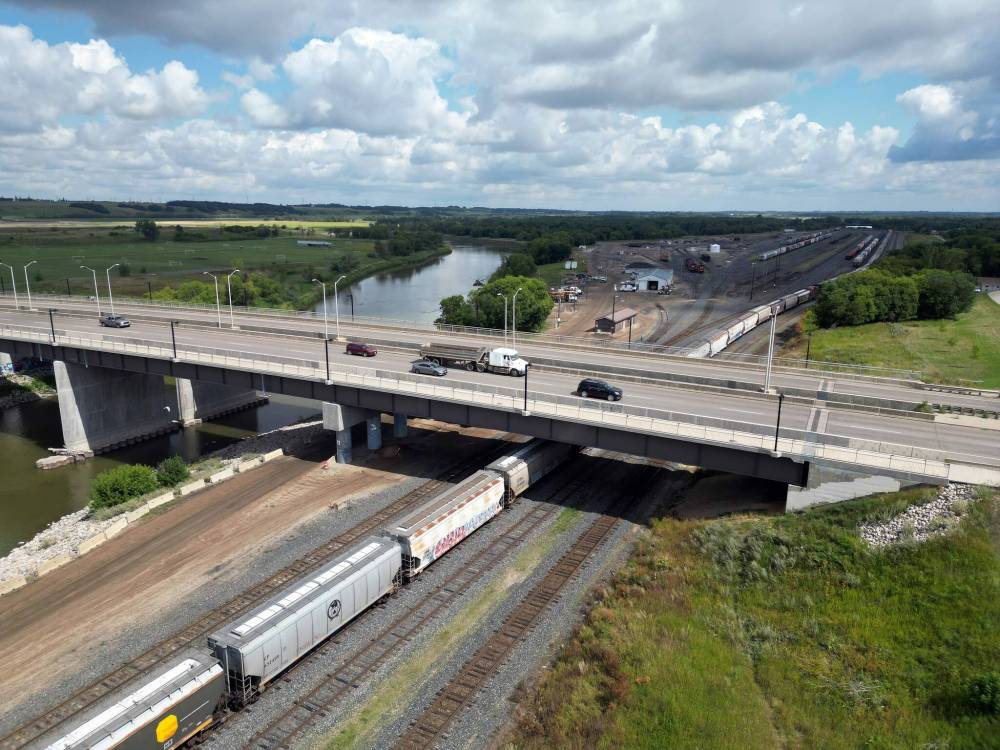
Deveryn Ross writes that he’s puzzled about why the province did not include Brandon in Lloyd Axworthy’s rail line relocation study. (File)
It’s an ambitious vision for Winnipeg, but the more pressing need and greater opportunity is here in Brandon, where the rail relocation issue continues to be ignored.
Brandon owes its existence to rail transportation — its location was chosen by Canadian Pacific Railway planners almost 150 years ago — but the city is now bisected by CPKC and CN lines that each cut east-west paths through the city.
As in Winnipeg, rail cars carrying vast amounts of dangerous cargo, including toxic chemicals and explosive combustibles, roll through Brandon each day, often at considerable speed. Derailments and collisions have occurred over the years, and a number of children and adults have been killed while crossing, working or playing near the tracks.
That alone is justification for considering measures that would reduce the risk, but an even more compelling factor is the fact that the Brandon Regional Health Centre — the only major hospital between Winnipeg and Regina — is located just 20 metres from the CN rail line.
Long trains of tanker cars carrying highly combustible Bakken oil — the kind that caused such devastation and loss of life in Lac-Mégantic, Que., in 2013 — regularly roll past the Brandon hospital. If a similar accident were to happen on the CN line in Brandon, the death toll could easily exceed the lives lost in Lac-Mégantic a decade ago.
The CN rail line also divides the entire city, with long trains often delaying access to the hospital, hindering the movement of emergency vehicles and lengthening fire, ambulance and police response times. Moving that line to the city’s outskirts would eliminate the threat posed by dangerous cargo moving so close to the hospital, while also ensuring hospital access and improving emergency response times.
Relocating both the CN and CPKC lines in Brandon would free up acres of land that could be used for housing, recreation, commercial development and downtown revitalization without adding to urban sprawl.
That would be a more efficient use of our existing infrastructure, compared to what would be required for similar developments on the outer edge of the city.
It would also dramatically increase property tax revenue for the city and school division, and could stimulate the development of a new or expanded industrial park on the edge of the city.
Most importantly, relocation of the CPKC and CN lines would make Brandon safer by largely eliminating the volume of toxic and volatile goods passing through the city.
Those are all compelling reasons to explore rail line relocation in the Wheat City, and the argument is further strengthened by the possibility that some or all of the cost of relocating the lines could be borne by the federal government pursuant to the Railway Relocation and Crossing Act.
Manitobans living outside of Winnipeg are often too quick to accuse the province of “Perimeteritis,” but this may be one of those rare instances when the claim has some validity.
Given the many potential benefits of rail relocation in Brandon — and the likelihood that those benefits could be achieved more quickly and at a lower cost than in Winnipeg — it’s puzzling why the Kinew government did not include Manitoba’s second-largest city in Axworthy’s rail line relocation study.
With the study still in its infancy, there is ample time for the government to expand the study’s scope to include Brandon. It’s an idea worth considering for the Wheat City, and gives rise to this obvious question: If not now, then when?