
How Trump 2.0 could impact Canadian agriculture
Advertisement
Read this article for free:
or
Already have an account? Log in here »
We need your support!
Local journalism needs your support!
As we navigate through unprecedented times, our journalists are working harder than ever to bring you the latest local updates to keep you safe and informed.
Now, more than ever, we need your support.
Starting at $15.99 plus taxes every four weeks you can access your Brandon Sun online and full access to all content as it appears on our website.
Subscribe Nowor call circulation directly at (204) 727-0527.
Your pledge helps to ensure we provide the news that matters most to your community!
To continue reading, please subscribe:
Add Brandon Sun access to your Free Press subscription for only an additional
$1 for the first 4 weeks*
- Enjoy unlimited reading on brandonsun.com
- Read the Brandon Sun E-Edition, our digital replica newspaper
*Your next Free Press subscription payment will increase by $1.00 and you will be charged $20.95 plus GST for four weeks. After four weeks, your payment will increase to $24.95 plus GST every four weeks.
Read unlimited articles for free today:
or
Already have an account? Log in here »
Hey there, time traveller!
This article was published 09/11/2024 (703 days ago), so information in it may no longer be current.
As Canadians recall the shock of Donald Trump’s first presidential victory, the news of his recent return to the White House has stirred both anxiety and anticipation. Trump’s re-election is undeniably a pivotal moment, and this time, Canadians may approach it with more reservation, reflecting on the changes his first term brought to our shared economy and agri-food trade.
During Trump’s first administration, Canada performed reasonably well economically, even amid intense political rhetoric and policy shifts. Our GDP per capita grew by 6.3 per cent, far more robust than the stagnant growth we are experiencing today. The agri-food trade between Canada and the U.S. also flourished, growing by almost 20 per cent from 2016 to 2020. Despite the “America First” focus, our food sector benefited from stronger cross-border trade — a trend that may continue, though with potentially higher stakes.
However, Canadian farmers now face a more challenging landscape. Trump’s campaign promises include measures to reduce costs for American farmers to enhance their competitiveness, while agricultural costs in Canada have steadily increased. Since 2019, wholesale food prices in Canada have risen nearly 40 per cent more than in the U.S., placing Canadian producers at a disadvantage and making it harder for them to compete. A second Trump administration could deepen this gap, increasing the pressure on Canada’s agricultural sector.
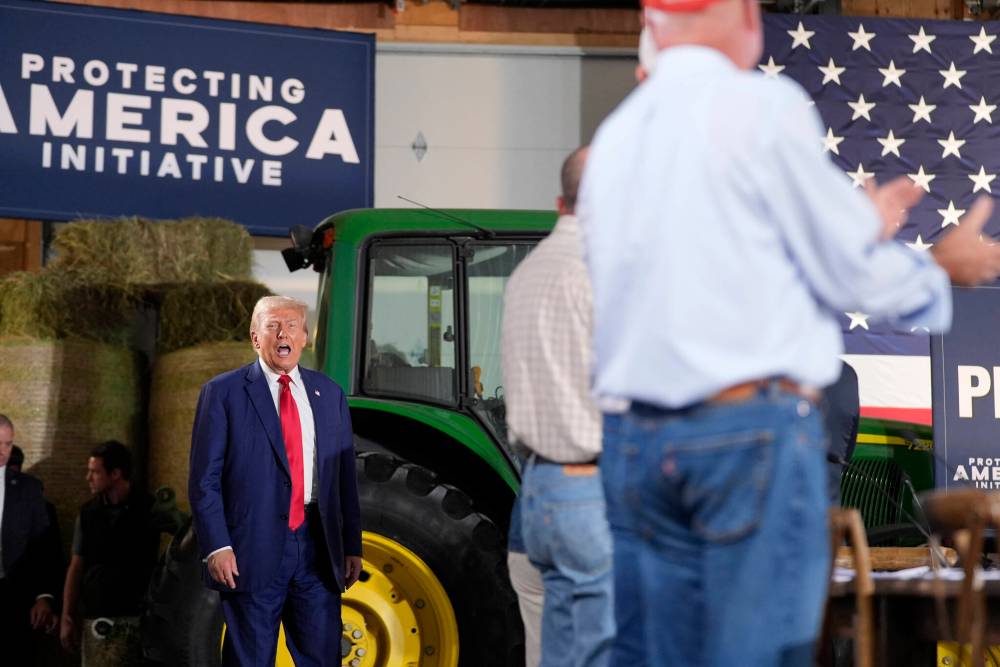
Republican presidential nominee Donald Trump arrives to speak at a campaign event at a farm in Smithton, Pa., in September. Sylvain Charlebois writes that while Canada performed reasonably well economically during Trump’s first administration, Canadian farmers face a more challenging landscape as Trump is poised to return to the Oval Office. (File)
Environmental policies could also become a major point of contention. During his first term, Trump reversed more than 100 environmental regulations, many of which President Joe Biden later reinstated. With Trump back in the presidency, Canada’s already controversial carbon tax could put additional strain on cross-border trade. Since 2019, the carbon tax in Canada has increased from $20 per tonne to an expected $95 per tonne by 2025, drastically raising the cost burden on Canadian agriculture. Trump’s less restrictive environmental approach could give American farmers a cost advantage, leaving Canadian agriculture facing higher operational expenses.
Trump will also likely support an updated almost US$2-trillion Farm Bill, bolstering U.S. crop insurance, subsidies, and agri-food research to counter China’s global influence. With China tensions simmering, Canada may have to carefully navigate this increasingly competitive and politically fraught landscape. The likelihood of higher ethanol production and a continued hard line on Chinese tariffs, policies that the Biden administration largely upheld, underscores that Canada’s alignment with U.S. agricultural strategies will be critical to avoid potential trade disruptions.
In global trade, the stakes are equally high. The BRICS nations (Brazil, Russia, India, China and South Africa) are strengthening their alliances to counterbalance Western influence, and a more isolationist U.S. approach under Trump could force Canada to choose its alliances carefully. This strategic recalibration won’t be easy, as Canada’s role as a middle power may come under strain in a world more polarized between competing economic blocs.
On North American trade, Canada must confront a transactional approach from a Trump-led U.S. that may bring both predictability and hard-nosed negotiations. Trump’s proposed renegotiation of the North American trade agreement could mean sensitive areas like dairy will return to the bargaining table. Bill C-282, which would protect Canada’s supply management systems from future trade deal concessions, might be an early casualty. If enacted, Canada could face immediate pressure from the U.S. to scrap the legislation, complicating efforts to safeguard our agri-food sector’s unique protections.
Canada’s agri-food industry stands at a crossroads, where costs, environmental policy and geopolitical pressures intersect. While Trump’s return might yield certain economic benefits, it would also challenge Canada’s trade policies, cost structures and environmental standards. Canada’s agri-food stakeholders will need to prepare for complex adjustments with Trump’s second presidency.
» Sylvain Charlebois, a Canadian professor and researcher specializing in food distribution and policy, is a senior director of the Agri-Food Analytics Lab at Dalhousie University and co-host of The Food Professor Podcast.
» Troy Media