
Trumpism as a movement is here to stay
Advertisement
Read this article for free:
or
Already have an account? Log in here »
We need your support!
Local journalism needs your support!
As we navigate through unprecedented times, our journalists are working harder than ever to bring you the latest local updates to keep you safe and informed.
Now, more than ever, we need your support.
Starting at $15.99 plus taxes every four weeks you can access your Brandon Sun online and full access to all content as it appears on our website.
Subscribe Nowor call circulation directly at (204) 727-0527.
Your pledge helps to ensure we provide the news that matters most to your community!
To continue reading, please subscribe:
Add Brandon Sun access to your Free Press subscription for only an additional
$1 for the first 4 weeks*
*Your next subscription payment will increase by $1.00 and you will be charged $20.00 plus GST for four weeks. After four weeks, your payment will increase to $24.00 plus GST every four weeks.
Read unlimited articles for free today:
or
Already have an account? Log in here »
Hey there, time traveller!
This article was published 23/11/2024 (499 days ago), so information in it may no longer be current.
Donald Trump earlier this month called his re-election the greatest political comeback in history. He wasn’t wrong. But his imminent return to the White House also signals something much larger.
It cements the Make America Great Again movement as the catalyst for a generational realignment of U.S. society.
When Trump first came to power nearly a decade ago, he was a celebrity carnival barker and political unknown who eked out a win against Hillary Clinton despite losing the popular vote. The anti-establishment forces that propelled him to office were loosely organized and badly misunderstood.
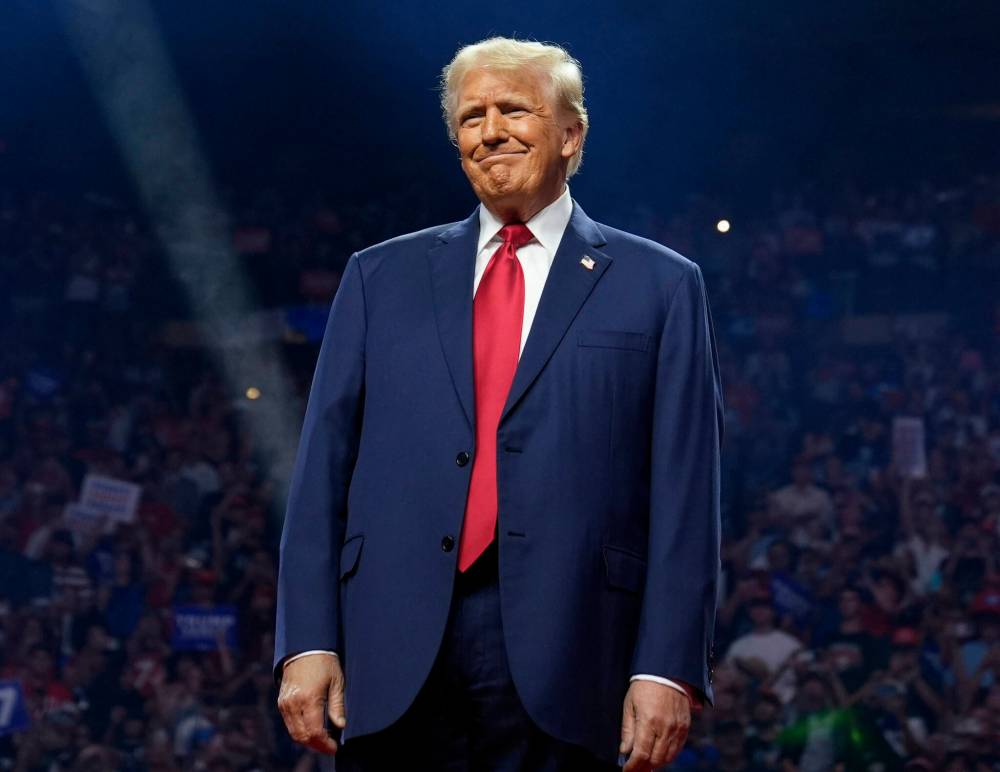
U.S. president-elect Donald Trump’s second term in the White House will mark a long-term change in American politics, Kyle Hiebert writes. (File)
Today is much different. Trump and his MAGA base have become permanent fixtures of the political landscape in a country plagued by distrust of institutions and populist disdain for expertise. And their cause is gaining momentum.
Post-pandemic surveys, for example, suggest some four in 10 American adults now think a secret cabal of globalist power brokers controls the world. Conservative intellectual Tom Nichols wrote the day after the election that many voters chose Trump “because they wanted what he was selling: a non-stop reality show of rage and resentment.”
But millions of other people who didn’t feel this way cast ballots for Trump, too. In their eyes, Trump’s authoritarian impulses are forgivable if his America First decrees as president will make life simpler and more affordable.
This is not unique to the United States. Throughout the Western world, citizens are increasingly distressed by rapid economic, demographic and social change. People on both ends of the political spectrum increasingly feel liberal democracy and free markets no longer work for them. Ethno-nationalism and extremist undertones are on the rise.
In such circumstances, Trump’s ultranationalist agenda of tariffs, deregulation, strict immigration control and transactional foreign policy won him the majority of voters for the first time. The U.S. as a whole has drifted rightward.
Republicans saw gains this election in every key demographic group aside from those earning more than US$100,000 per year. This includes a higher share of Gen Z and college educated voters, and double-digit gains in liberal bastions like Los Angeles, New York City and San Francisco.
America’s far right has also found its next generation of leaders — JD Vance, Elon Musk and former Fox News personality Tucker Carlson, among many others. Each is masterful at harnessing the fragmented online media ecosystem to influence a critical mass of voters, rendering the traditional “ground game” of political campaigns obsolete.
Serious intellectual infrastructure is also in place. Professional ideologues aligned with MAGA principles have been distilling their governance ideas into tangible policies at well-funded think tanks. The Heritage Foundation — with its Project 2025 initiative — is the most well-known. But there is also the Center for Renewing America, American Compass and the American First Policy Institute.
Federal courts could soon be stacked with MAGA sympathizers.
There’s speculation loyal Supreme Court justices Samuel Alito and Clarence Thomas — both in their 70s — may voluntarily retire to enable Trump to appoint younger replacements, thereby resetting the clock on conservative control of the bench.
In an interview with the New York Times published this summer, Trump’s former chief strategist, Steve Bannon, claimed that the MAGA movement was locked in a spiritual struggle of good versus evil. “We’re not looking to compromise. We’re looking to win,” he said.
But governing is complex and immensely difficult. And Trump is clearly far more an agent of chaos than a disciplined autocrat. Even with Republicans controlling both chambers of Congress, not everything will go the Trump administration’s way.
“Certain things are endemic with Trump: drama, infighting, leaks, and the revolving orbit of people coming in and out,” one analyst told Bloomberg after Trump’s victory.
Musk, for example, has attached himself to Trump and made several brash predictions since the election about reshaping government. But Trump is ruthless to inevitably disavow anyone guilty of outshining him. The two men’s political co-dependence is likely bound to self-destruct.
Trump’s radical proposals could also prove logistically impossible. Or once enacted, trigger backlash over unintended — though widely anticipated — negative fallout. Economists already calculate Trump’s vow to slap tariffs on all imports and deport millions of foreign-born workers would reignite rampant inflation. Democratic governors, lawyers and civil society groups are also planning to throw sand in the gears of Trump’s legislative agenda through a concerted legal blitz in the courts.
Plus, unforeseen disruptive events and emergencies — both foreign and domestic — are guaranteed to arise and distract. They always do.
Trumpism may have transitioned from a fringe aberration to mainstream phenomenon.
But that doesn’t mean it has monopoly control over America’s future.
» Kyle Hiebert is a Winnipeg-based political risk analyst and former deputy editor of the Africa Conflict Monitor. This column was previously published in the Winnipeg Free Press.