
Softer Trump tone may hint at a new strategy
Advertisement
Read this article for free:
or
Already have an account? Log in here »
We need your support!
Local journalism needs your support!
As we navigate through unprecedented times, our journalists are working harder than ever to bring you the latest local updates to keep you safe and informed.
Now, more than ever, we need your support.
Starting at $15.99 plus taxes every four weeks you can access your Brandon Sun online and full access to all content as it appears on our website.
Subscribe Nowor call circulation directly at (204) 727-0527.
Your pledge helps to ensure we provide the news that matters most to your community!
To continue reading, please subscribe:
Add Brandon Sun access to your Free Press subscription for only an additional
$1 for the first 4 weeks*
*Your next subscription payment will increase by $1.00 and you will be charged $20.00 plus GST for four weeks. After four weeks, your payment will increase to $24.00 plus GST every four weeks.
Read unlimited articles for free today:
or
Already have an account? Log in here »
Hey there, time traveller!
This article was published 29/03/2025 (362 days ago), so information in it may no longer be current.
The editorial in today’s Sun discusses yesterday’s conversation between Prime Minister Mark Carney and U.S. President Donald Trump. In particular, it notes the constructive, even positive, tone of Trump’s social media post and asks what conclusions Canadians should draw from that change.
The question the editorial does not ask, however, is what would motivate Trump to change his attitude and demeanour toward Canada. What would cause him to suddenly favour a more amicable approach toward his nation’s dealings with its northern neighbour?
There’s always the possibility that Trump’s posture toward Canada could revert back to the recent threatening attitude, but other factors may be motivating him to change his approach.
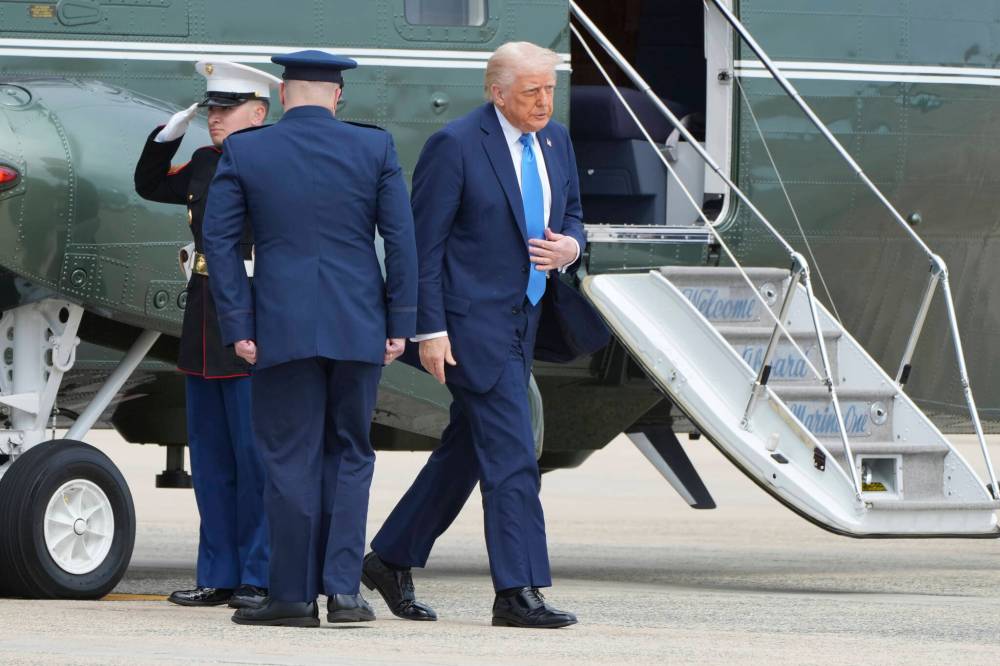
U.S. President Donald Trump walks from Marine One to board Air Force One at Joint Base Andrews, Md., on Friday en route to Florida for the weekend. (The Associated Press)
For starters, the U.S. stock market continued its steep multi-week decline yesterday. That skid began when Trump first announced his plan to impose tariffs on Canada and Mexico, costing American investors billions upon billions of dollars in losses.
Virtually every time Trump has threatened Canada with economic measures or annexation, the market has reacted negatively. Perhaps he has finally figured out that his threats of imposing tariffs on Canada — or, even worse, using economic force to eventually result in the annexation of Canada — is bad for American businesses.
Another factor that may have the president’s attention is the negative reaction of American voters to his tariff threats. Just yesterday, Newsweek reported that a YouGov/Yahoo poll had found that Trump’s approval rating regarding his handling of the U.S. economy stands at just 39 per cent, with a majority of respondents believing that America is either already in a recession or headed toward one.
On Thursday, CNN reported that a Washington Post-Ipsos poll had found that 64 per cent of Americans oppose tariffs being imposed on Canada, while 59 per cent are against tariffs on Mexico. It also reported that, according to a CBS/YouGov poll, just 30 per cent of Americans believe Trump should prioritize tariffs.
Also on Thursday, it was reported that the Leger polling organization had found that a higher percentage of Americans want to be annexed by Canada than Canadians who want their country to be annexed by the U.S. The poll revealed that just nine per cent of Canadians believe it is likely that Canada will become the 51st U.S. state, but 20 per cent of Americans would like their state to join Canada and become a Canadian province. The percentage is even higher among respondents between the ages of 18 to 34, at 30 per cent.
Trump knows that he can only implement his agenda if he continues to have the support of the House of Representatives and the Senate. The Republicans have a stable majority in the Senate, but a razor-thin majority in the House that could soon be lost in byelections to fill empty seats.
If the Republicans lose their majority in the House, Trump’s administration would be dead in the legislative water. Such a situation wouldn’t just stall the implementation of his policy proposals. It would subject him and his cabinet colleagues to a wave of Congressional investigations, which could eventually lead to impeachment and other disciplinary proceedings in that legislative chamber.
That only occurs if Trump continues to anger American voters to such a degree that they demand their representatives oppose Trump’s agenda or they defeat Republicans in byelections. Has a significant percentage of American voters reached that point? It’s possible.
Over the past several weeks, a number of members of Congress and the Senate have held town hall meetings in their respective districts or states, in which they were confronted by voters who are angered by Trump’s actions. In Republican districts, representatives have been accused of selling out their voters in order to stay on Trump’s good side. In Democratic districts, they have been accused of not fighting Trump hard enough. It has reached the point where many Republicans are now refusing to hold town hall meetings.
Given the potential for all that public hostility to jeopardize the implementation of Trump’s agenda, you know the president is paying attention. That may explain why he may be trying to lower the temperature of his rhetoric on tariffs.
That may be the case, but Trump still appears committed to implementing widespread tariffs next week, including tariffs against Canadian goods, commodities and services. If he proceeds with that plan, Americans will quickly see the price of many products rise, and that will likely fuel even more anger toward the president. That will cause his approval numbers to drop even further — and that will put the Republican majority in the House of Representatives at even greater risk.
How does Trump avoid all of those problems and improve his polling numbers? By softening his tone toward allies such as Canada, and by replacing threats with good-faith negotiations aimed at a long-term solution.
If that is what is happening here, it’s not hard to understand the reasons why.