
All in a day’s work for Dr. Mott
» NEELIN VIEWS
Advertisement
Read this article for free:
or
Already have an account? Log in here »
We need your support!
Local journalism needs your support!
As we navigate through unprecedented times, our journalists are working harder than ever to bring you the latest local updates to keep you safe and informed.
Now, more than ever, we need your support.
Starting at $15.99 plus taxes every four weeks you can access your Brandon Sun online and full access to all content as it appears on our website.
Subscribe Nowor call circulation directly at (204) 727-0527.
Your pledge helps to ensure we provide the news that matters most to your community!
To continue reading, please subscribe:
Add Brandon Sun access to your Free Press subscription for only an additional
$1 for the first 4 weeks*
*Your next subscription payment will increase by $1.00 and you will be charged $20.00 plus GST for four weeks. After four weeks, your payment will increase to $24.00 plus GST every four weeks.
Read unlimited articles for free today:
or
Already have an account? Log in here »
Hey there, time traveller!
This article was published 12/05/2025 (319 days ago), so information in it may no longer be current.
Dr. Shelley Mott, a École secondaire Neelin High School graduate (class of 1999) and current St. Boniface Hospital physician, sat down with the Neelin Journalism Team to discuss her experience working in the medical field, her memories from the height of the COVID pandemic, and her best words of advice for future medical students. Some responses have been edited for length.
Q: I’d like to start by asking you to talk a little bit about what you do right now, kind of a day-to-day at work.
A: I’m currently on a maternity leave, but when I’m working, I’m doing weekly hospital-based work. It’s called hospitalist, and I take care of in-patients, people who have been admitted to hospital for medical reasons. Typically, a person will present to the emergency department with a medical problem. It can be anything from pneumonia to COPD exacerbation to heart failure, and they will be admitted to the hospital and then they would come under my care.
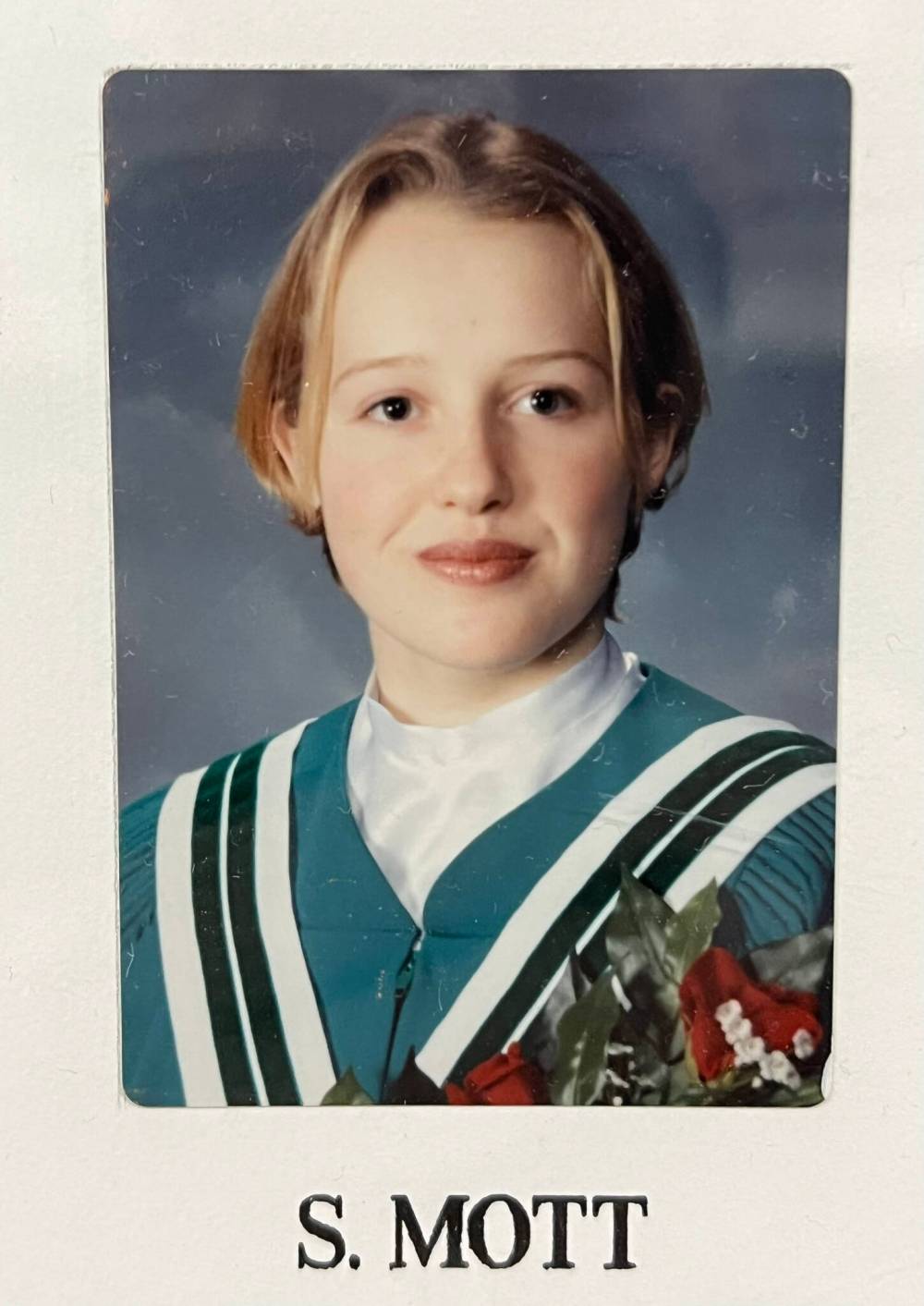
École secondaire Neelin High School graduate Dr. Shelley Mott, class of 1999, shares some of her experiences and advice for prospective medicine students during an interview with columnist Arden Hebert. (Submitted)
Q: What initially drew you to the medical field?
A: That’s a good question. I was interested in medicine from a pretty young age. I’d always been interested in the human body and how it works and and things like that. I did a bachelor of science, so I kind of had an interest in learning about science, and nature, and I think medicine. I also have kind of a strong social side to me, and I liked being able to meet people and talk to people and get to know people especially — it’s often people at their most vulnerable — and try to help people kind of on an individual level. I know there’s lots of ways to help in this world, and this is, you’re really kind of at the grassroots level, helping people just one-on-one and individually and (that) kind of drew me to it.
Q: Is there anything that you’ve noticed since getting into (medicine) that was different than what you were expecting prior to starting work in the field?
A: Yes, it’s definitely much different than what my idea of medicine was from TV or movies. There was no one in my family in the medical field, so I didn’t have any personal experience. It was mostly kind of glamourized. What I didn’t appreciate was how involved that personal level was and how much of medicine is just about forming relationships with your patient, forming a relationship with your patient so that they trust you because so much is based on just information that the patient gives you. So much of the problem solving that we do is based on their history, what symptoms they’ve had, what’s led up to this event, that kind of thing. And so being able to communicate with people and develop relationships with people is key to getting that information out of people, and I don’t think I appreciated that going into it. I thought it was more just like a mystery you need to solve, and you need to get the facts and solve it that way. There’s a lot more nuance, a lot more art to medicine than that.
Q: Could you talk a little bit about how you started, whether you want to talk about school or maybe a first job after school?
A: I went to Brandon University, did my bachelor of science there, and I did zoology there, which is quite applicable. You know, all animals are kind of the same that way, the physiology part of it is the same. And then I spent some time working at the hospital in Brandon. (I) actually worked in the lab in the morgue for a couple years doing autopsies there and then as a pathologist assistant there, looking at specimens from the operating room. I kind of learned how the hospital works that way, and I had kind of an inside look at things that way. Then I had applied to medicine a few times and didn’t get in, so I spent a year travelling and then I moved to Winnipeg and got into medicine after that, so I had a three- or four-year gap between my undergrad and getting into medicine. And as I said, as far as my preparation, the work in the lab and the morgue was probably the most useful background that I had besides my undergrad degree.
Q: Do you have any advice for anyone looking to get into the medical field? Anything you wish someone had told you?
A: Persevere. Keep applying. Don’t let a first rejection set you back. Take it as a learning experience and reapply. If you can talk to people who are in the field to find out what the day-to-day life is like, like what the job entails (that) would be very helpful. Like I said, it’s a job that has a glamourized version of it on TV, which I guess, you know, a lot of jobs do, but there’s so many medical shows that people have a bizarre understanding of how the medical system works. So, try to talk to people who are in the medical field — nurses, doctors, whoever that is — and just get an idea of how it works in this country and in this province. Find out what your life would be like, and if you want to do that because there are some drawbacks to it (that) I think people might not be aware of.
Q: What are some of the changes you noticed occurring during COVID? What has stayed since then or what has gone back to how it was previously?
A: Yeah, well, there was a big change for COVID. I was impressed with how quickly the health-care system adapted. I work at Saint Boniface Hospital and wards were emptied out and converted, (and I saw) the same thing at the Brandon hospital because I was working there at the time, too. All of the protective equipment that the PPE was used. Things shifted very quickly. People took it very seriously and it was impressive how many changes were made and how many people were on board with it and just changed. As far as since COVID, I’m not working right now, but I know when I last worked, which was in the summer, we were still wearing masks when we had to see patients and I think it’s kind of crazy that we weren’t before, especially for people with respiratory illnesses and things like (that) where they’re coughing or … I feel like very naked, not wearing a mask around patients. I think we’re just more aware of our own (hygiene), we washed our hands 1,000 times a day, we were always very cautious about things like that, but now (we’re) even more cautious and aware of those things. I think a lot of it has gone back to the way things were before. We don’t (have) COVID wards anymore. When people are admitted, either with COVID or happen to get COVID, you know, like whether that’s the reason they’re admitted or they just have it in hospital … they’re isolated within their room the same way we do with other infections … but they’re not, there’s no wards.
Q: How does it feel to reflect on those super-intense periods a few years out?
A: It was a strange time. It was very isolating for everyone, not just to health-care workers. I left my house and went to work, which was an experience that a lot of people didn’t have; they stayed at home and worked. But I got to leave my house and go and talk to other adults and … It was kind of interesting that way where my husband spent two years at home not talking to anybody else or not seeing anybody else. But, I guess some of the really difficult parts about going through COVID from a work perspective, is that a lot of these patients that are going through really difficult illnesses, whether it was COVID or for whatever other reason they were admitted, and they couldn’t have their family around like most people (who) have family visitors, some all the time, and we’re talking to family, and we were very busy and we didn’t have a lot of time to update families with phone calls. And it’s hard to know when you’re not seeing families regularly which families are involved and want regular updates and which ones were kind of more distant and didn’t need the updates from their uncle’s hospitalization or whatever. So it was really isolating for patients. And that was hard to watch that and hard to navigate that because there were some rules that (for example), say when a person was dying, then family could come in. But to make that call that that person is now dying, where 10 minutes ago they were just very sick, (was difficult). You know, there’s some nuance to that and kind of labels that you wouldn’t put on things normally, like normally I wouldn’t have to identify that this person is just very sick. Your family should be here regardless. Yeah. So that was really difficult, the family perspective. At St. Boniface Hospital, we had several times where there was an outbreak (of) COVID. I was on a non-COVID floor, but I’ve had several times that there was an outbreak of COVID on our floor and then one patient after another would flag as positive with COVID, and you just knew that it was going to be a death sentence for some of those people (when it was really bad), before there were vaccines and that, and it was just really hard to kind of know that you were going in to work the next day with like five or six of your patients would be have (to be) moved because they have COVID. They’re on the COVID floor now and you didn’t know if they were going to make it. And it was all happening so fast, and it was emotionally draining and hard to watch.
Q: Is there anything you wish people knew about what goes on in hospitals? COVID-related or not.
A: Yeah. One thing I think is that people come in with this conception that the doctor is the final say and the doctor makes all these decisions, and really, in a hospital anyways, we really work as a team. Everything from the bedside nurse, being one of the most important people on that team who’s with the patient day-to-day and knows the patient better than anyone on a given day, (to the) physiotherapist, the occupational therapist, the pharmacist, the respiratory therapist, social workers, spiritual care – there’s a whole group of people that work to get people feeling better, kind of physically, mentally and spiritually, and the doctor is just one member of that team. (Doctors often) defer to their colleagues to make those expert decisions in their areas.
Q: Did you ever have any challenges with people who were skeptical of the medical establishment?
A: Yeah, for sure. Especially later on, not initially. Initially people were afraid of COVID, rightfully so, and (were) just kind of very trusting, but definitely I had the experience of having a person on their deathbed denying COVID existed. That definitely happened. But you have to meet people kind of where they’re at and part of the art of it is trying to give people your opinion and tell them and explain it in a way that they can understand it. But then at the same time, if (they’re) not going to believe it, there’s not much you can do about it and nature’s going (to run its) course, whether or not they agree with it.
Q: What’s a kind of simple or obvious thing that people overlook that could keep them healthy for as long as possible?
A: (Make sure) you’re staying on top of seeing your doctor regularly to stay on top of preventive health care. As people get older the guidelines change based on your age category, but staying up to date with all of your regular cancer screenings, and just see your doctor regularly, whenever they say to follow up, (whether that be) one year, three years, whatever it is, see them regularly so that you stay on top of those cancer screening protocols. And then you know, just treat your body well. Keep yourself fit or, you know, keep yourself relatively fit. Eat well. Try not to smoke. Try not to drink. Try not to do drugs. Those kinds of things. What we see in hospital, one of the biggest determinants of health, is your social economic status, which that’s a whole other conversation, but that ends up being one of your biggest determinants of health.
Q: Lastly, do you have any advice for anyone who is about to graduate high school and is wanting to get into the medical field?
A: Doing an undergrad degree in something that would somewhat prepare you for medicine is not a bad idea. (I have) some colleagues who did their undergrad in pharmacy, but I mean that’s a career on its own, but they did an undergrad in pharmacy and then went on to medicine and that would be such a useful undergrad degree. Do an undergrad degree in something that will give you some preparation. Like I said, try to talk to people who are in the medical field and try to talk to different specialties within the medical field, like family doctors or surgeons or whatever, to find out that this is something that you want to do. Maybe there’s another area in the medical field that is more interesting because there are a lot of other members of the team that are very important, and not a lot of people think about occupational therapy as a career. If medicine is the goal, find out as much as you can from people who do that job to make sure that’s what you want. You want to know what you’re getting into. The worst thing would be to go through all that schooling and then not enjoy what you do. But the nice thing about medicine is that there are so many different opportunities within the field, like I just have one little niche area, but you can do almost anything you want. You’ll find something that will make you happy.
» Arden Hebert is a Grade 12 student at École secondaire Neelin High School.